


Hard skills are technical abilities and knowledge that you acquire through education, training, or practical experience. Unlike soft skills, which relate to interpersonal abilities and the way you deliver work, hard skills are more measurable and job-specific.
Employers use hard skills to assess whether an applicant can perform the core functions of a role. Demonstrating that your hard skills are exactly what they need is therefore much more likely to land you interviews.
Let’s explore the best hard skills for CVs that employers are looking for. It’s always good to consider the hard skills you possess, as well as those most in demand, so that you can maintain a competitive edge in the job market.
According to LinkedIn’s 2025 Work Change report, 70% of the skills in most jobs will change by 2030, with AI emerging as the primary catalyst for this shift. Staying ahead of the curve in the workplace will involve continually identifying and developing the in-demand skills.
Top 10 hard skills in 2025
Let’s jump right into examples of hard skills you should be focusing on as a skill-seeker. Here are the top 10 hard skills that employers in the UK are looking for:
- AI and machine learning. Increasing numbers of roles across diverse sectors require AI skills, and AI-literate professionals can command premium salaries.
- Data analysis and visualisation. Transforming complex, raw data into actionable insights allows businesses to make informed decisions and gain competitive advantage.
- Cybersecurity. With cyber threats on the rise, organisations highly value professionals who can safeguard networks, apply encryption, and strengthen digital defences.
- Cloud computing. Cloud-based solutions are in high demand as they are the cornerstone of digital transformation, enabling businesses to boost efficiency and flexibility.
- Project management. Coordinating resources, managing budgets, and delivering projects on time to high-quality standards are fundamental skills across many roles.
- Software engineering and programming. The increasing need for new software and mobile apps means a rising demand for software engineers and programmers with proficiency in languages like Python and Java.
- Digital marketing. There is global demand for agile digital skills, especially for professionals who can engage customers online via SEO, content marketing, and social media.
- Database management. Expertise in managing and processing data efficiently and effectively is essential across various sectors.
- Design and user experience. Good design and intuitive UX/UI can make or break a product. Businesses want people who can create visuals and digital experiences that feel both engaging and easy to use.
- Business analysis. Bridging business needs and technological solutions makes the role of business analysts increasingly important and one of the most sought-after skills.
How to develop hard skills
Identifying the most in-demand hard skills list is one thing; working out how to secure this expertise is the next step. There are plenty of ways to grow your expertise and impress employers with your commitment to continual professional development.
Here are some ways to secure and upgrade your hard skills:
- Earn a recognised certification to gain new skills or boost your existing skill set. In-demand areas could include project management, finance, IT, and cloud computing.
- Explore online learning platforms such as Coursera, Udemy, or LinkedIn Learning. Many courses come with certificates that you can showcase on your CV and LinkedIn profile.
- Look for opportunities at work to practice new hard skills, whether that’s volunteering for a project, shadowing colleagues, or taking the lead on tasks outside your comfort zone.
- Take on side projects or volunteering roles to apply your abilities in real-world scenarios, such as building a website or managing social media for a local charity.
- Connect with mentors and professional networks to learn which hard skills are most in demand and secure guidance on developing these abilities.
By investing in your professional growth, you’ll build a strong list of hard skills that will look great on your CV and give you the confidence to tackle new challenges.
Where to list your hard skills
Your hard skills are valuable assets that you should be ready to show off in a range of scenarios. When it comes to job applications, there are some tips you can follow:
Hard skills for your CV
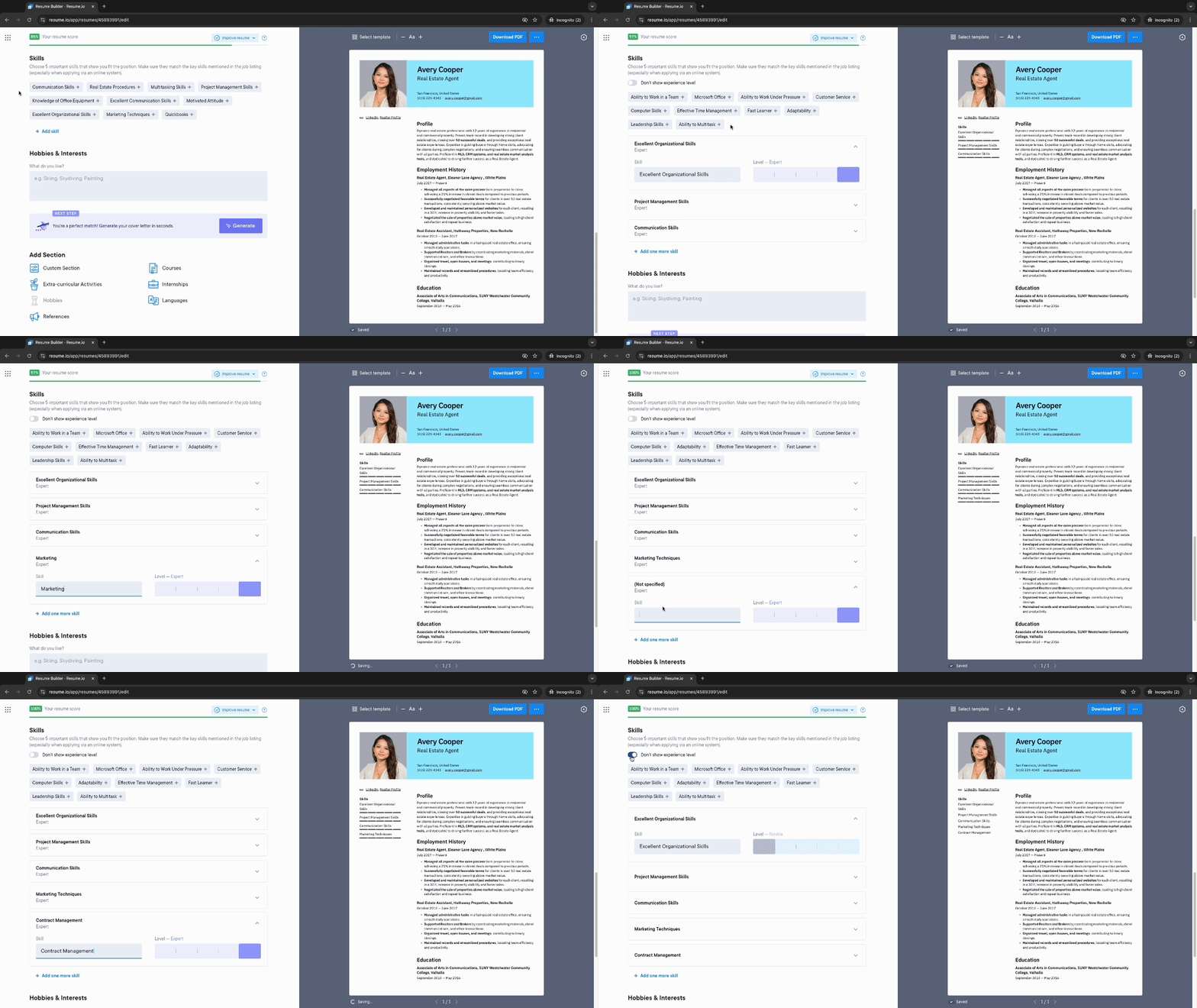
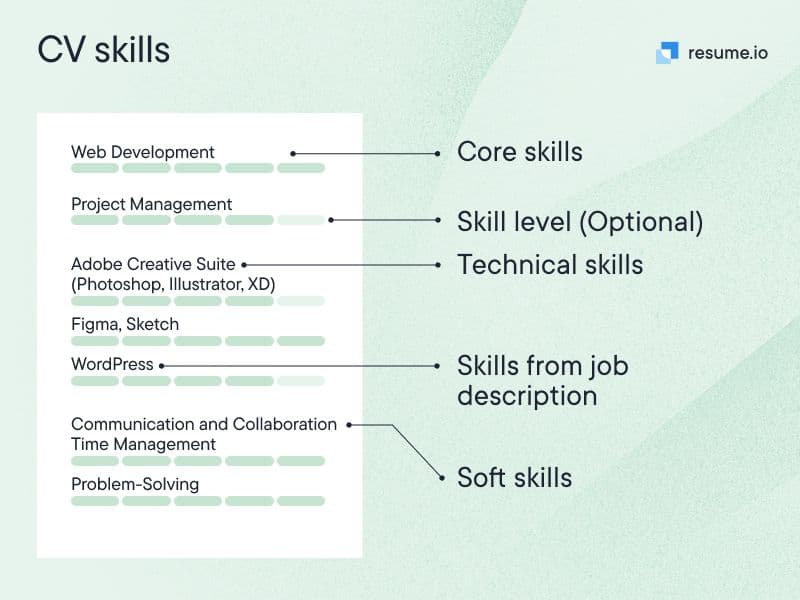
When adding hard skills to your CV, the format you choose matters. Experienced professionals usually benefit from a chronological CV, where employment history takes the lead and the skills section is shorter. If you’re new to the workforce or changing careers, a functional or hybrid CV may work better, with a more prominent skills section.
In all cases, list your most relevant hard skills clearly, alongside a few complementary soft skills. In functional or hybrid formats, the skills section can be longer and more detailed.
If you opt for a chronological CV, showcase your hard skills list more subtly through your profile summary and work experience, using examples and results to give extra weight to your expertise. For example, “Boosted sales by 20% through advanced data analysis.”
Hard skills in your cover letter
Your cover letter offers space to expand on your technical skills in greater detail. Instead of just stating that you have a skill, describe a time when you used it successfully.
For example, if you work as a computer scientist, you may mention that you “regularly troubleshoot code errors.” However, this sounds a bit basic. Instead, you could explain how you quickly identified and fixed a complex bug, thereby ensuring zero impact to business operations. Specific details are much more engaging and persuasive.
Hard skills in an interview
At an interview, be ready to share examples of how you’ve applied your hard skills in practice. Apply the STAR method as you’re preparing for your interview to help you get started:
- Situation. Outline the context.
- Task. Define your role in the task.
- Action. Explain what you did, focusing on the hard skill.
- Result. Highlight the outcome, backed by measurable results or improvements.
The description of the job you are applying for is the best place to pinpoint which hard skills the employer is looking for. When prioritising which ones to highlight on a job application, list the hard skills mentioned in the job ad first—but only if you possess them, of course!
50+ Hard skills examples
Here’s a breakdown of more than 50 examples of hard skills across different industries, with a particular emphasis on digital transformation, data-driven decision making, and global competitiveness.
Technology & IT
Demand for IT expertise continues to rise. Employers are especially keen on professionals who can develop, secure, and maintain modern tech systems.
- AI and machine learning
- Cloud computing (AWS, Azure, Google Cloud)
- Cybersecurity (risk management, threat detection, and cloud security)
- Programming (Python, Java, C#)
- Web and app development (JavaScript, .NET, React)
- Blockchain and Web3 technologies
Analytical & data skills
Almost every industry relies on data to guide decision making, so professionals who can analyze data and turn it into actionable insights are in high demand.
- Database management (SQL, Oracle)
- Data processing and reporting
- Business analysis
- Research and statistical modelling
- Data visualisation (Tableau, Power BI)
- Mathematical modelling
- Big data engineering
Finance & accounting
Financial know-how is essential for stability and growth. From SMEs to global banks, strong financial management ensures resilience in a competitive market.
- Fintech
- Risk management
- Financial planning and analysis (FP&A)
- Compliance and auditing
- ESG principles
Marketing & communications
With UK businesses competing for visibility in online markets, digital marketing and communication skills are more important than ever.
- SEO and SEM strategies
- Content marketing and copywriting
- Social media strategy and management
- Video and multimedia campaigns
- CRM knowledge (Salesforce, HubSpot)
- CMS tools (WordPress, Shopify)
- A/B testing and conversion rate optimisation
- Analytics (Google Analytics, Hotjar)
Design & creative
Design is no longer limited to creative agencies—it’s a skillset valued across tech, e-commerce, education, and beyond.
- UX/UI design (Figma, Adobe XD)
- Graphic design (Photoshop, Illustrator, InDesign)
- Branding and typography
- Photography and visual storytelling
- Print and digital layouts
- Motion graphics and animation
- Video editing (Premiere Pro, Final Cut Pro, DaVinci Resolve)
Project management
Project management isn’t just for job titles with “manager” in them. Nearly every industry values professionals who can keep teams on track and deliver results.
- Agile and Scrum methodologies
- Kanban systems
- Resource allocation and scheduling
- Risk mitigation
- Budget oversight
- Project lifecycle management
- Tools (JIRA, Trello, MS Project, Monday)
Healthcare
The UK healthcare sector is under constant pressure, and technical expertise is crucial for patient care, research, and administration.
- Health administration
- Biomedical engineering
- Data analysis
- Health informatics
- Rehabilitation techniques
- Occupational therapy
- Medical technology
- Clinical research and trials
Hospitality & retail
Customer-facing industries thrive on efficiency, presentation, and compliance. Hard skills here directly impact customer experience and revenue.
- Customer service
- Event planning
- POS systems
- Inventory management
- Visual merchandising
- Health and safety compliance
Transportation & logistics
As supply chains become more complex, logistics professionals who can keep goods and services moving smoothly are indispensable.
- Fleet management
- Shipping documentation
- Route planning and optimisation
- Vehicle maintenance and safety
- Supply chain analytics
Education & training
With the rise of edtech and online learning, education professionals with technical expertise are in high demand.
- E-learning platforms (Moodle, Blackboard)
- Online course design
- Virtual classroom tools (Zoom, Microsoft Teams)
- Curriculum development
FAQs about hard skills
Here are some common questions about hard skills to help you make the most out of your skill set in your next job search.
What are the most important hard skills?
It depends on your sector. For example, data analysis and AI are crucial in finance and tech, while design and digital marketing matter more in creative fields. Look at current job adverts in your area to see which hard skills are mentioned most often.
How do I prove that I have these hard skills?
Employers want to see evidence. You can demonstrate hard skills on your CV and cover letter by listing relevant qualifications, certifications, or training courses, and by showing results from past roles (e.g., “Increased website traffic by 40% through SEO strategies”). Including tools or software you’ve used is another strong way to prove your expertise.
Should I list hard skills I’m still learning?
Yes you can, but make that clear. If you’re studying for a certification or actively building your skills, mention it as “in progress” or highlight it in a professional development section. This shows employers that you’re proactive and committed to growth.
How many hard skills should I list on my CV?
Aim for 8–12 well-chosen hard skills for your CV and sprinkle these across the various sections. Focus on those most relevant to the role you’re applying for, rather than listing every hard skill you have. Quality and relevance matter more than quantity.
Employers often use hard skills to assess whether a candidate can perform the core functions of a role. According to the Department of Education’s 2024 Employer Skills Survey, there are significant skill gaps and shortages across numerous sectors in the UK. If you can demonstrate that you have the specific skills an organisation is looking for, you’re going to boost your chances of landing an interview.
Need help incorporating your hard skills into your CV? Our powerful CV builder can make this process a breeze by providing a wide range of key hard skills for your CV to choose from, with proficiency levels you can adjust.


