

Public relations (PR) professionals are specialists in crafting a favorable public image of a company, organization or government entity. They manage contacts with the media, promoting a positive narrative and sometimes “put out fires” by addressing negatives that may arise. PR specialists seeking employment must put their best foot forward, using their natural powers of persuasion, with an impressive resume and a standout cover letter.
Related Cover Letter Examples
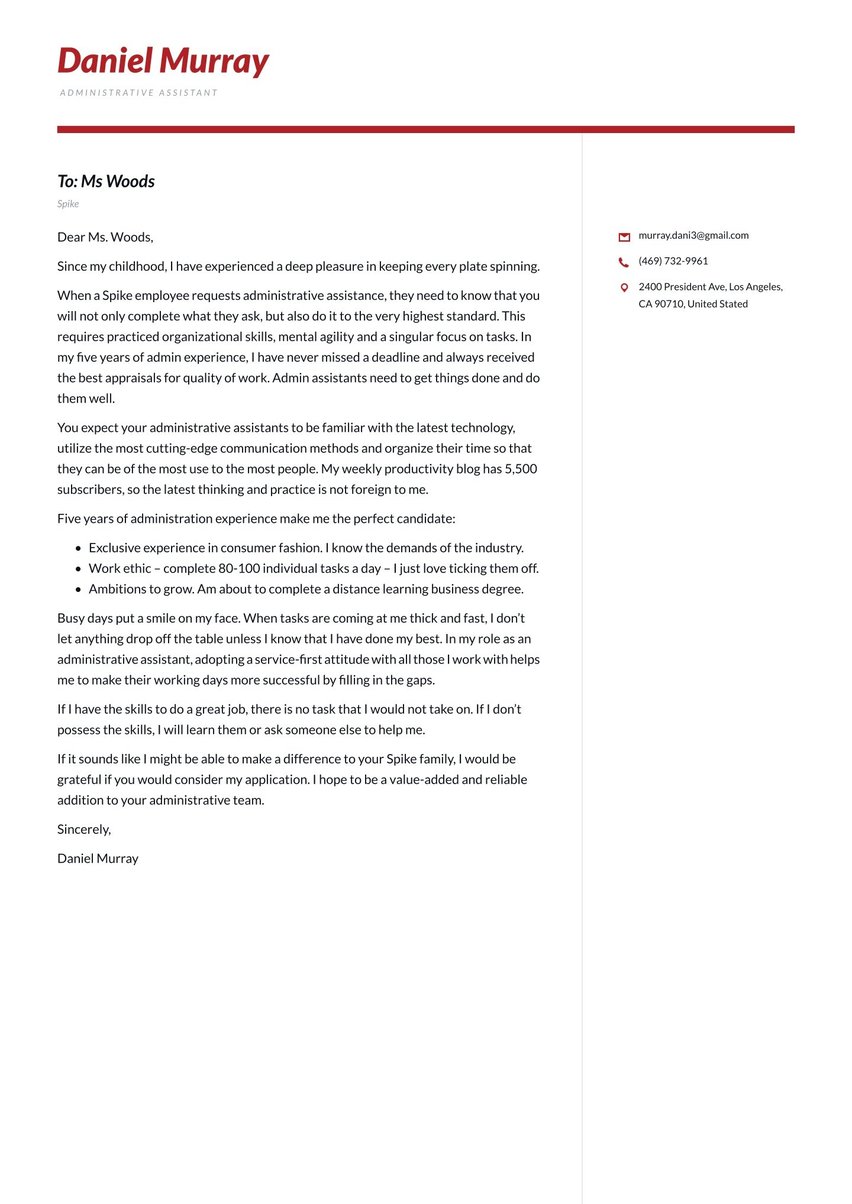
Marketing Manager cover letter example
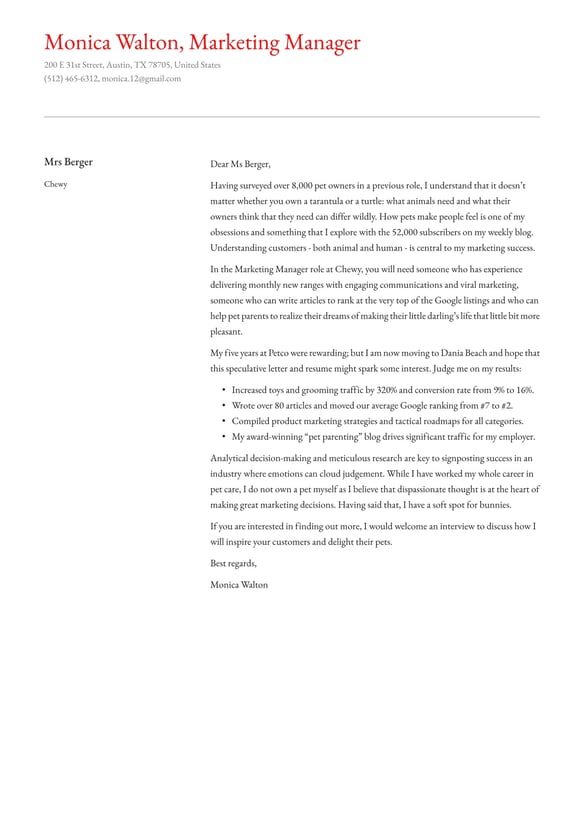
Perfect for Marketing Manager roles, this template’s clean structure and balanced white space highlight your creativity and analytical skills. Its conversational tone and bold headers help communicate expertise and passion to hiring managers effortlessly.
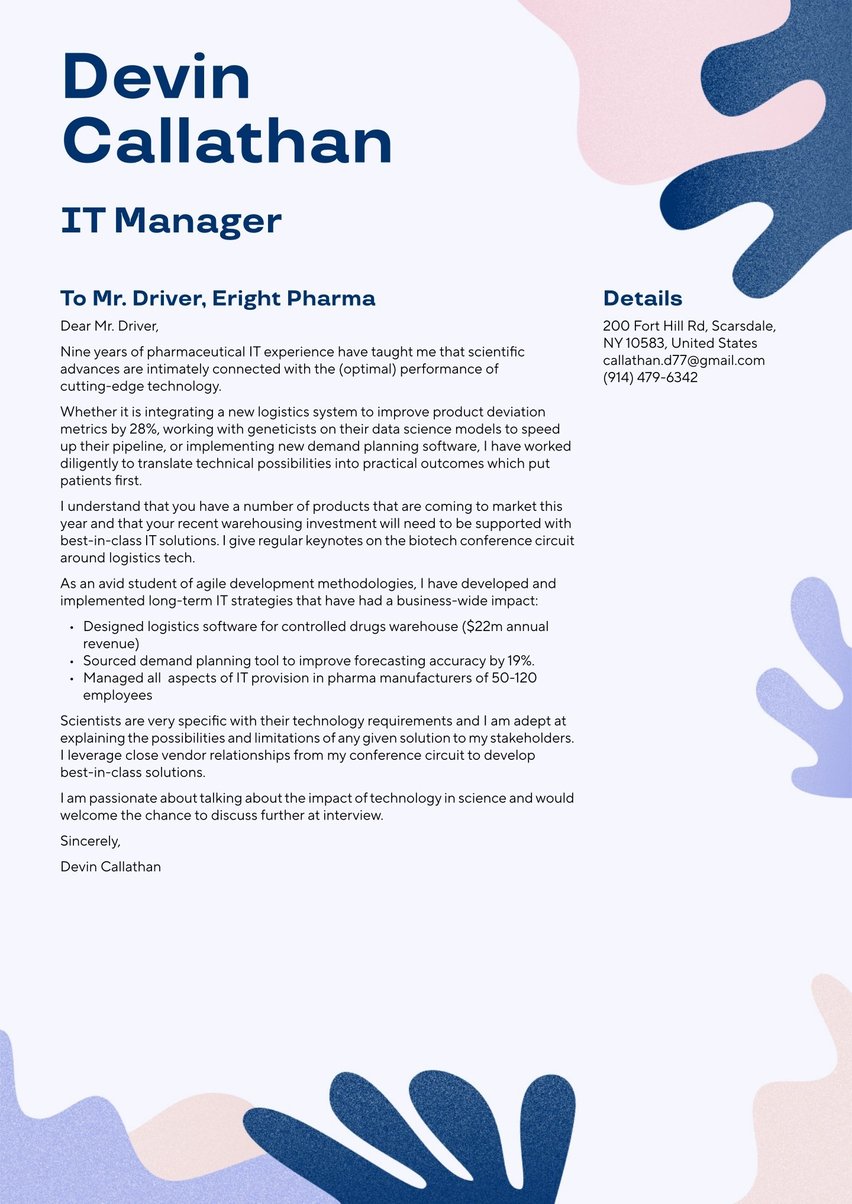
Social Media Manager cover letter example
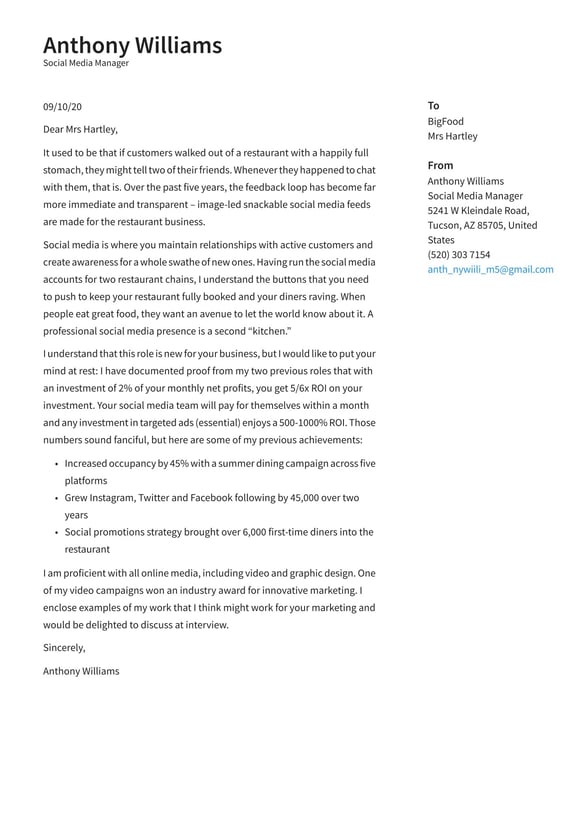
Tailored for Social Media Managers, this template’s clean structure and bold header styling amplify your creativity and strategic mindset. Its balanced white space and conversational tone showcase your results-driven expertise to marketing-savvy employers.
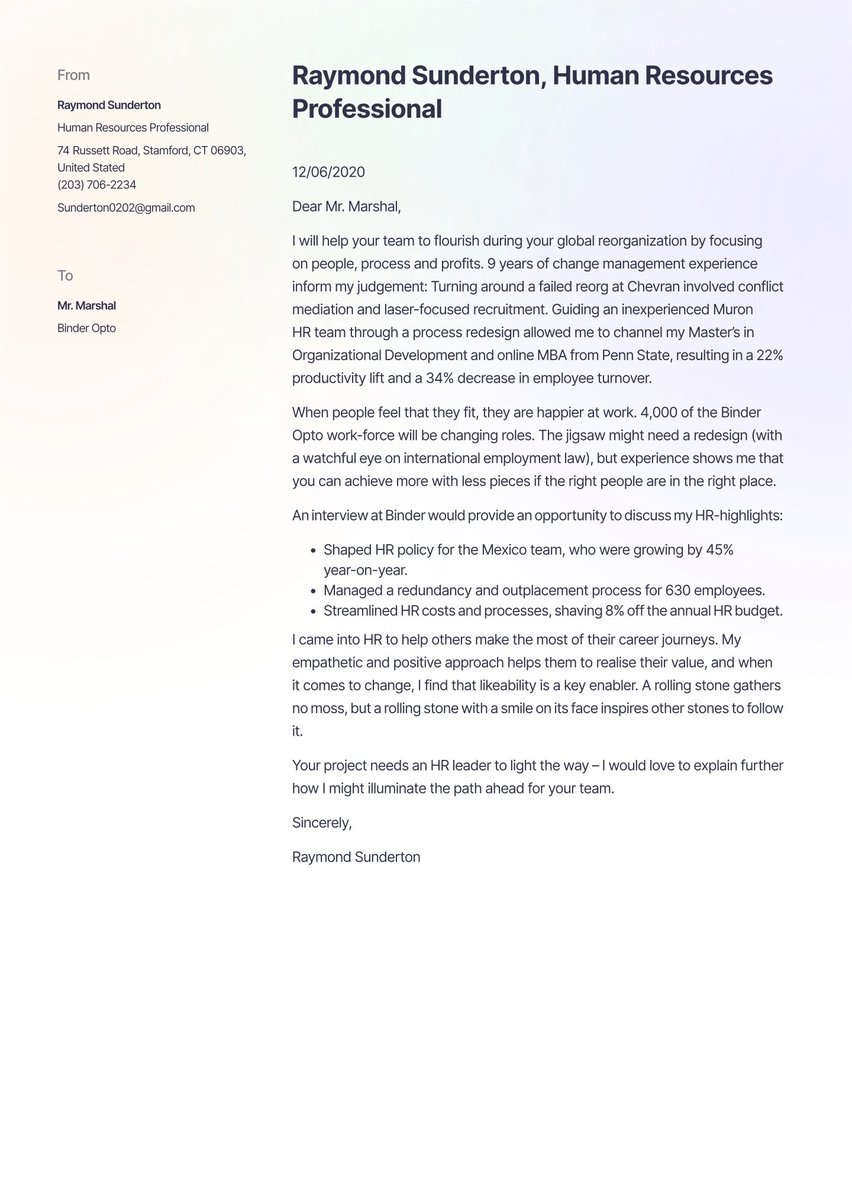
Event Coordinator cover letter example
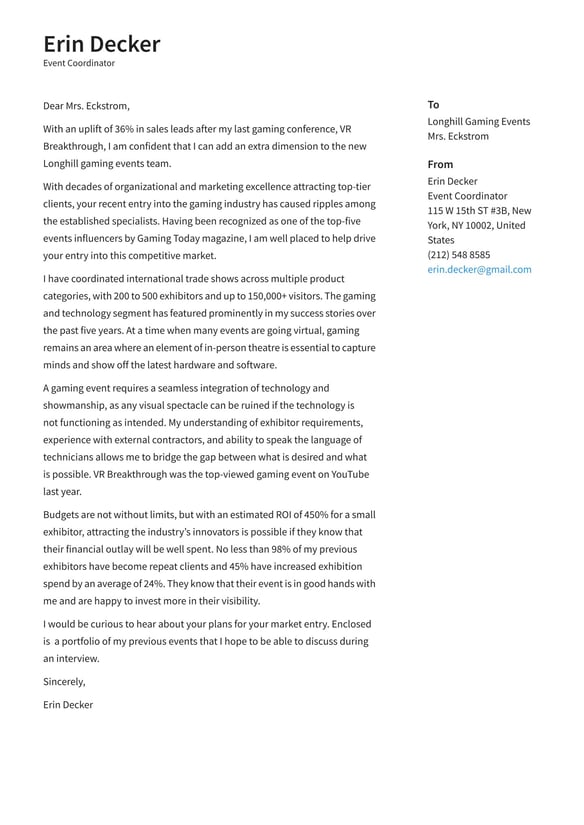
This sleek, professional template highlights your organizational expertise and creative flair, perfect for Event Coordinator roles. Its balanced structure and ample white space emphasize your achievements, ensuring your skills shine for hiring managers in the events industry.
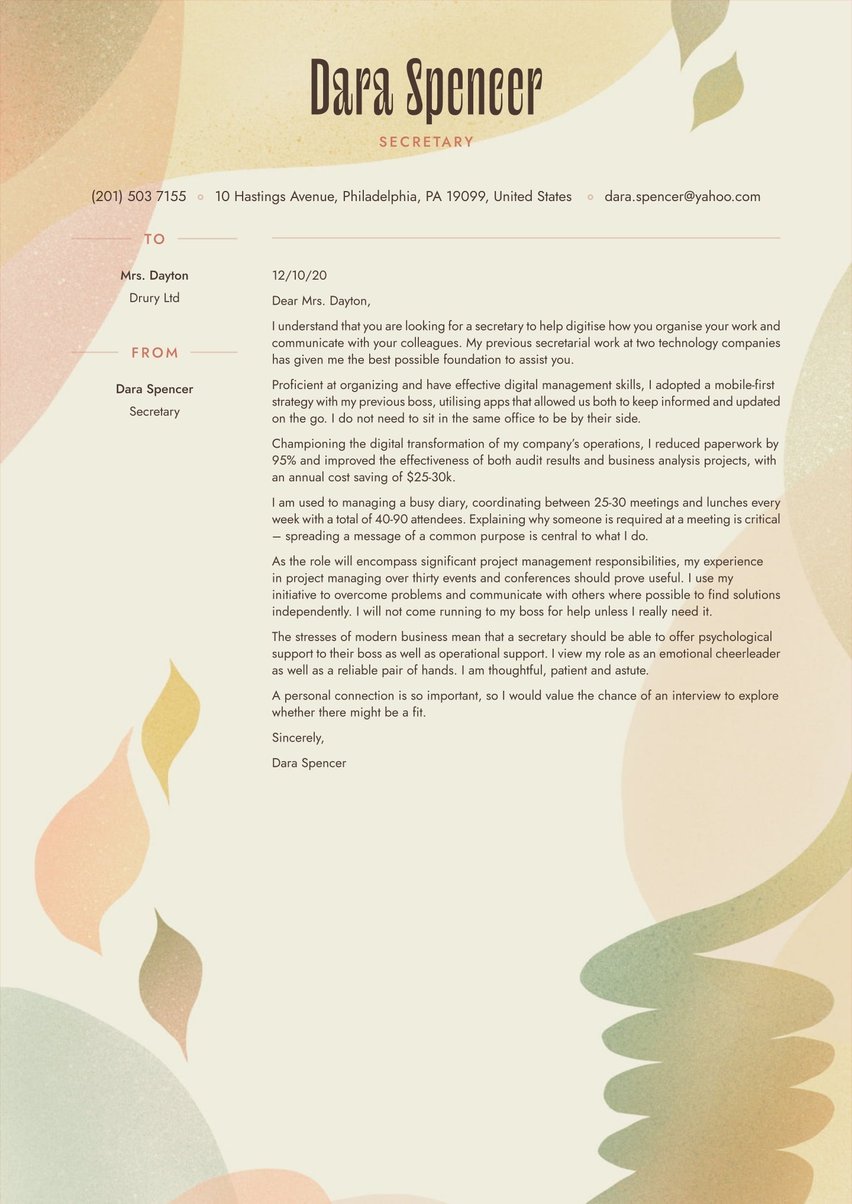
Marketing Coordinator cover letter example
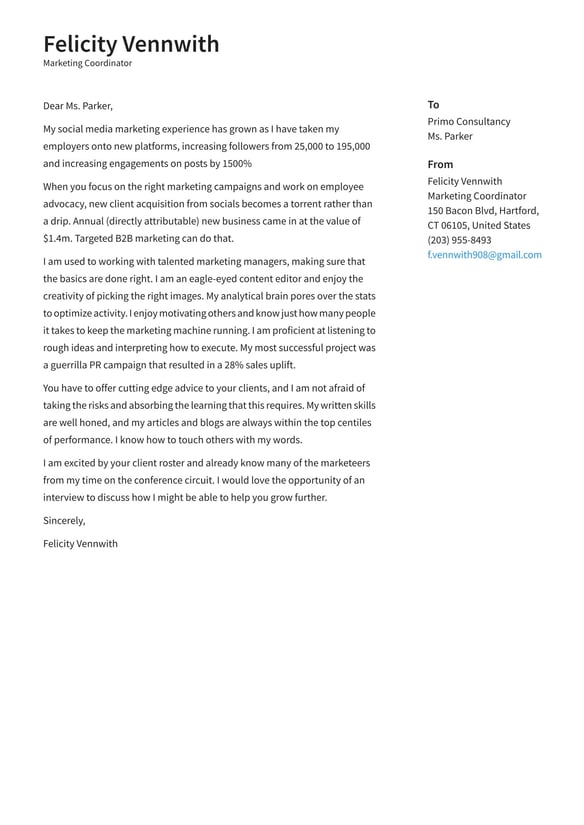
Perfect for Marketing Coordinator roles, this template’s clean structure and balanced white space amplify your creativity, analytical skills, and results-driven mindset. Its polished header styling ensures your achievements captivate hiring managers instantly.
Event Manager cover letter example
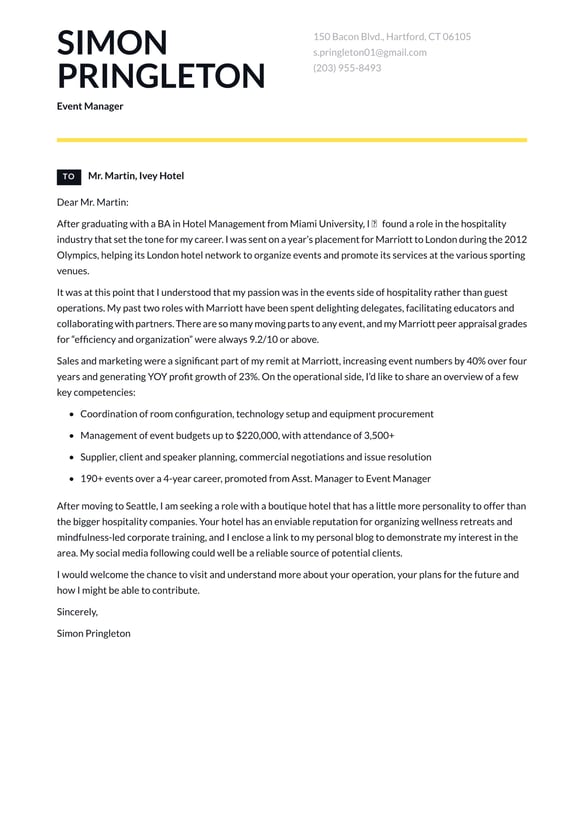
This polished, professional template blends clean structure with ample white space, reflecting the organizational precision and creativity essential for Event Manager roles. Its modern header styling highlights your expertise, impressing boutique hotel decision-makers.
Brand Ambassador cover letter example
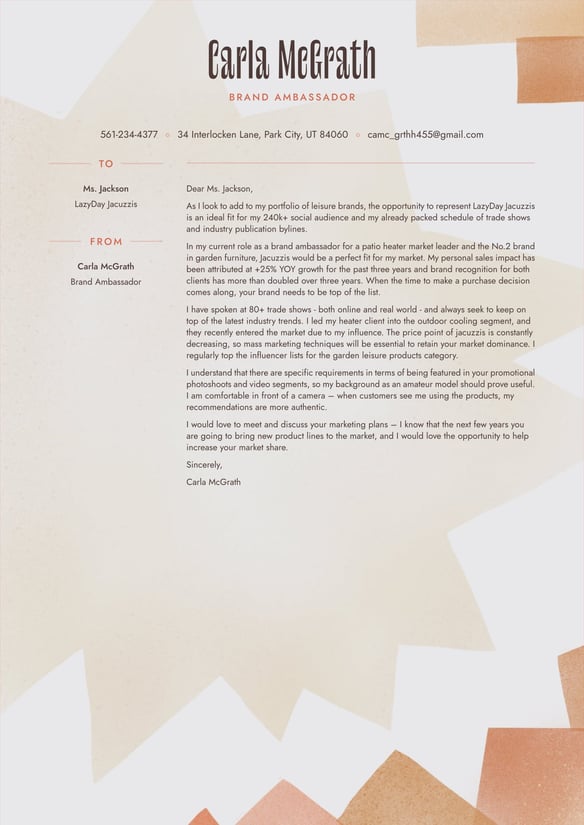
Showcase your charisma and influence with this sleek, modern template tailored for Brand Ambassadors. Its clean layout and bold headers amplify your achievements, while ample white space ensures your story resonates with marketing teams and decision-makers.
Brand Manager cover letter example
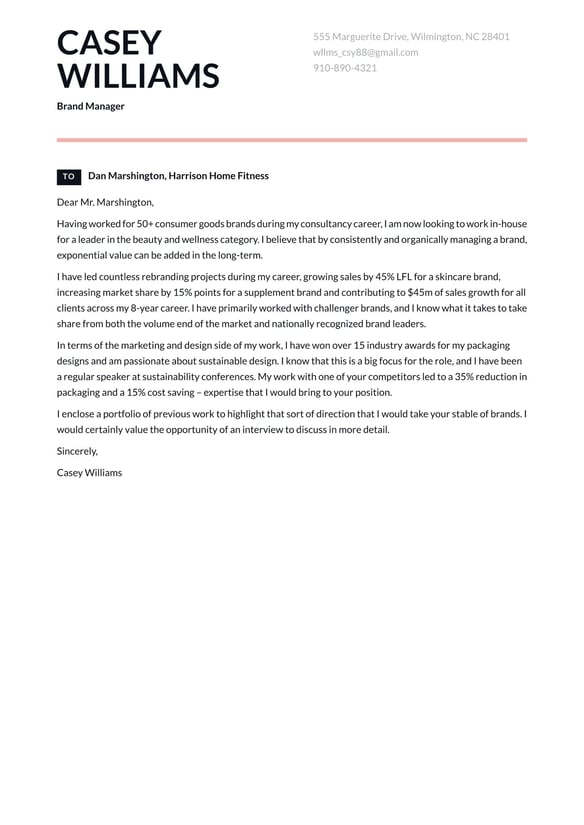
This sleek, professional template highlights your strategic vision and leadership skills, ideal for Brand Manager roles. Its clean structure and balanced white space emphasize clarity, helping you communicate achievements and creativity to decision-makers effortlessly.
Copywriter cover letter example
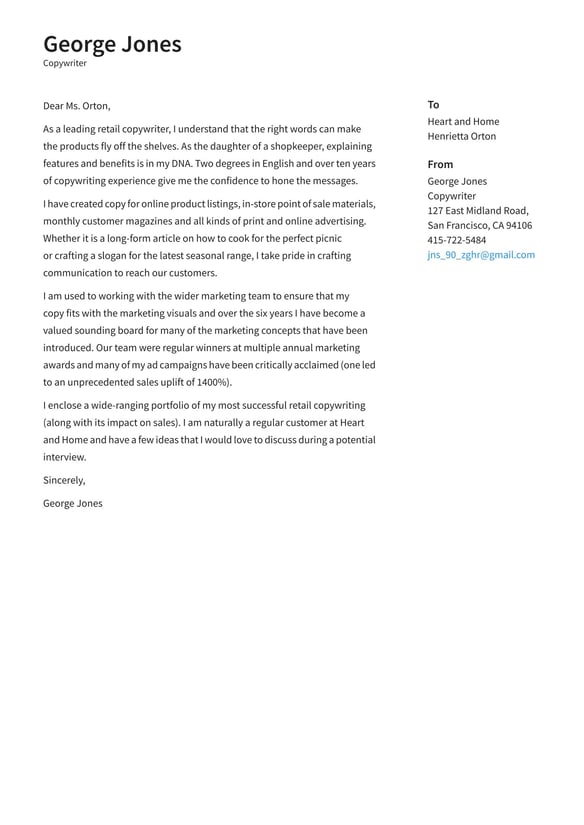
Perfect for copywriter roles, this template’s clean structure and ample white space amplify your creativity and storytelling skills. Its polished header styling conveys professionalism, helping you connect with marketing teams and hiring managers effortlessly.
Digital Marketing Manager cover letter example
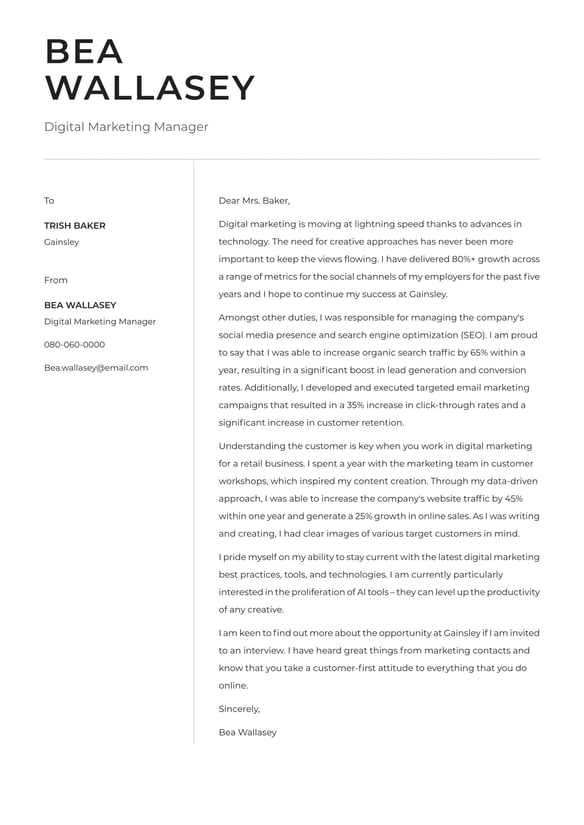
This clean, modern template highlights your strategic mindset and creativity, perfect for Digital Marketing Manager roles. Its balanced white space and bold headers emphasize key achievements, helping you connect with data-driven and customer-focused hiring managers.
Marketing Director cover letter example
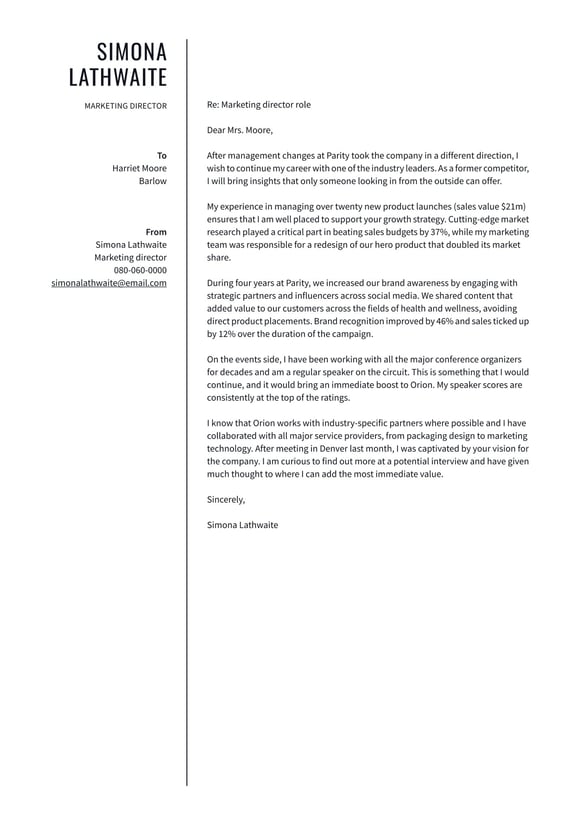
This sleek, professional template highlights your strategic mindset and leadership qualities, perfect for Marketing Director roles. Its balanced layout and modern header styling emphasize clarity and confidence, resonating with executive-level decision-makers.
This guide (along with cover letter samples of writing and a cover letter example of structure) will discuss:
- What does a public relations specialist do?
- Public relations pay and job outlook
- Why a cover letter is essential in public relations
- Best format for a public relations cover letter
- Tips to writing a winning cover letter
- Common mistakes to avoid.
What does a public relations professional do?
Unlike advertising specialists, PR people do not buy ads, but instead promote clients’ interests by influencing the media to provide favorable coverage.
They are sometimes called media specialists or communications specialists. In politics and government, they serve as press secretaries, and they may represent celebrities or other public figures as publicists.
PR specialists write press releases and speeches, respond to press calls, prepare information for the media, and organize news conferences and other public events. They keep their fingers on the pulse of public opinion and evaluate an organization’s overall advertising and marketing efforts to make sure they are in line with its desired image.
Public relations salary and job outlook
According to the U.S. Bureau of Labor Statistics (BLS), public relations specialists earned a median annual salary of $61,150 in 2019, although the top 10 percent earned more than $115,430.
How much do public relations specialists make?
These were the median annual wages for PR specialists in the U.S. in the top industries where they worked in 2019:
- Business, professional, labor, political and similar organizations $66,340
- Government $65,310
- Advertising, public relations and related services $64,230
- State, local and private educational services $57,940
Source: https://www.bls.gov/ooh/media-and-communication/public-relations-specialists.htm#tab-5
According to another source, Glassdoor.com, public relations salaries average $54,627 in the United States. According to Payscale.com, the average base salary in public relations is $49,637. And Salary.com says the average annual salary for a public relations specialist in the U.S. is $55,147, in a range typically falling between $49,776 and $65,266.
What is the job outlook in public relations?
Public relations jobs are expected to grow 7% from 2019 through 2029, compared to a projected growth of 4% for all occupations, according to the BLS. The increasing popularity of social media and other online sources present both new opportunities and potential problems for an organization’s public image, and savvy PR professionals will be needed to provide 21st-century solutions.
Why a cover letter is essential in public relations
Every publicist needs a winning pitch, and for a public relations specialist seeking a job, a cover letter is a crucial part of a job application.
You need a resume too, of course, but that’s not enough. A resume provides a mission-critical overview of your employment history, education and skill set — and a cover letter will typically address many of these same issues. But a cover letter allows you to introduce yourself to a hiring manager, to establish a personal connection, to talk about your aspirations related to the specific company you’re targeting.
A cover letter is a golden opportunity to showcase your personality, passion and likability in a way that a resume simply can’t. And especially in the field of public relations, it’s an opportunity not to be squandered. You are an expert in promotion and publicity, so you need to need to promote yourself in a personal way.
Surveys of hiring managers have found that the failure to include a cover letter with a resume is one of the leading reasons a job candidate is rejected. A few employers sometimes request that you send a resume only. But unless you’re specifically told not to, always include a cover letter with a resume.
Best format for a public relations cover letter example
The best format for a public relations cover letter is based on a very traditional structure with the following cover letter elements:
- Header
- Cover letter greeting
- Cover letter introduction
- Cover letter middle part (body)
- Cover letter ending (conclusion)
- Sign-off/signature line
The application letter should be one page only, 400-500 words max and have enough white space between paragraphs to make reading easy and convenient.
Let’s look at what each of the cover letter elements/paragraphs should contain (along with actual cover letter samples of writing).
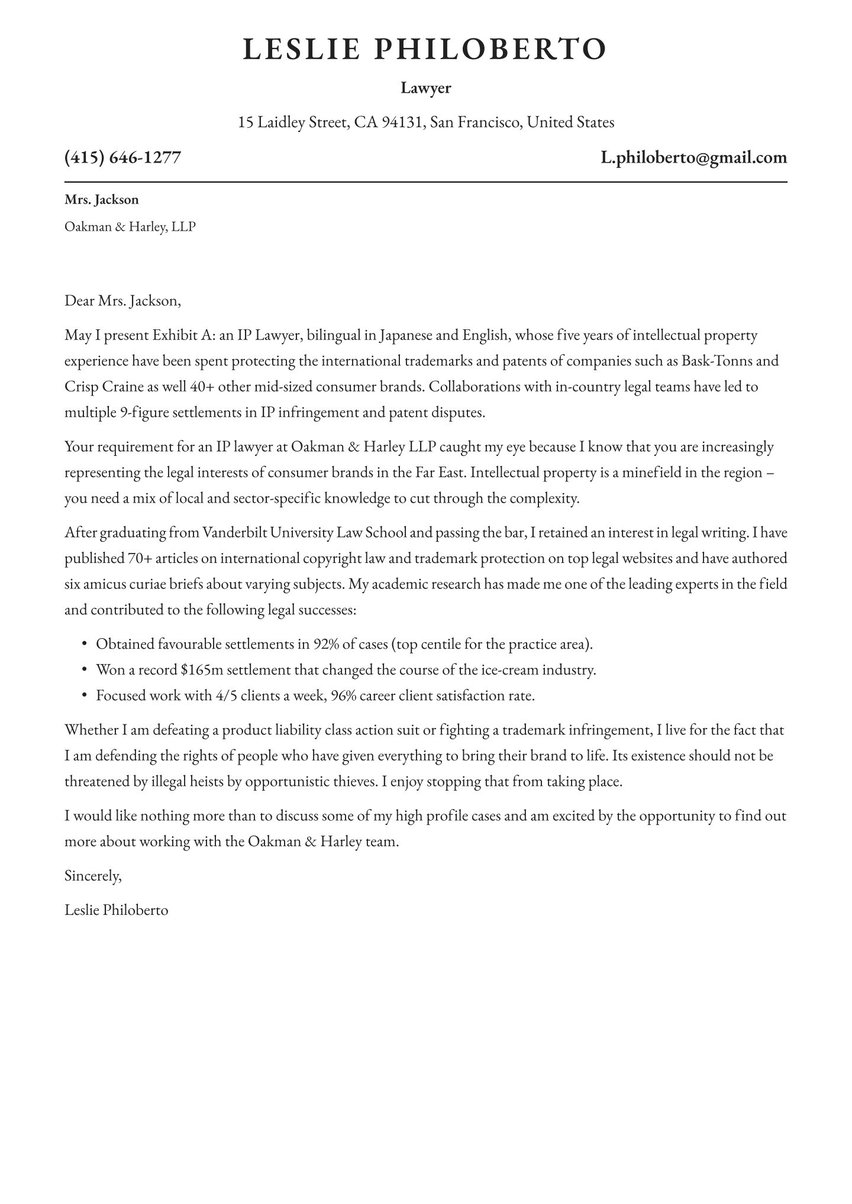
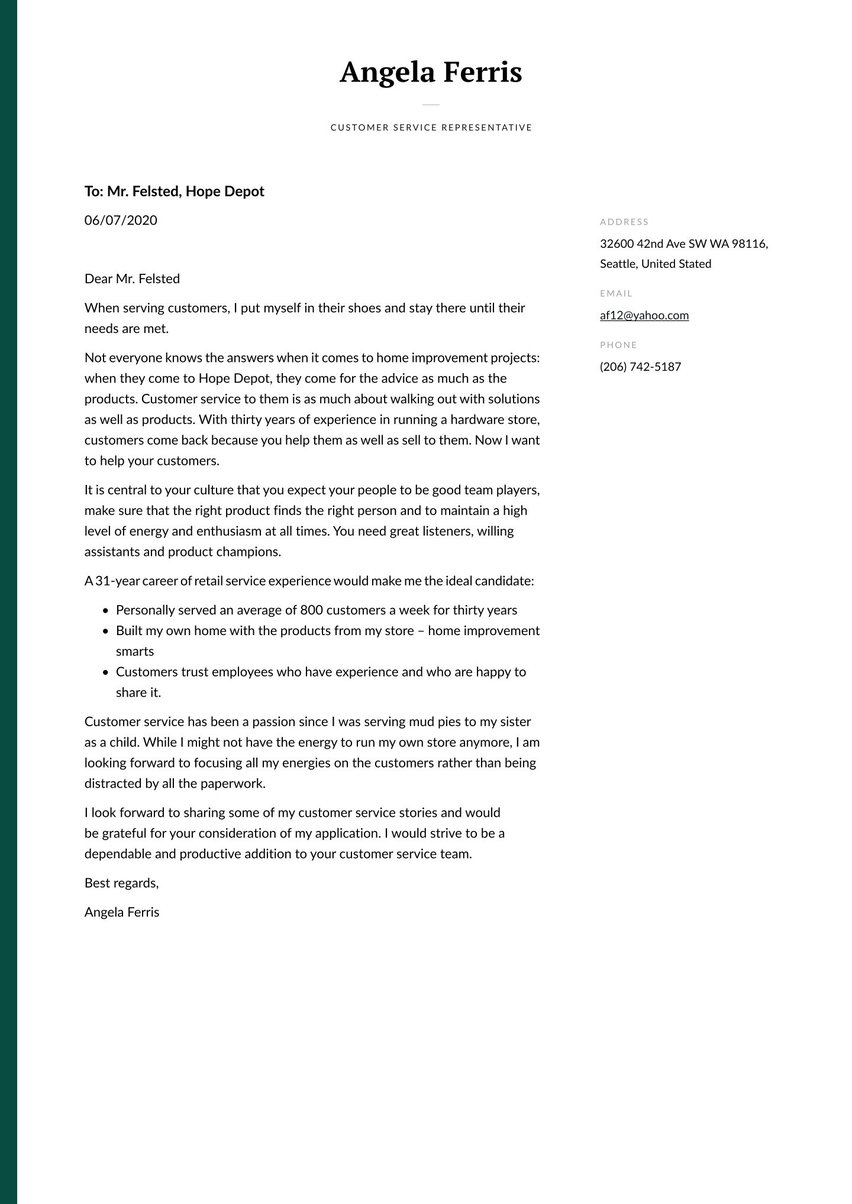
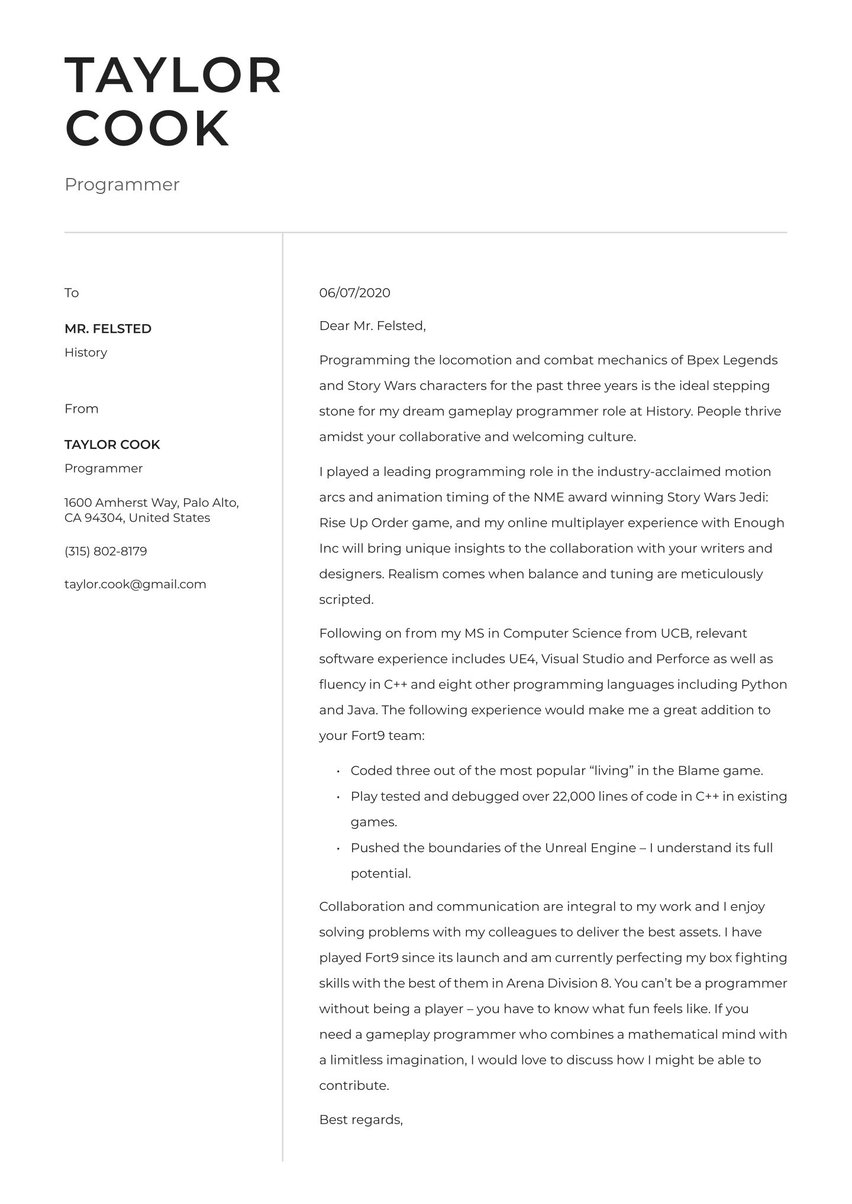
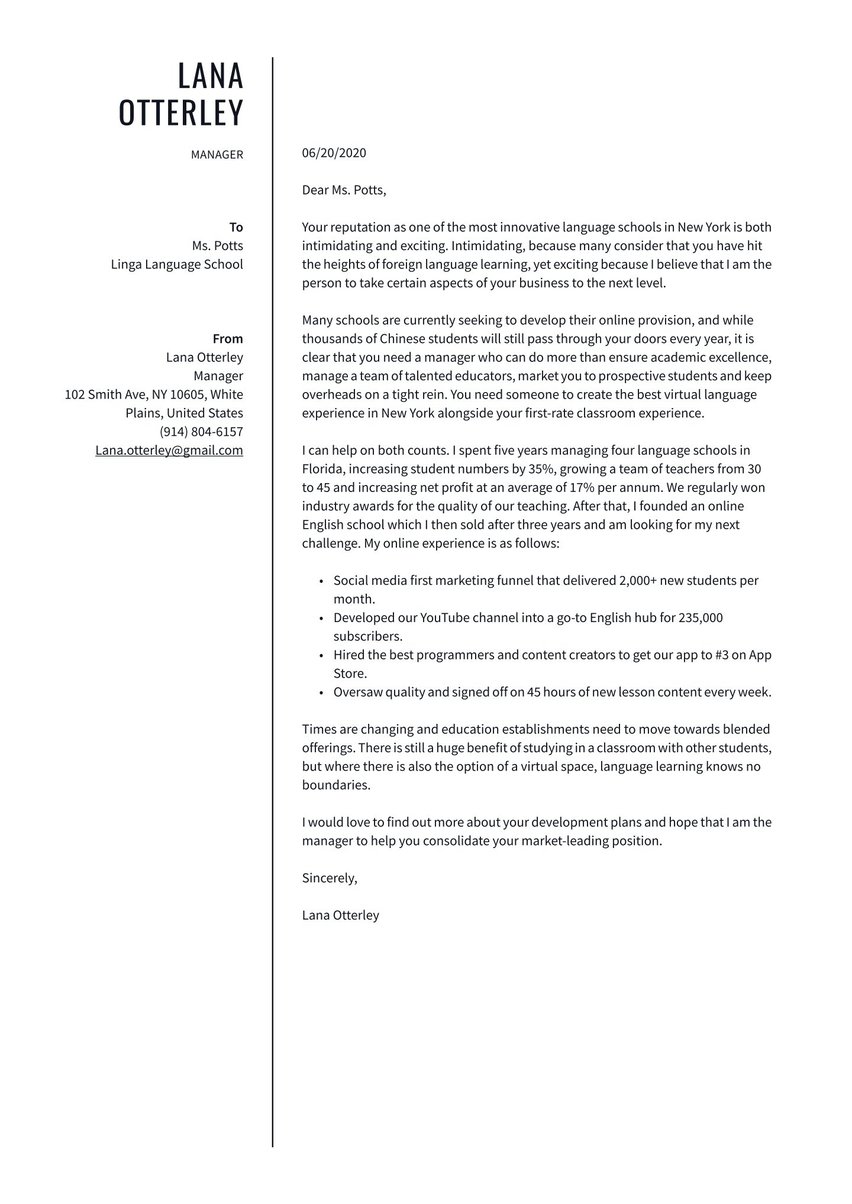
Cover letter header
Once known as a letterhead, this is the attractively designed space at the top of your letter that contains your name, occupation, address, phone number and email.
It may contain an accent color, creative use of typography and white space, and perhaps your photo. So in addition to containing your critical contact info, it’s an important design element on the page, since there will be nothing below it but solid paragraphs of black text. It should be pleasing to the eye, giving your resume a distinctive look that shows you put some thought into it.
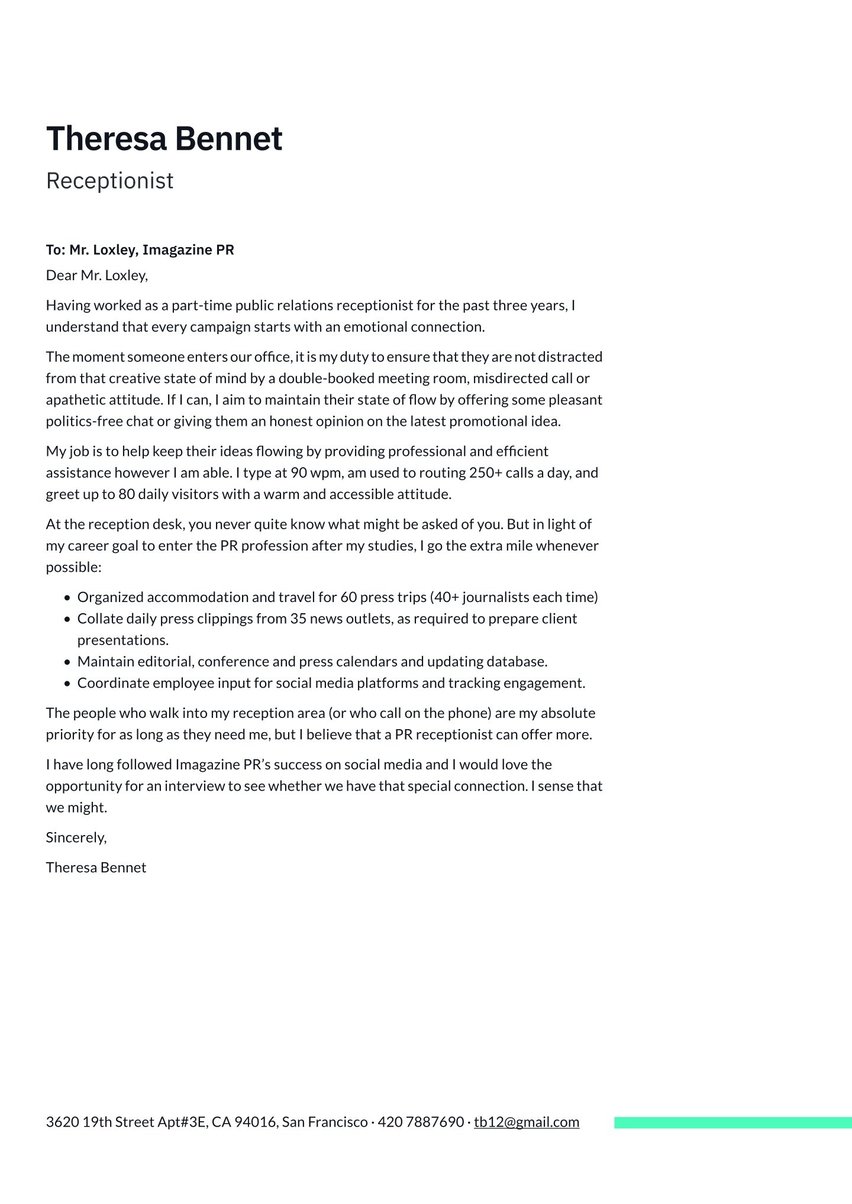
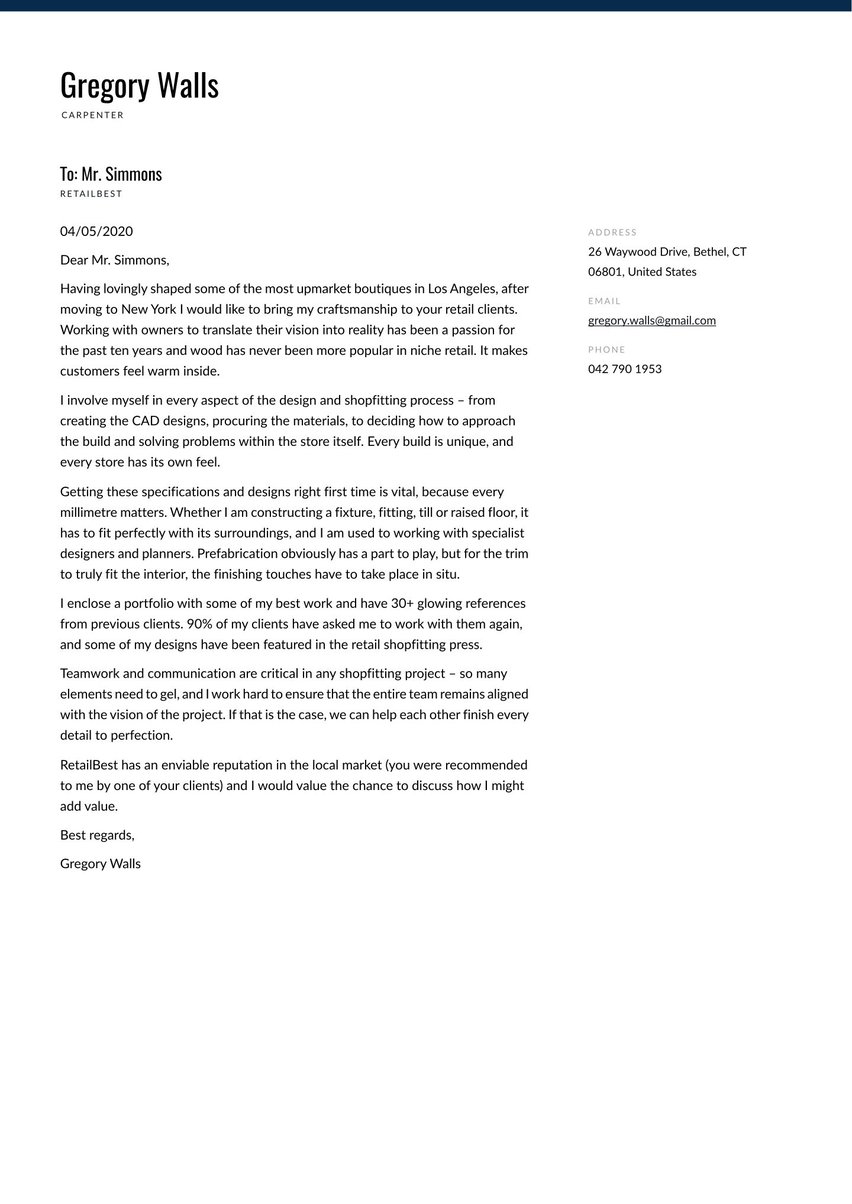
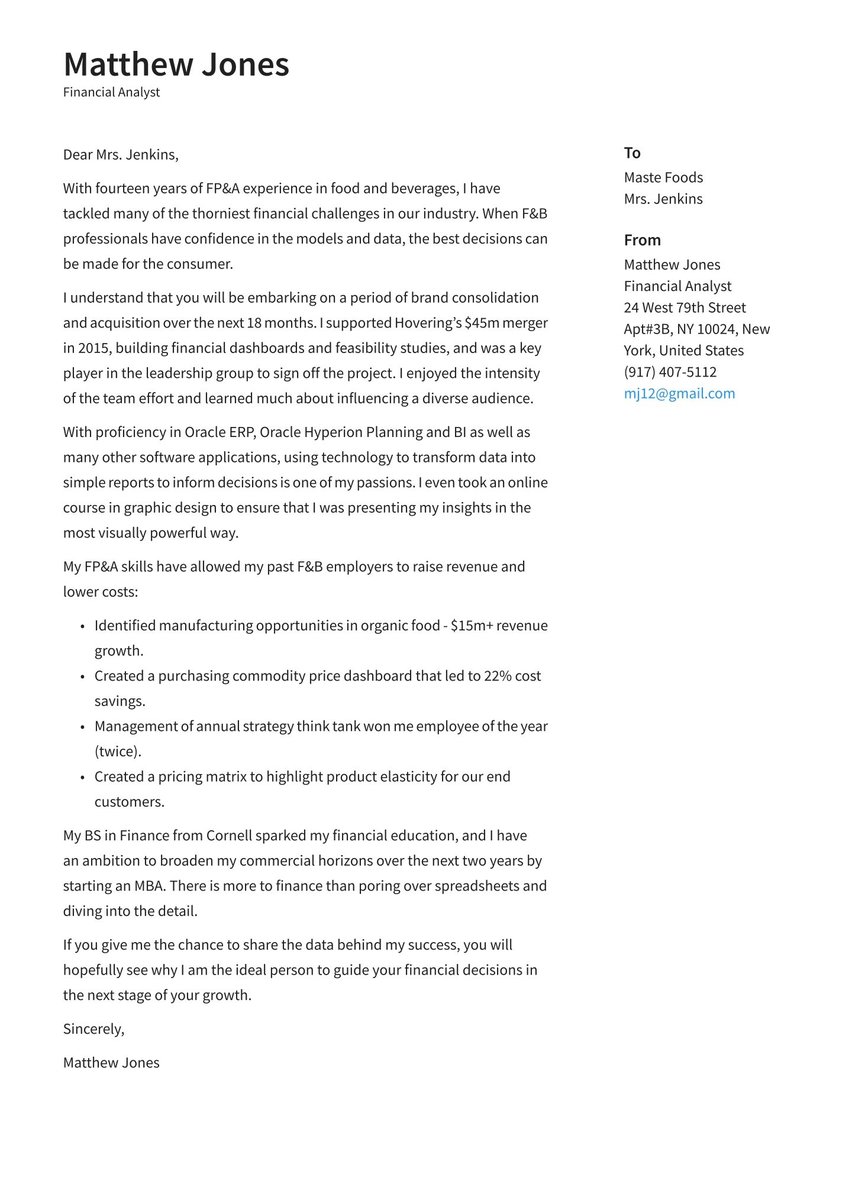
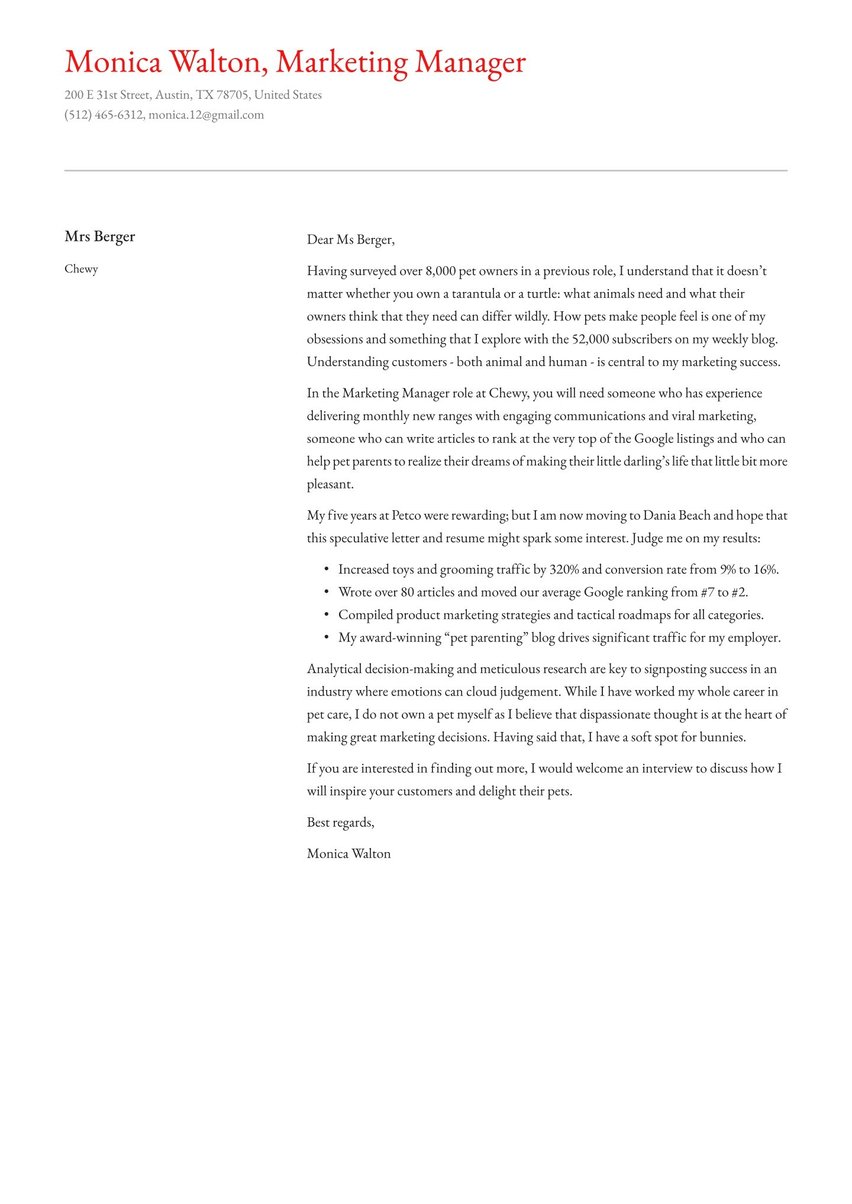
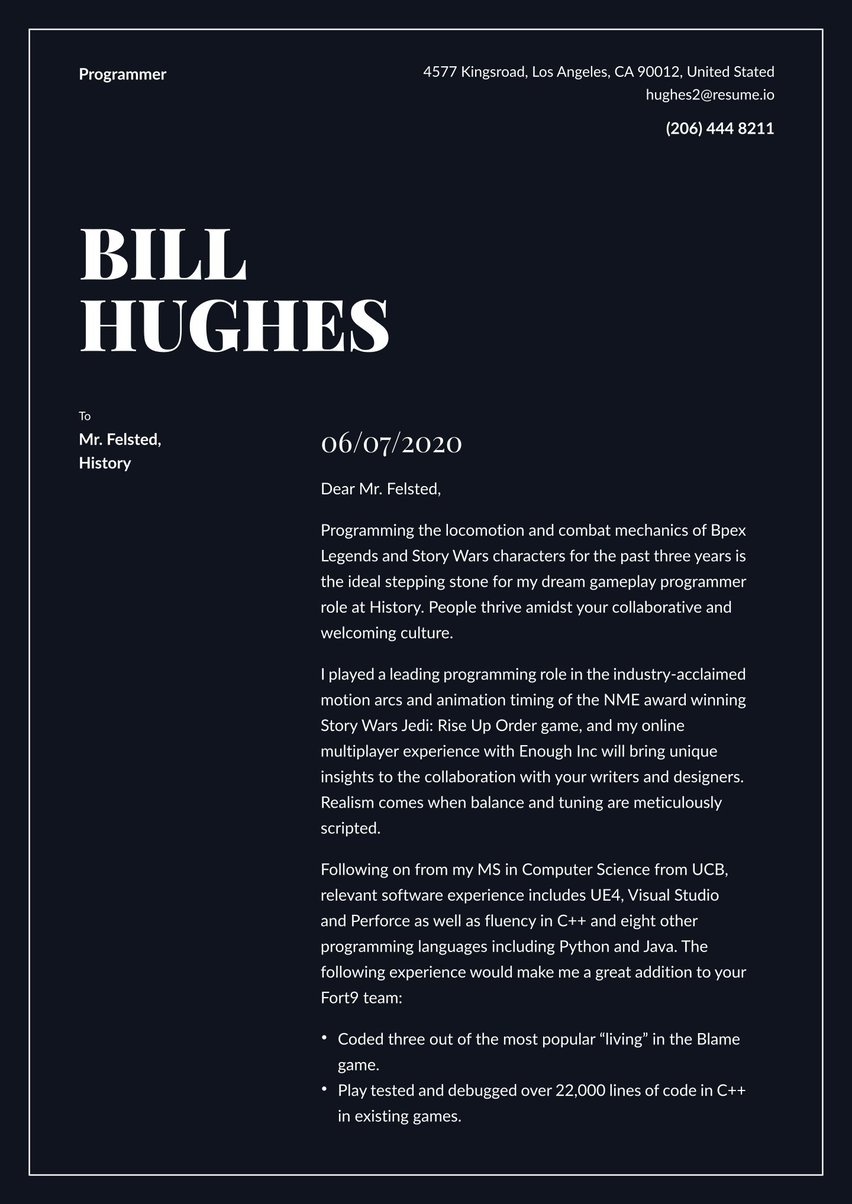
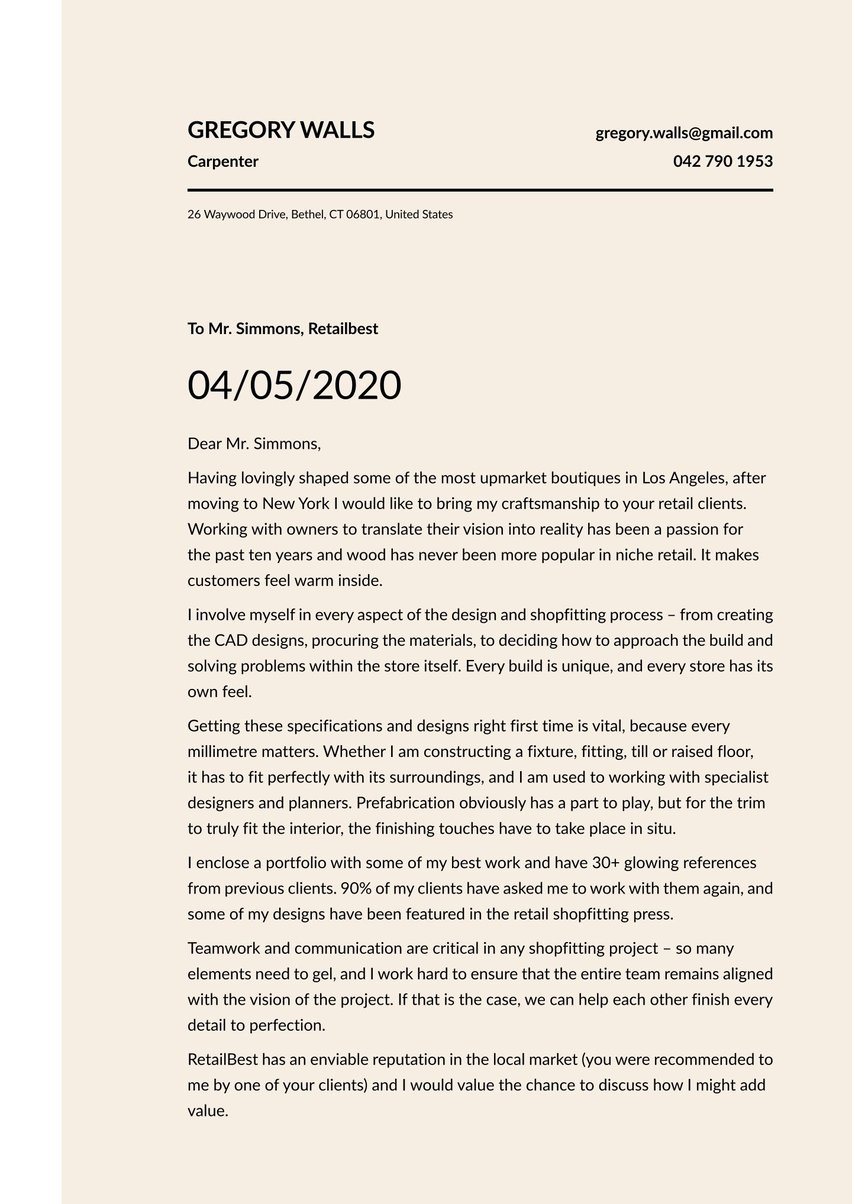
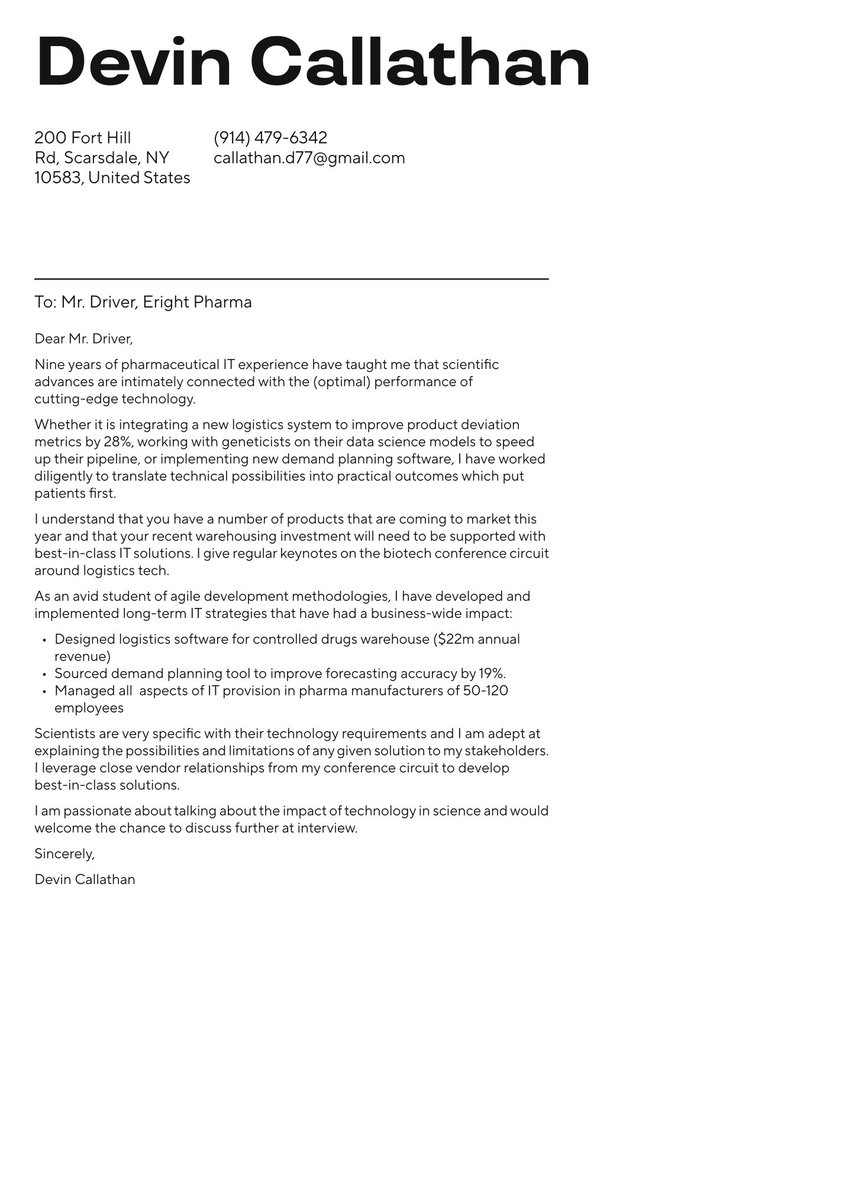
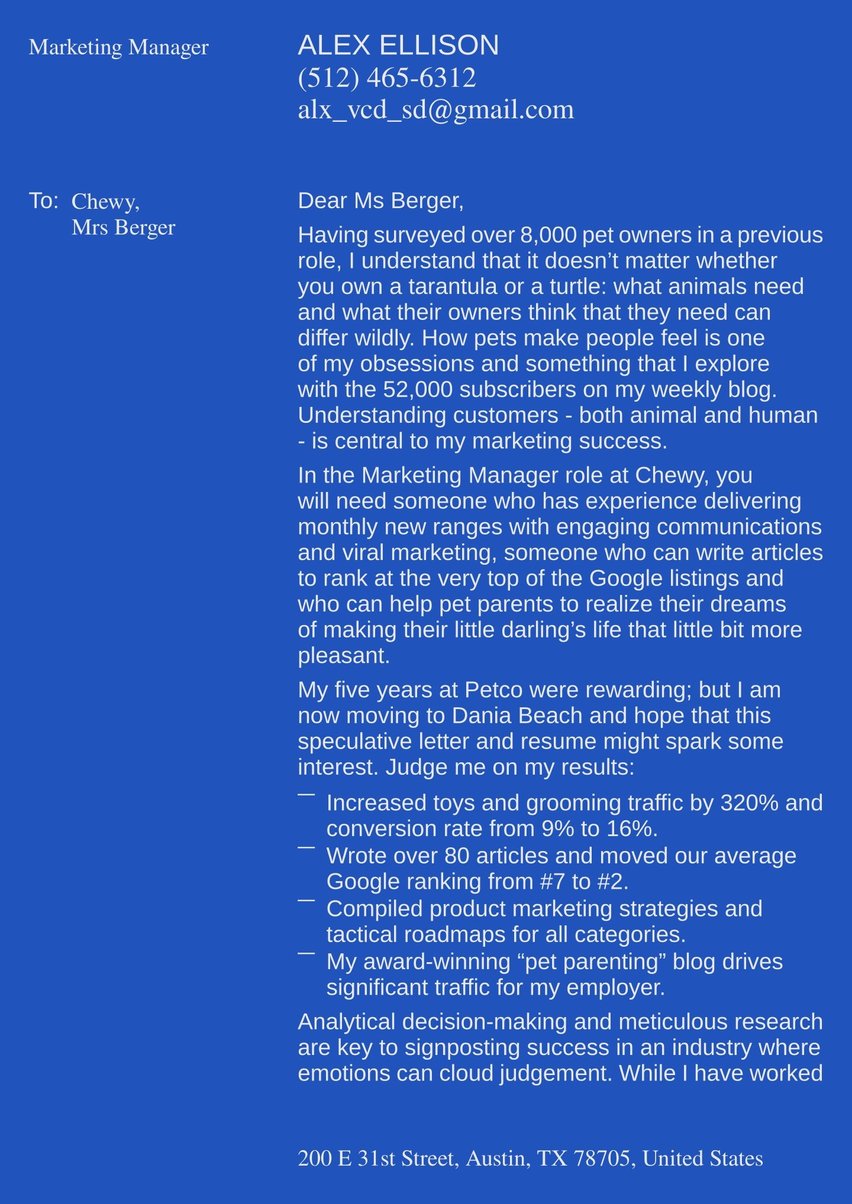
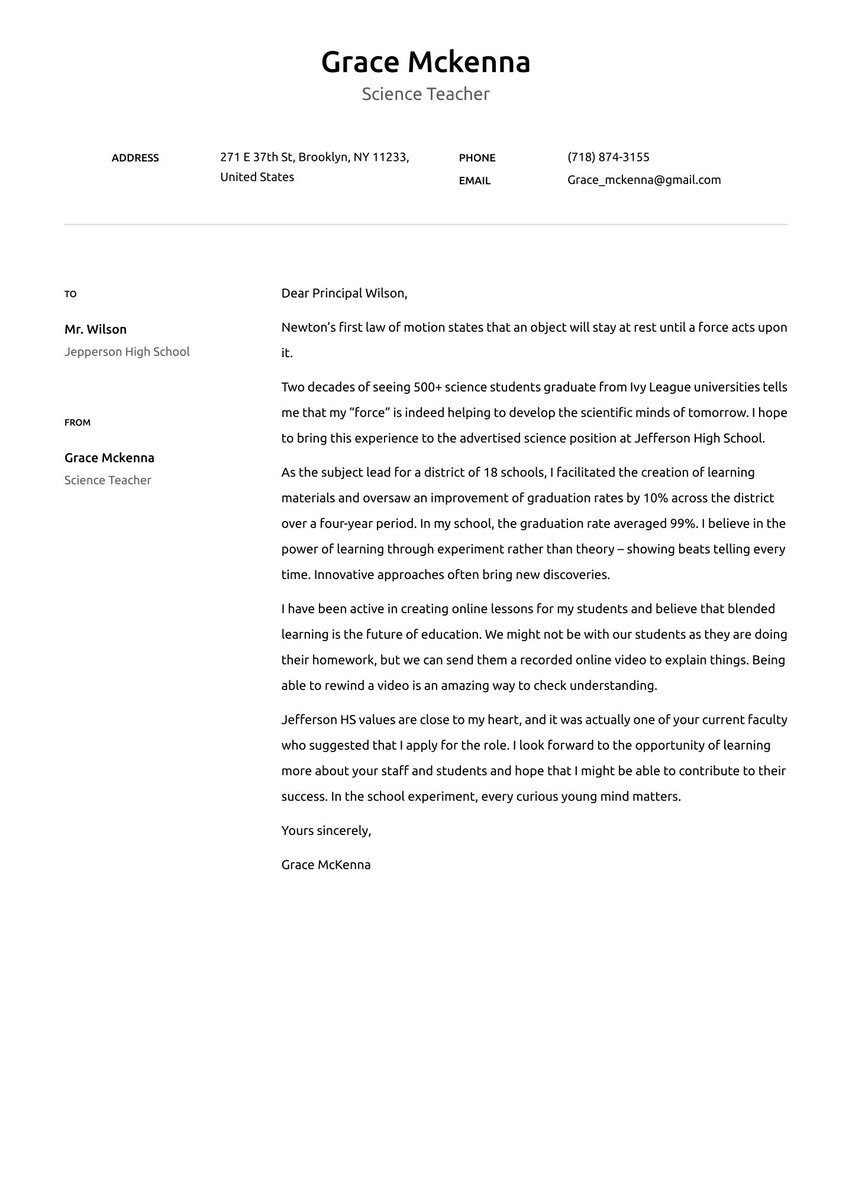
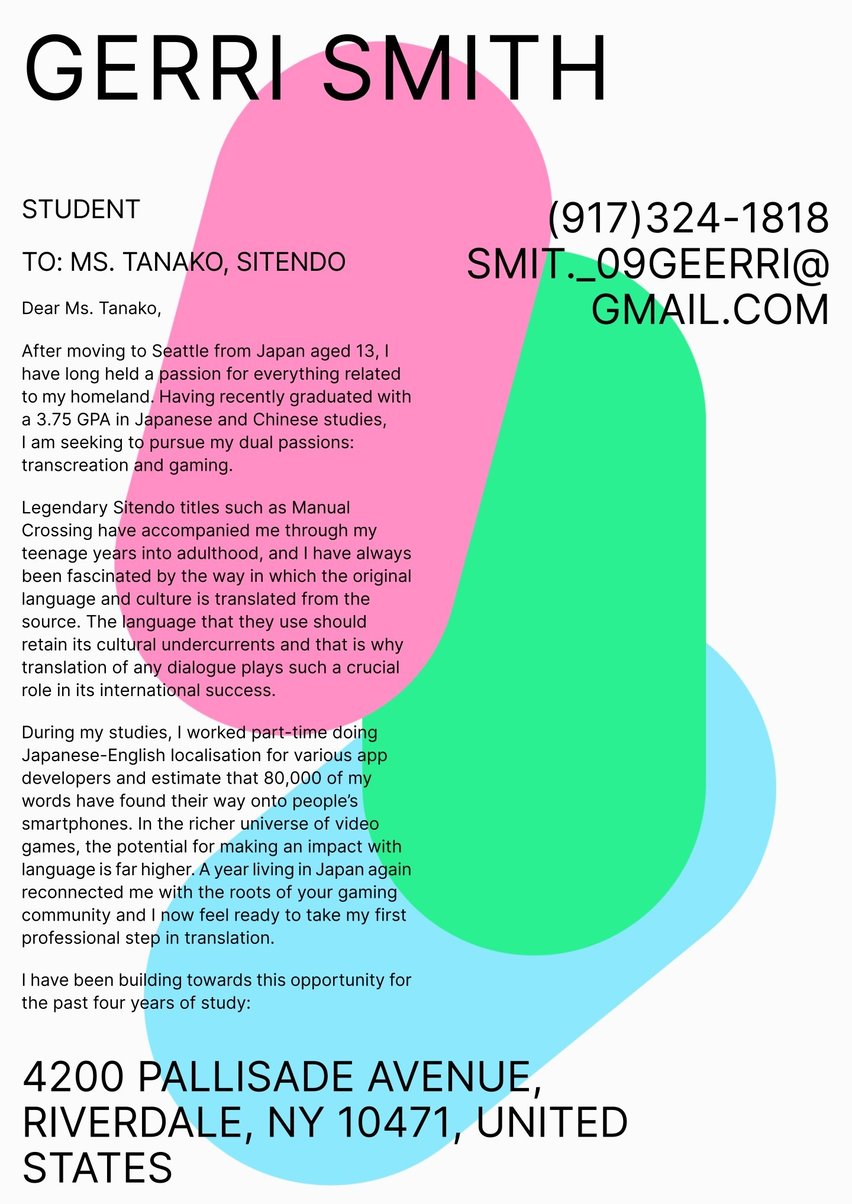
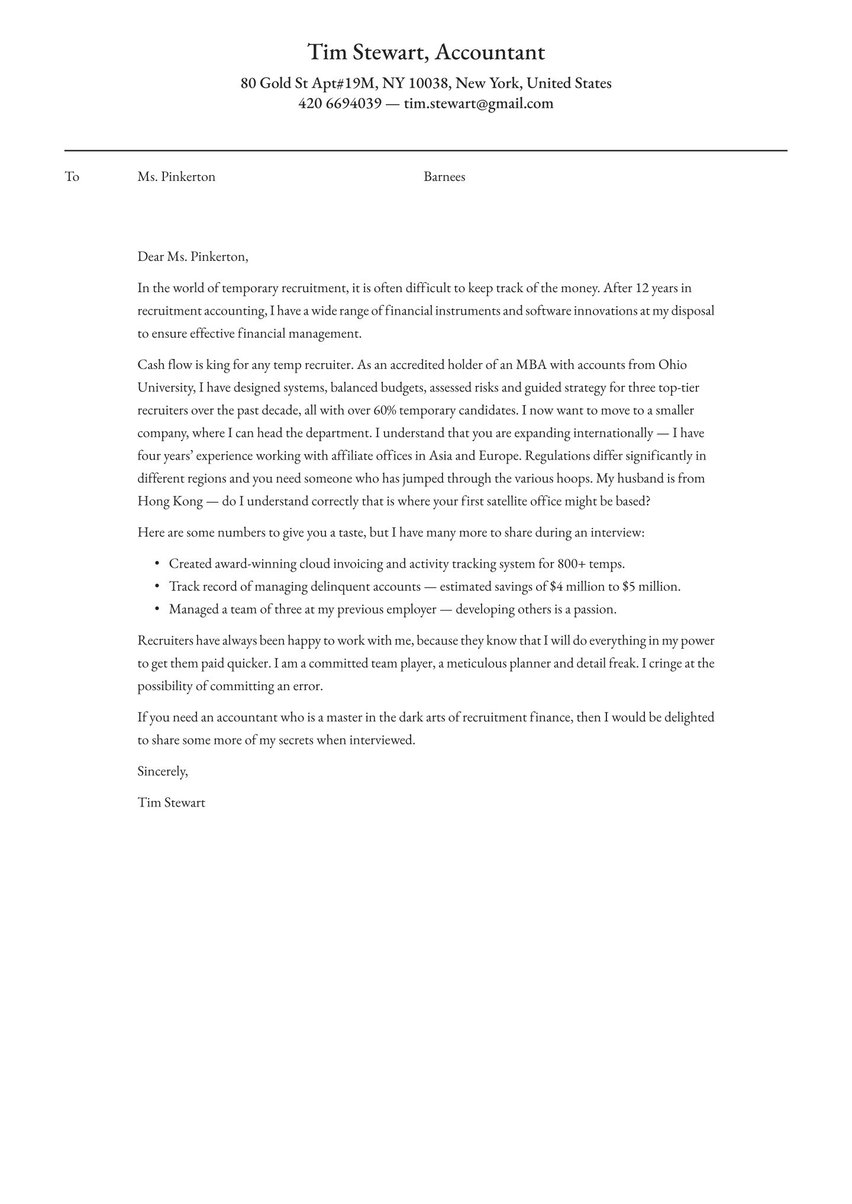
Take a moment to review Resume.io’s cover letter examples and templates, which feature a variety of header designs. If you find one you like, click to download it, replace the text with your own info, and the hardest part of designing your cover letter is done. Now all you have to do is write it.
Make your resume and cover letter a matching set
Resumes and cover letters are meant to go together, so you need to give them a matching style. Use the same fonts, font sizes and formatting choices in your resume and cover letter, and the headers on the both of them should be very similar if not identical.
Cover letter greeting
This is the line at the top of the letter that says “Dear Mr. X” or “Dear Ms. Z.” Do everything in your power to address your cover letter to a specific person — it shows professionalism and attention to detail if you’ve gone to the trouble of finding out who’s doing the hiring for the position you want. If you’re responding to a job listing that doesn’t mention a name, it may be worth calling the company to inquire.
Unless you happen to know the person you’re writing to, stick to the formality of using a last name. And although words like “Greetings” or “Hello” may be acceptable at times in places of “Dear,” it’s a bit risky to be too informal in a letter where you’re asking for a job.
Cover letter introduction
The opening paragraph of your letter should hook the reader by alluding to something that makes you sound like a promising job candidate. If you have years of successful experience in public relations, look no further than this angle.
Or you may be new to the field — perhaps you’re just graduating from college, but if you have a relevant degree from a good school, this can be your opener too.
Use strong, compelling language that will get people’s attention, and avoid clichés like “Please consider this letter my application for….”
Go to Resume.io to review some good cover letter examples for an event manager, marketing manager or social media manager. Here’s a good cover letter sample for the intro of a public relations professional application:
After seven years of organizing 30+ international test drives and 100+ press events, I have come to realise that the secret of great automotive PR lies in letting others experience the drive themselves. I can create evocative images with words, but there is nothing like gliding down a picturesque Scottish Highland road in the summer with the top down.
Cover letter middle part (body)
In the middle part of your cover letter, the central two or three paragraphs, you must make the heart of your case that you’re the person for the job.
Highlight your most impressive past work experience, mentioning not only where you worked but what you accomplished there. Be specific, using facts and figures wherever possible, such as dollar figures or percent increases.
If you’ve worked in public relations long, you’ve probably had to put out a fire or two. Relate an anecdote about a problem you once faced, the action you took, and the satisfactory result you achieved.
You may also choose to mention your education and any special training in your field.
And ideally, you should mention the name of the company you’re writing to, and say something about what you hope to bring to the table for that company. For example, if you’re aware that a company is seeking to expand in a competitive new direction, you might say something about an overall public relations strategy that would help smooth the way.
At the very least, mentioning the company by name shows you are not mass-mailing the same generic letter to multiple employers. This, by the way, is a major faux pas, as every cover letter should be unique and tailored to each prospective employer.
Here’s a cover letter sample of a well-written middle paragraph for a public relations specialist:
Managing the PR campaigns for Toyoton with the Yardman agency for four years was the most enjoyable part of my ten-year public relations career, and I would love to continue the award-winning work that I was doing on their electric car range for Jeslar. We increased brand awareness of each model by 18% after every campaign – taking over 9 points of market share from our main rivals.
Crisis PR was no small part of the role and I managed the fallout of a factory fire, political issues, family ownership disputes and a commercial strategy that was initially far from the mark. With electric vehicles it is important to project where you are taking your customers instead of where you are right now (especially when your main battery supplier lets you down). I won “Crisis PR Campaign of the Year” for that one.
I have also helped to manage the changing public perceptions of petrol and diesel cars in an increasingly environmentally-aware world. Sometimes PR serves a broader purpose and electric cars are a mode of transportation that I feel hugely passionate about.
How to close a public relations cover letter
The ending of your cover letter may be one of the most important parts of the document. So the question “how to close your cover letter?” is a vital one. Your final paragraph can be used to summarize what you’ve said already, to thank readers for their time, or perhaps to work in one last nugget of information about your skills. But whatever else it contains, the conclusion must have some kind of call to action.
This might be as simple as saying you look forward to hearing back. You might say you would be delighted to visit the company HQ and meet with the principals, or you might express your willingness to join a Zoom call at any time to discuss your qualifications further.
If you want to be a bit more assertive, you could even say something like, “Would you mind if I call you in a week or two to discuss these possibilities further?”
The idea is to get the hiring manager to do something as a result of your cover letter — at least send an email in reply — and not just lay it aside and forget about it.
Here’s a cover letter sample of a good conclusion to a public relations application:
I have curated a portfolio of articles, press clipping, social media posts that I feel would be a good fit for the role at Jeslar. Your position of market leadership is testament to your unrivalled manufacturing expertise, and it is vital that you have an ability to communicate your journey to your customers. I hope that an interview might offer me the chance of explaining how I can contribute to your PR cause.
Sign-off/signature line
When it comes to the sign-off of your cover letter, keep it simple like in this cover letter example:
Sincerely,
Simon Tan
If you like, you can choose some closing words other than the traditional “Sincerely,” such as “Best regards,” but avoid anything that sounds too casual.
If you’re planning on printing this cover letter to send by snail mail or deliver in person, you do need an actual signature above your typed name. This is not necessary in electronic correspondence, although you can add a scanned version of your signature if you like.
How to write a persuasive public relations cover letter
A cover letter is an exercise in persuasion, and as a public relations professional, persuasion is precisely your field. You are an expert in portraying organizations in a positive light, so you need to do the same for your greatest asset — yourself.
Just as a good salesman is focused on the needs of the customer, you need to focus on the needs of the company you’re targeting. You’re not writing to convince the company that you deserve a job — you’re writing to convince the company that it needs you.
Perhaps the company needs you to resolve an image problem it may have. Perhaps it’s a little-known organization that needs you to drum up attention. Or perhaps the company is already well known and has a good reputation, but it wants to compete with the best of the best, and it needs to take its publicity to the next level.
In all of these cases, the focus should be on what the company needs, not what you need. Your contribution should help make the company stronger, more efficient and ultimately more profitable. Hiring you should earn the company more money than it will cost.
So put yourself in the shoes of the person you’re writing to, and write the letter that person would want to receive.
Pay close attention to your tone of voice. It should exude confidence born of competence, but it should never cross a line into arrogance or self-importance. You have to write a letter that makes you sound likable. Nobody wants to work with somebody they don’t like.
Public relations cover letter design and layout
Your letter should look as good as it reads, demonstrating the same feel for design and presentation that you would use on actual clients in a public relations job. Here are some tips to clean design and layout:
- Font: Use a legible, “normal-looking” font — nothing wacky or avant-garde. Review our guidance on best fonts to use in cover letters.
- Font size: Keep the font to a minimum of 10 points and a maximum of 12. Avoid shrinking the font size to force a wordy letter onto one page, when what you really need to do is trim your text.
- Align text left: While the text in a book may look fine justified from margin to margin, letters look more natural if aligned left, leaving a little space at the end of each line.
- Margins: Use a 1-inch margin on the top, bottom, left and right.
- Paragraphs: Avoid long, blocky paragraphs. Leave a space between paragraphs, and don’t indent them.
- Balance: Strive for a balanced, centered look and feel with an appropriate amount of evenly distributed white space. For example, your letter should not have a bunch of text at the top and very little at the bottom, nor should there be gaping white spaces trapped inside the letter.
- Save as PDF: Unless the employer requests some other file type, send your cover letter as a PDF, either in an email attachment or uploaded to the employer’s job-application system. A PDF will preserve your formatting so that your text doesn’t jump around (or worse, turn to garble) when opened on someone else’s computer.
- Use a professional cover letter template: You can sidestep all these errors by using a professional designed template from our extensive array of cover letter examples.
Cover letter mistakes to avoid
Here are some common cover letter mistakes you need to avoid:
- Typos and other errors: You simply can’t afford typos, misspellings, grammatical errors or bad punctuation in a one-page letter seeking a position in public relations. You need a “perfect pitch,” so if writing is not your long suit, find an editor to review your letter.
- Cover letter clichés: Write in fresh, original language that the recruiter hasn’t read a thousand times before. Many cover letters start with “I’m writing this letter to….” This is “junk ink” — they already know you’re writing this letter. And please don’t call yourself a “self-starter” or a “team player” who “thinks outside the box.”
- Mass mailings: A cover letter is not a one-size-fits-all document. Tailor each letter to each employer, and let the hiring manager know you’re doing so by addressing that company’s needs.
- Irrelevant info: If you have room in a one-page letter to gab about your hobbies and interests outside work, then you’re missing an opportunity to use the precious space here to highlight skills that are relevant to the job you’re seeking.
Key takeaways
- Public relations professionals are specialists in shaping a positive public image for any organization. They make good money and face a strong job outlook, but they need a standout job-application package to compete for the best jobs.
- In applying for a public relations job, a cover letter is a crucial companion to a resume because it enables you to showcase your personality, passion and enthusiasm.
- Use an attractive header, a proper greeting and a thoughtful introduction, body and conclusion to cover all the bases you need to cover, with nothing extraneous.
- Follow the rules for attractive design so that your cover letter looks as good as it reads.
- Focus on the needs of the employer, not your own, and strike a tone that hiring managers will find persuasive.
Resume.io provides an extensive library of marketing cover letter examples and writing guides, in addition to occupation-specific advice on all aspects of the job-application process.
For additional inspiration, here are a few links to related cover letter examples and guides in the field of marketing and sales:
- Marketing cover letter example
- Digital Marketing cover letter example
- Sales cover letter example
- Sales Manager cover letter example
- Sales Executive cover letter example
Best of luck in your job search!