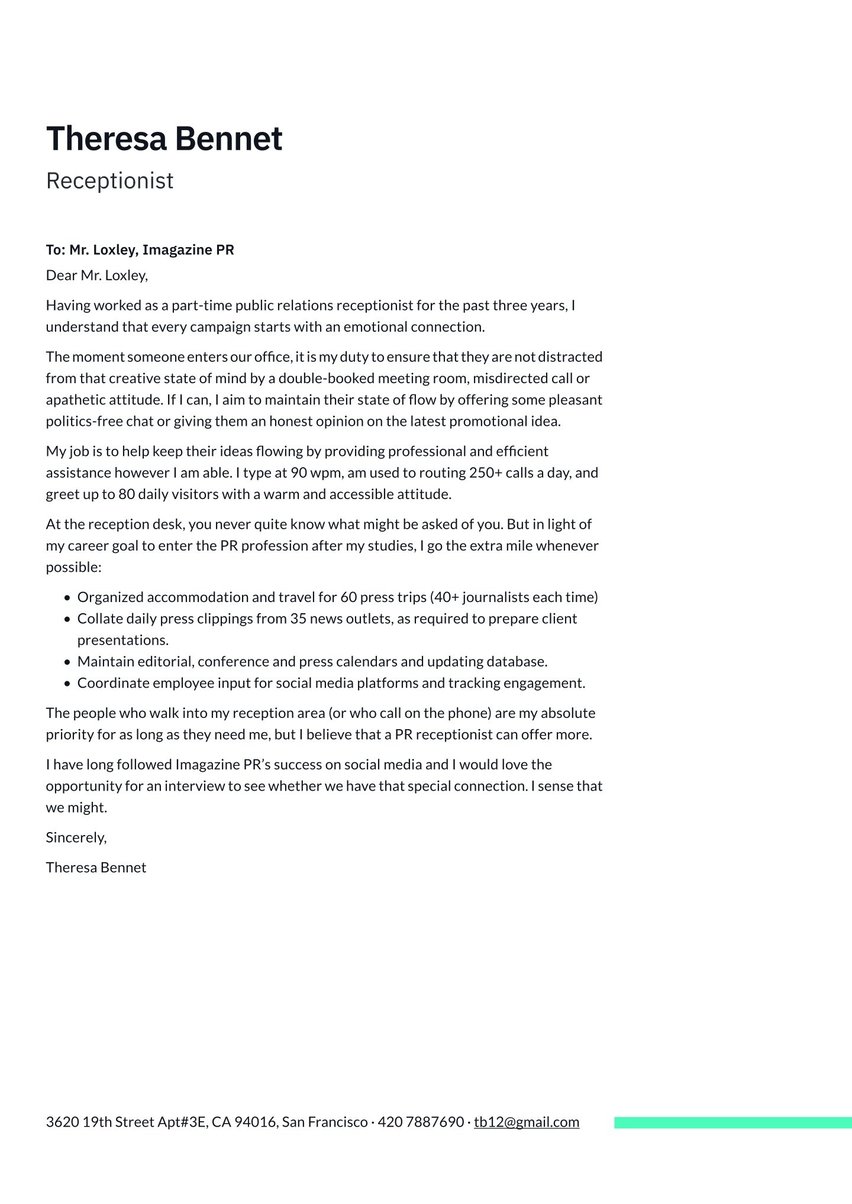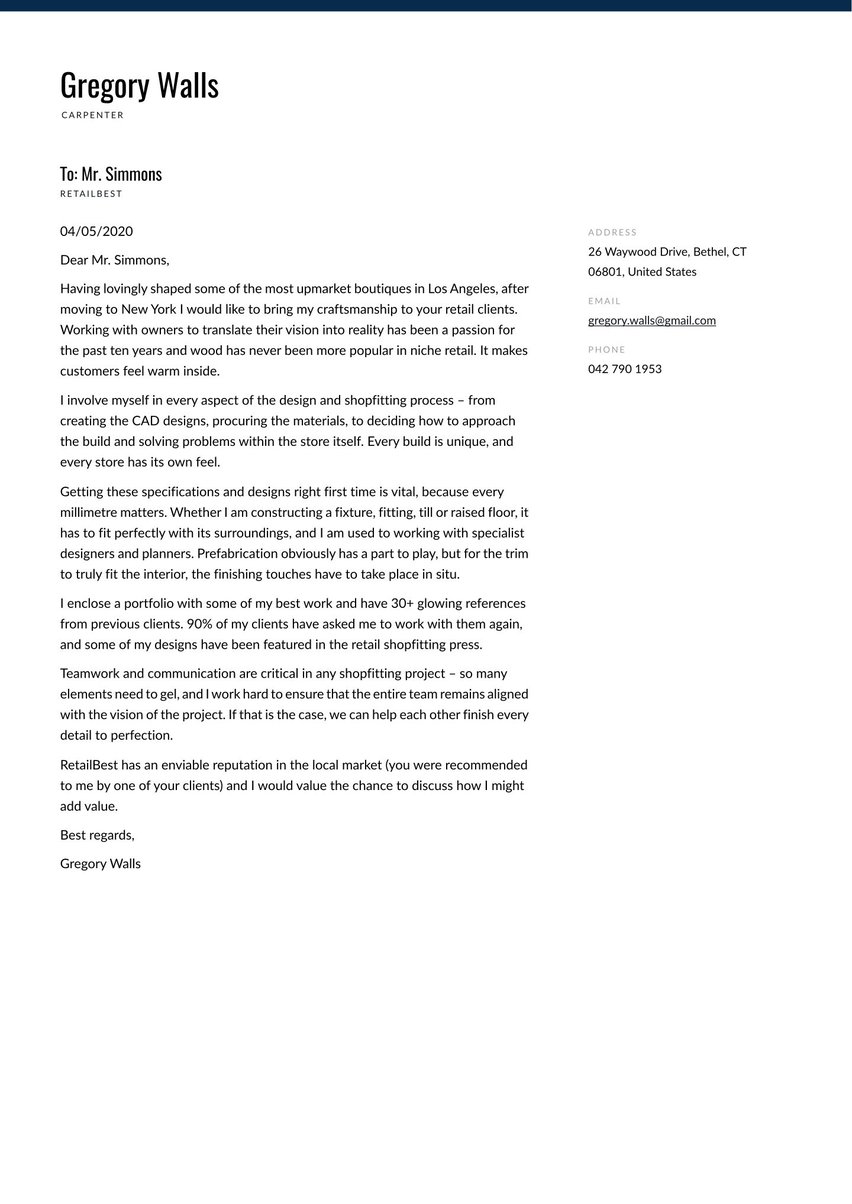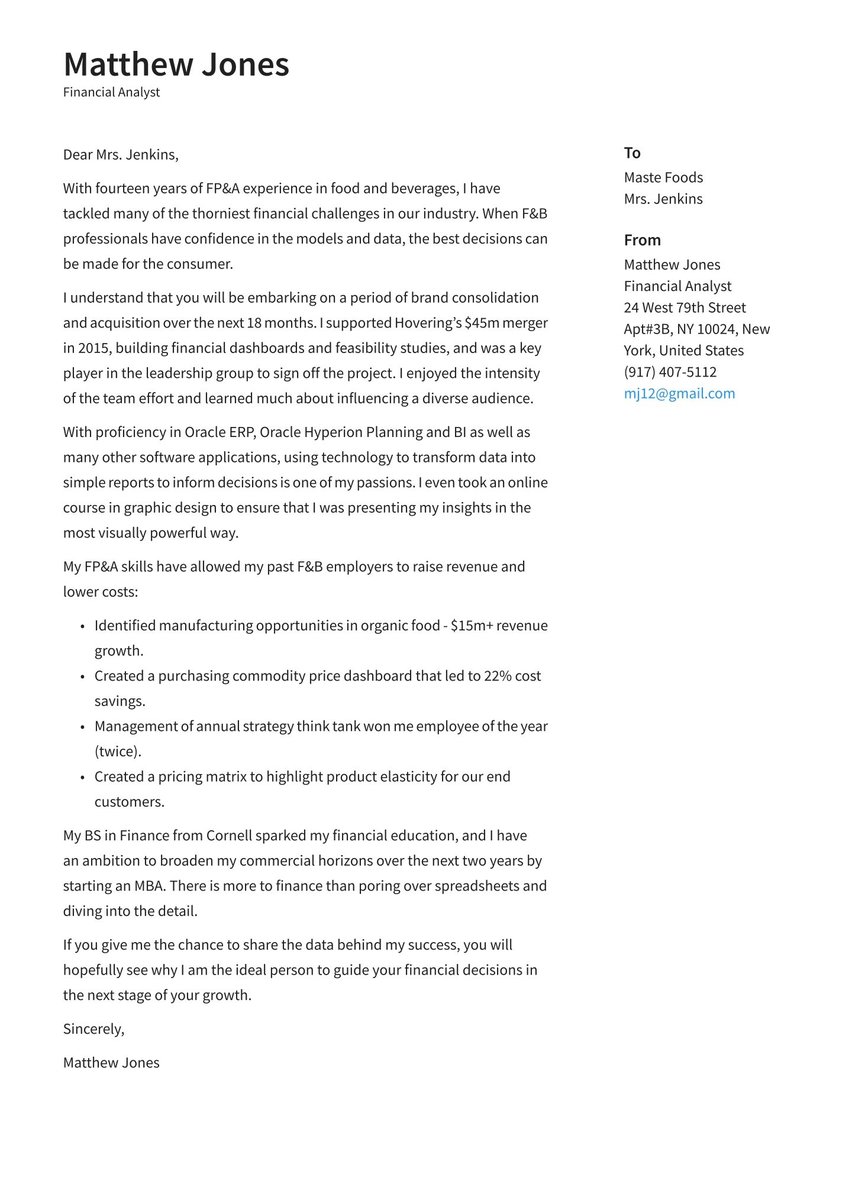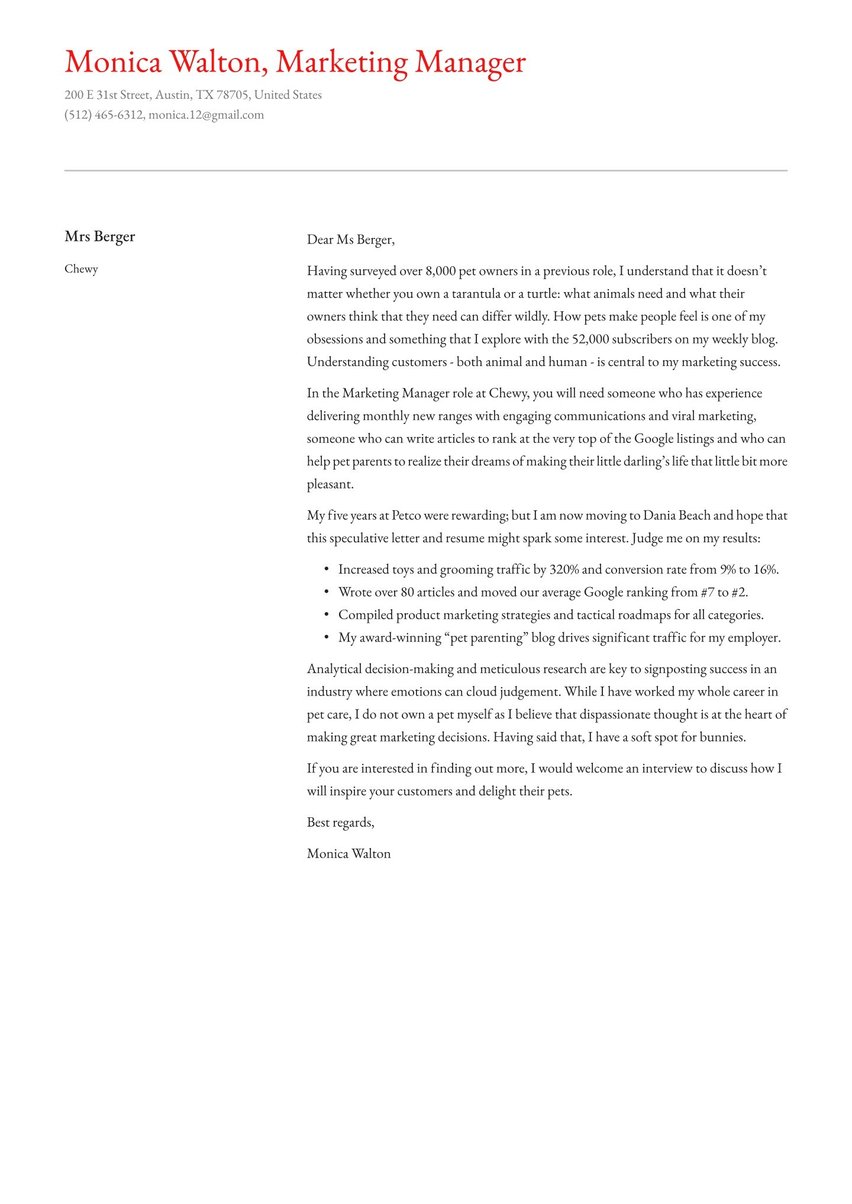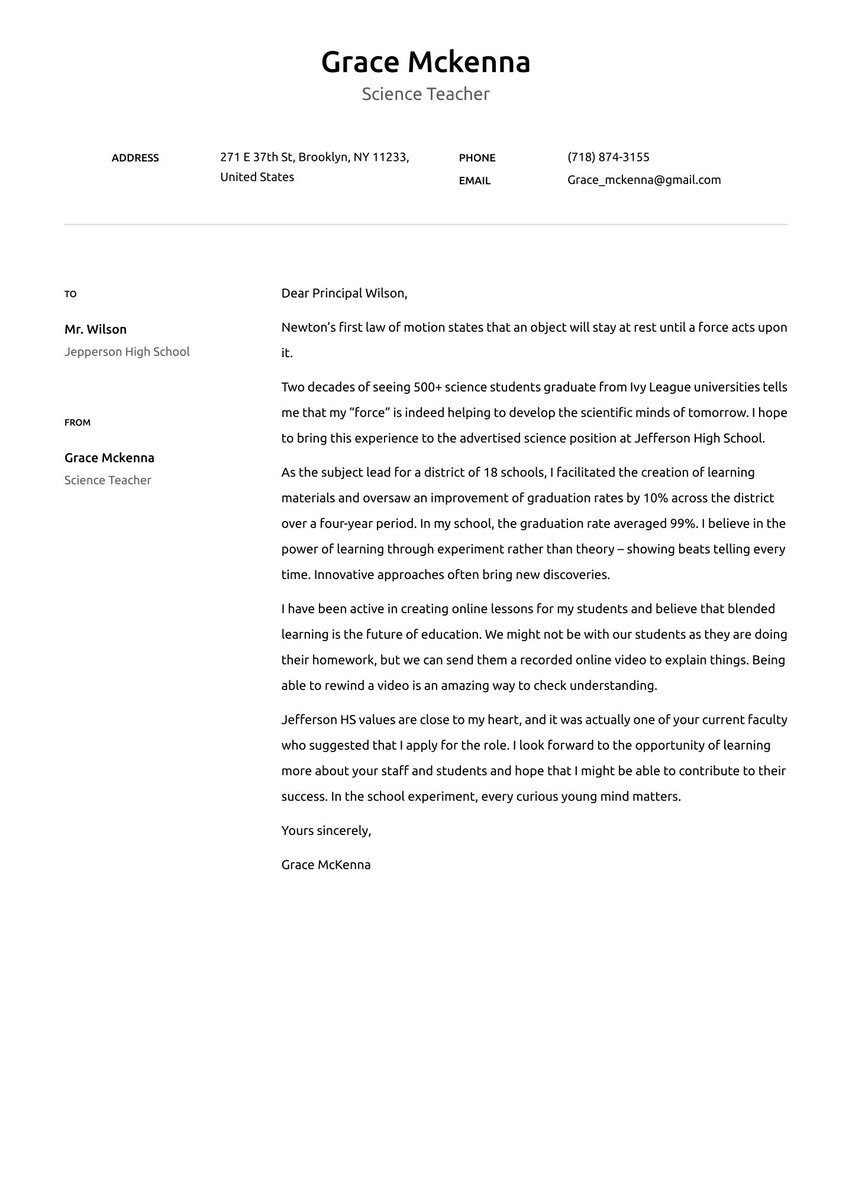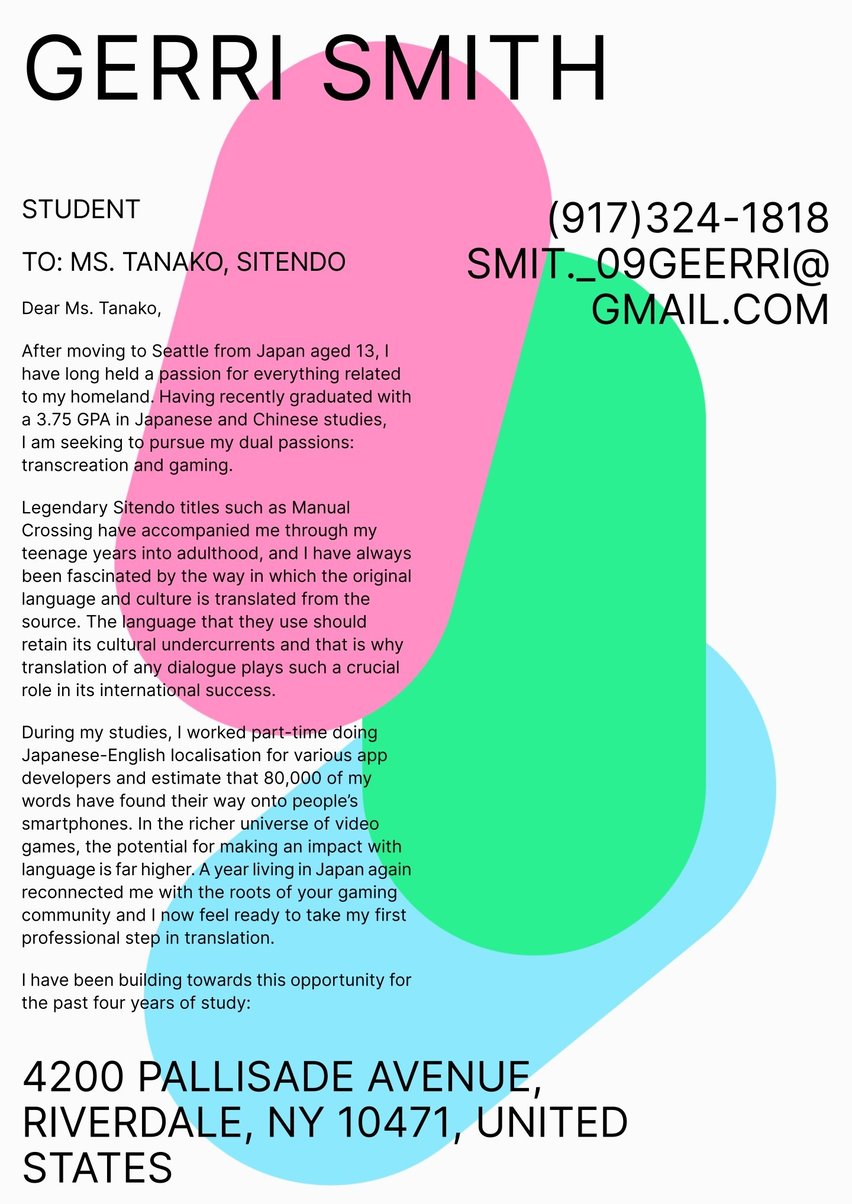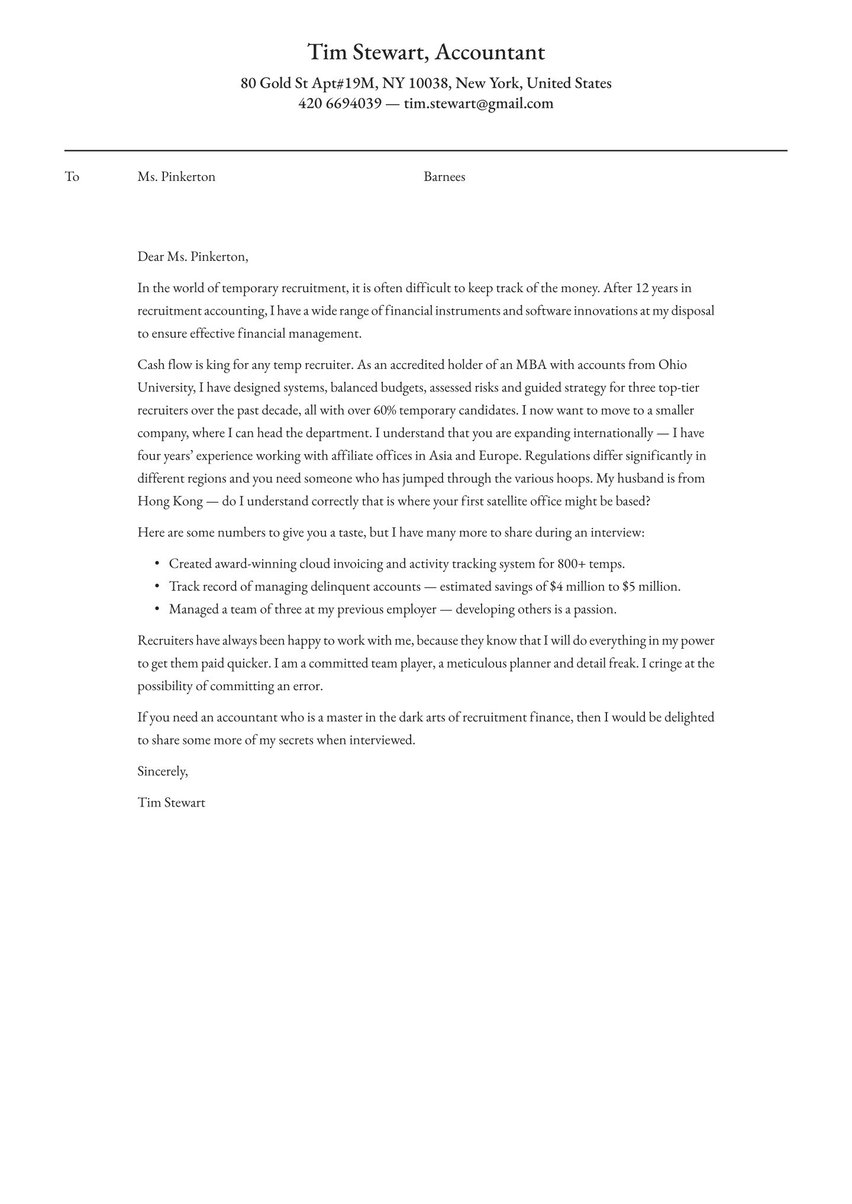


Paralegals are an increasingly important component of the legal landscape, playing a vital support role that decreases the workload of attorneys and increases efficiency in law offices. With the workforce demand for these professionals growing rapidly, an exceptional paralegal cover is essential to make your best job-winning case.
Related Cover Letter Examples
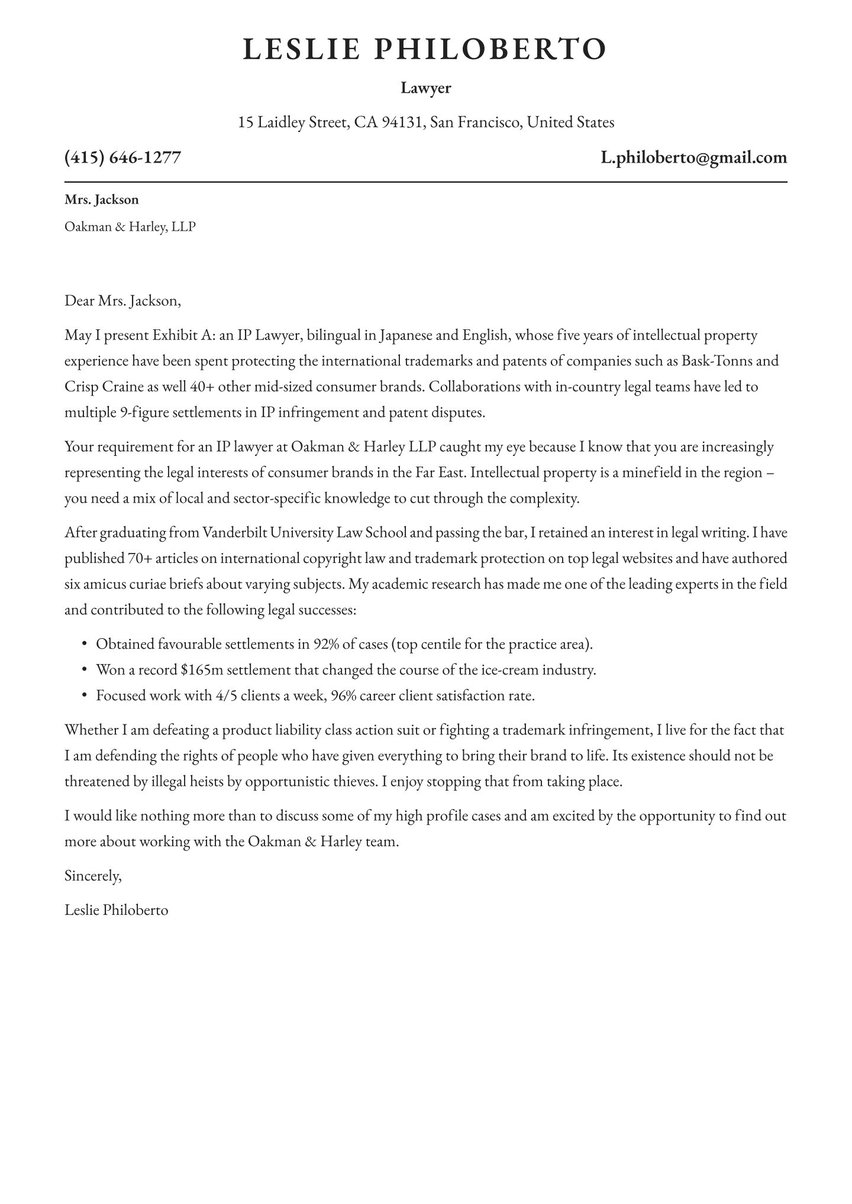
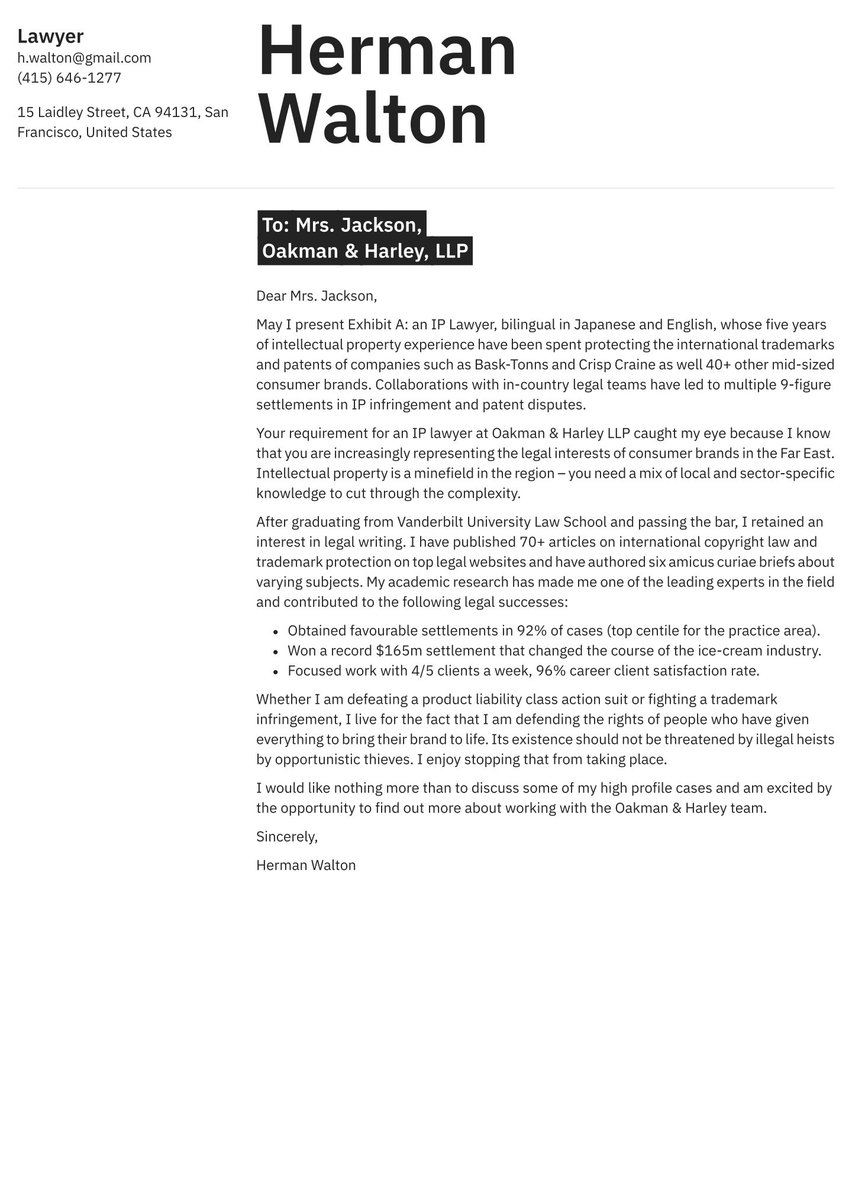
Lawyer cover letter example
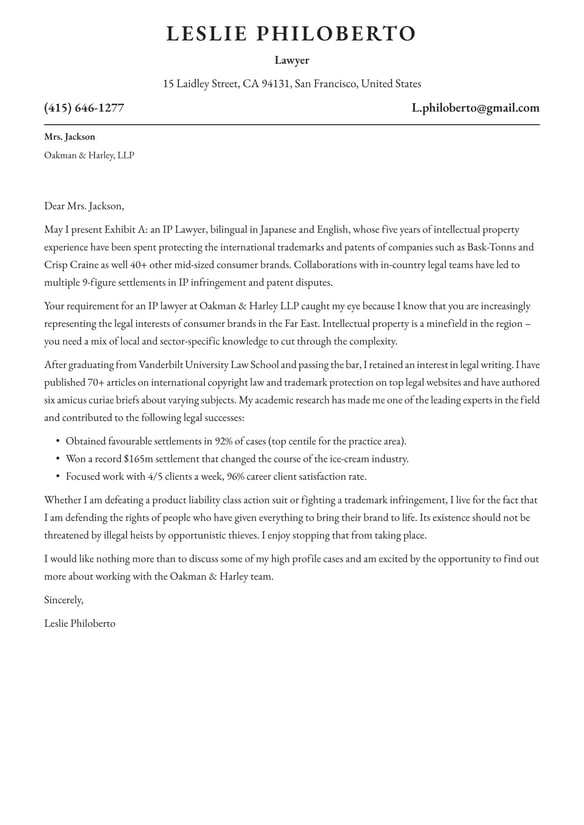
Tailored for lawyers, this polished template balances structure and white space to reflect professionalism and precision. Its clean header styling and formal tone emphasize your expertise, ensuring your achievements resonate with discerning legal recruiters.
Legal Assistant cover letter example
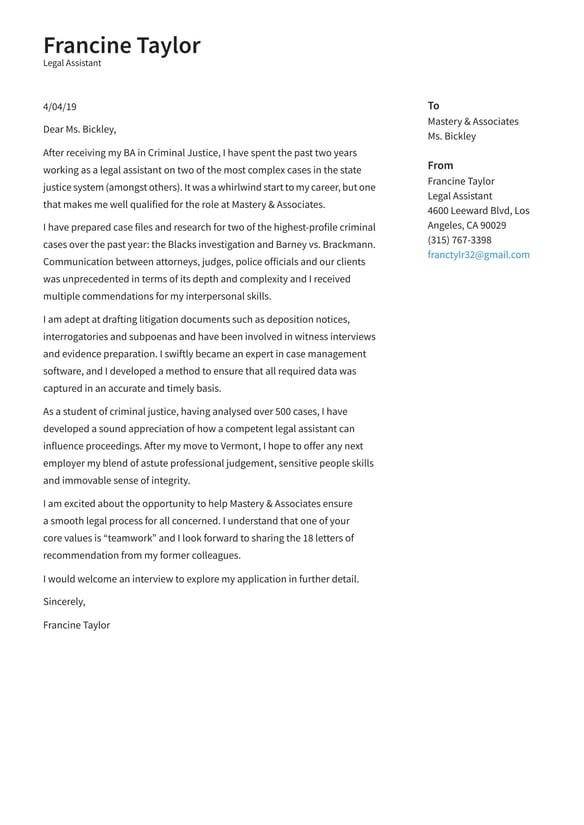
This polished, professional template features a clean structure and ample white space, ideal for Legal Assistant roles. Its balanced tone and organized layout highlight your precision, communication skills, and integrity, impressing attorneys and hiring managers alike.
Attorney cover letter example
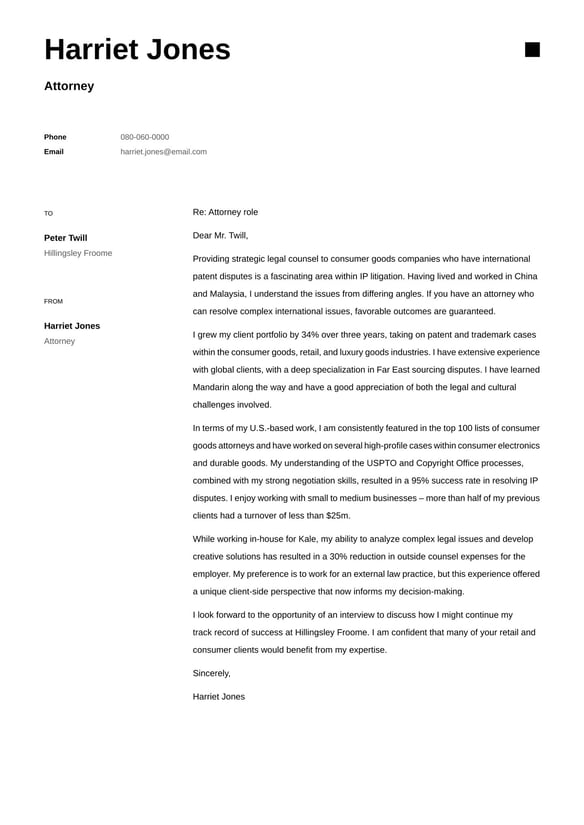
This sleek, professional template complements the precision and authority expected in attorney roles. Its clean structure and balanced white space highlight your expertise, while bold headers ensure your achievements resonate with discerning legal professionals.
Paralegals often generate billable hours, but they do so at a much lower rate than attorneys. This allows law firms to pass on lower costs to their clients, which in turn attracts more clients. The good news for paralegals is that the job outlook is outstanding.
According to the Bureau of Labor Statistics, employment of paralegals and legal assistants is expected to grow 10% between 2019 and 2029— roughly double the average for all professions.
For an irresistible pitch to get the job you want from all that are out there, you need a compelling paralegal cover letter, along with your resume. That’s where resume.io comes in — offering more than 125 occupation-specific writing guides and free cover letter examples. In addition, we offer formatting advice, plus field-tested templates and builder tools to help you create both resumes and cover letters.
In this guide, along with the corresponding cover letter example, we’ll give you step-by-instructions on how to write an outstanding cover letter for a position as a paralegal. What we’ll cover:
- The paralegal job role
- Why it’s critical to establish a personal connection with a cover letter
- How a cover letter should be structured and how to optimize the impact of each component: header, greeting, introduction, body and conclusion
- Writing psychology — how to trigger both rational and emotional responses in your reader
- How to avoid common mistakes that could send your cover letter to the trash

What does a paralegal do?
The qualifications to become a paralegal, while not carved in stone, usually include a combination of education, training, work experience and certification. Paralegals assist attorneys directly in preparing cases — doing, in the words of the American Bar Association, “substantive legal work for which a lawyer is responsible.”
There’s some confusion about the differences between legal secretaries, legal assistants and paralegals — and the definitions of these terms have been a state of flux.
- Legal secretaries tend to perform less specialized administrative tasks like word processing, filing, billing, office management and answering phones. However, legal secretaries today are commonly called legal assistants.
- Paralegals work more directly in support of attorneys, doing legal work including research, interviews with clients and case preparation. However, paralegals are also sometimes called legal assistants.
- In 2020, the American Bar Association changed its 1997 definition of “legal assistants” by replacing the word with “paralegals.” However, the ABA did not offer any new definition of “legal assistants,” leaving the term in limbo.
- The primary professional organization for paralegals in the U.S. is still called the National Association of Legal Assistants — although it refers to its members as paralegals.
- The Bureau of Labor Statistics has not caught up to the ABA’s definitions, treating the terms “legal assistant” and “paralegal” as synonymous, while specifying that this occupation “excludes legal secretaries.”
- Bottom line, be aware that not everyone agrees on what these terms mean, and you should strive for clarity in your job application to describe exactly what your skills and qualifications are.
Why do I need a paralegal cover letter?
The importance of a good paralegal cover letter
You’re well aware that lawyers often write letters. But maybe they don’t like to write letters, or they’re too busy, so what they’d REALLY like is an assistant to write their letters for him. As a paralegal, your cover letter is literally a demonstration of your ability to perform a basic function of the job you’re seeking. And it’s not just letters — paralegals may be called upon to draft legal briefs, case histories and summaries of case law. It’s a job that requires a buttoned-down mind, a talent for legal analysis and excellent writing abilities. Your cover letter is your way of demonstrating that you have all these qualifications.
Whether you’re a bricklayer or a barber, it’s always best to include a cover letter unless the job listing specifically instructs you not to. But for paralegals in particular, it should be considered an essential component of any job application.
The reason for a cover letter
The purpose of the cover letter is to establish a personal connection between yourself and the hiring manager at the firm where you want to work.
While your resume will cover much of the same ground as your cover letter, the resume is a much more impersonal document. The cover letter is a personal pitch that establishes a person-to-person connection — not with a resume intended for the entire world, but with a private conversation. It’s literally an appeal — you ARE asking for a job — but at the same time you are describing all of your experience and training for this job. You’re not talking about how you “deserve” a job, you’re talking about how your contribution could solve a potential employer’s problems.
In most cases, a cover letter should be one page containing 200 to 400 words. It should specify the job you’re looking for and describe your experience, skills and qualifications for that job.
These are your main objectives in writing this cover letter:
- To establish a personal dialogue with a potential employer
- To describe how your experience and skills make you an ideal candidate for the job
- To demonstrate by your letter that you have writing skills
- To close with a call to action looking forward to future contact
If anything in your cover letter isn’t accomplishing any of these goals, it probably needs to be cut. After learning in the following chapter what your cover letter should contain, go on a search-and-destroy mission to remove everything that doesn’t belong from your final version.
Best format for a paralegal cover letter: Structure and examples
Cover letters for paralegals, or pretty much any occupation, should follow the same basic structure:
- The cover letter header
- The greeting
- The introduction
- The letter body
- The conclusion
- The signature
Let’s take a look at each of them.
Cover letter header
The header is the space at the top of the letter that has your name, address, phone number and email. The contact info is crucial for obvious reasons — you don’t want to create any mysteries about who you are or how to contact you.
The name of the letter writer is often placed top and center in the largest text on the page. As well as displaying your confidence in yourself, this makes your name stand out and makes you more memorable. Always include your phone number and email. In some cases, a snail mail address may be unnecessary, but where you live may be relevant to the employer, so it’s usually best to include one.
Align document styles
Your cover letter and your resume should use the same fonts and formatting styles, giving them a matching look. In fact, you may want the header on your cover letter and resume to be identical.
Suppose the hiring manager prints out 10 resumes and 10 cover letters, but gets them all mixed up. He or she should be able to page through them and easily identify which resume goes with which cover letter because of their matching visual styles. Aligning your document styles shows that you pay attention to detail and you’re organized and sharp-minded — all of which are essential qualities in a paralegal.
Finally, the header should be attractively designed with an appropriate amount of white space within and below it. The rest of your letter will be solid black text divided into paragraphs, but the header is the one place that allows for some variation in style.
Goal of the cover letter header: Distinguish yourself from other job applicants with a visually attractive document that shows your regard for detail and professionalism.
Cover letter greeting
The introduction to your paralegal cover letter generally needs three words, like “Dear Mr. Bond:” or “Dear Ms. Moneypenny:”.
You may find this dreadfully formal in the age of email, with the “Mr.” and “Ms.” and the colon at the end. But for decades, this has been the preferred format for business letters, whereas friendly letters use first names and commas. It’s true that email has relaxed these rules considerably, especially in replacing the colon at the end with a comma. Even the once-universal “Dear” has fallen out of favor, replaced by “Hi,” “Hello,” “Greetings” or other variations.
But beware of being too informal: “Wassup James” is just not going to work in a job application letter written to someone you don’t know. As a paralegal, bear in mind that writing formal letters is part of the job description, and you need to demonstrate that you have mastered the style.
It’s almost always best to address an individual by name in a cover letter. People like seeing their own names, and it’s another sign of your attention to detail that you’ve gone to the trouble of finding out who makes the hiring decisions. Also, a letter written to a named individual is more likely to get a reply. If a letter is written to an entire company or a department within the company, any of the recipients may feel that it’s somebody else’s job to reply. But if you address an individual by name, it suggests that you would like the courtesy of a reply.
If you’re responding to a job listing with no information about whom to write to, it may be worth calling the company to find out. Or the person’s name may be Robin, Dale or Jordan, and you need to know if that’s a “Mr.” or a “Ms.” However, some hiring managers deliberately obscure their names, wishing to remain anonymous for whatever reason. In such cases, they might find it troubling if you’ve gone to stalker-ish lengths to learn their identities, and you may have no choice but to address your email to an entire law firm or an anonymous hiring manager.
Goal of the cover letter greeting: Start off on a professional note by making a direct personal connection with the employer, using the recipient’s name if possible.
Cover letter introduction
The introduction to your paralegal cover letter should generally be one or two provocative sentences that identify the job you’re seeking and quickly highlight your qualifications for it.
With seven years of experience at a top law firm in Miami, I believe I would be an excellent candidate to provide dedicated, professional support to your attorneys as a senior paralegal.
“I am writing to….”
“This letter is in regard to….”
“Thank you for the opportunity to apply for….”
You don’t need to say you are writing — your recipients know you’re writing because they’re reading your letter right now. You don’t need to mention the letter itself. And the “thank you” opening presumes that the employer has extended some special invitation to you to apply for this job, which it hasn’t.
The introduction to your letter should be an attention-grabbing appeal written in an appropriate tone. It should never be bland or boring, nor should it be written in a tone that makes you look arrogant or presumptive.
Goal of the cover letter introduction: Capture the attention of hiring managers with a preview of your qualifications that intrigues them enough to read more.
Cover letter body
This is the heart of your letter, usually two or three paragraphs, and it’s where you must make your primary pitch.
The body of a cover letter is the place to reference your relevant work experience, job skills and other qualifications, and for paralegals this would certainly include any certifications in the field. Examine your record, relive your victories and highlight your achievements. Be as specific as possible in reporting your accomplishments, ideally using facts and figures. How many cases have you handled in your experience as a paralegal? How many briefs have you written? What was the dollar value to your firm of the clients you represented?
Is there one anecdote from your career that illustrates how you brought game-changing skills to the table to make the difference between winning and losing a case? Everybody loves a good story. What if you’re in the unhappy position of having little or no work experience? Maybe you still haven’t graduated from college, or maybe you’re changing careers. In such cases, you might shift your focus to your education and credentials, while also mentioning any internships, volunteer work or other relevant experience.
Finally, in addition to covering your past achievements, the body of the cover letter should highlight your skills, passions and long suits. Remember that you are not trying to convince anyone that you deserve a job. You are trying to convince people that hiring you will help solve their problems and will make them a stronger company.
Goal of the cover letter body: Highlight your most relevant accomplishments in a way that convinces the employer you will contribute to the firm's future success if hired.
Cover letter conclusion and signature
Your final paragraph should be both a summary of your pitch and a call to action.
“Would it be OK if I call you next week to discuss this further?”
“Would you have time to schedule an interview with me?”
“I know you are busy, but I look forward to hearing from you soon.”
The last thing you want your correspondent to do is set your letter aside and never look at it again. Your close should imprint the idea on the recipient of your letter that s/he should respond in some way.
Goal of the cover letter closing: End on a positive, self-assured note with a call to action that suggests you expect a response, and ideally, an interview.
The psychology of writing a paralegal cover letter
Never forget that you are writing this letter to a human being. And human beings have both hearts and heads — they function on a rational as well as an emotional level.
Don’t overlook the emotional aspect of the human psyche, and don’t be afraid to use language meant to trigger a response that comes more from the heart than the head.
I am often oddly thrilled to be presented with a complex, messy case that has no easy answers. I enjoy wading into its murky waters and finding the facts that will make the case for my clients. I derive satisfaction from bringing order to chaos.
This is very personal language — “thrilled,” “enjoy,” “my clients,” “derive satisfaction”— yet at the same time it may describe the very talents an employer is looking for.
Psychology is the art and science of trying to understand what is in other people’s heads. What are their problems, what are their needs, what are their concerns?
Finding the right tone
Most of the entities that employ paralegals have a distinctive voice, a tone that sets them apart, a verbal signature. For example, there is the “Better Call Saul” style of bus-bench advertising — “You don’t pay unless we win!” And there is a more sophisticated, more understated style at top law firms that may represent large corporations or high-profile individuals.
Do your homework. Study how your prospective employers talk, and talk to them in a language they understand.
Common cover letter mistakes: A few don’ts
Here are some of the common mistakes people make in writing cover letters:
- Language mistakes. The most common misstep in a cover letter or resume is bad spelling, grammar, punctuation or capitalization. Reread your letter again and again before you send it off. Correct English is not optional. If your letter contains simple errors that anyone could spot, it’s probably dead on arrival.
- Copy-and-paste letters. If your strategy is to send the exact same cover letter to 500 potential employers, then you can confidently expect that this exercise will result in zero jobs.
- Word bloat and clichés. Have you mentioned that you’re a “self-starter” and a “team player”? Have you mentioned that you work well with others or alone? Eradicate these timeworn phrases from your letter and tell us something we haven’t heard before. Also, delete any irrelevant information and focus on describing how you can help this company work faster, better and cheaper.
- Formatting fails. Do not use exotic fonts or splashy colors, and avoid anything that looks “gimmicky.” And beware of saving your document in a file format that your recipients may not even be able to open — or they may be able to open it, but the text jumps all over the place and looks terrible on their screen. Using a professional cover letter template eliminates the guesswork and can save you time and hassle for high-quality results.
Key takeaways for a paralegal cover letter
- The job outlook for paralegals is excellent, with 10% job growth expected between 2019 and 2029. Your path to getting the right job for you starts with an excellent resume and cover letter.
- Your cover letter is literally a demonstration of your ability to do a key part of the job, so it needs to reflect your familiarity with formal business-letter style.
- The cover letter should include a header, greeting, introduction, body, conclusion and signature. Understand the purpose of each of these sections and write them accordingly.
- Remember that your recipient is a human being, and your goal is to establish a person-to-person connection, so use a combination of rational and emotional language to trigger a personal response.
- Avoid English mistakes, clichés, irrelevant info and formatting fails.
Your best bet for circumventing any of these traps and keeping your letter on point is to use the field-tested templates and professional guidance at resume.io.
You are an expert in your field — now let us help you get the job you deserve. Get started with resume.io!
For additional inspiration, you can check out our related cover letter examples in the legal category:
Legal assistant
Lawyer
You may find more ideas in these administrative cover letter examples:
Administrative officer
Personal assistant
Administrative assistant