


We surveyed 1,000 workers to reveal the extent of workplace nepotism in the U.S. today: where it happens the most, who it benefits, and how employees feel about it.
According to Merriam-Webster, a nepo baby is “a person who gains success or opportunities through familial connections, especially a child of a famous parent (such as an actor, musician, entrepreneur, or politician).”
Alright, we’ve all heard of Hollywood “nepo babies,” but just how common are family hires in day-to-day life?
What we analyzed
To find out how workers feel about nepotism in 2025, we asked 1,000 working adults in the U.S. about how they define it, whether they’ve seen it in action, and what they believe its consequences are for fairness and workplace culture. Responses were broken down by different demographics, such as age, gender, and location, to uncover trends and disparities.
What we discovered
Our findings paint a clear picture: nepotism is widespread, influential, and far more visible to workers than employers might think. In fact, 401 in 1,000 respondents stated they have been hired at the same company as a relative at least once.
But despite family connections being the key to getting a foot in the door for some, about 54% say nepotism has a negative impact across nearly all aspects of the workplace, from team morale and DEI to productivity and innovation.
This doesn’t paint a pretty picture, especially with 42.1% saying nepotism is quite usual in the U.S. workforce and 27.5% claiming it’s extremely prevalent across the whole state.
Key findings
- Nearly 70% believe nepotism is widespread in the U.S. workforce
- 4 in 10 have been hired at the same company as a relative
- 5 in 10 say they’ve lost out on a job opportunity to a “nepo baby” colleague
- Men spot nepotism easily than women
- 72% believe that “it’s who you know” is a key hiring influence
- In their current workplace, 54.1% of employees know of colleagues hired through family ties, while a 24.7% of them suspect it happens quietly
- 54% believe nepotism has a negative impact on almost every aspect of the workplace
Family-ties and relatives call the shots when it comes to hiring
4 in 10 have landed a job where a relative was already employed, showing that family ties still play a significant role in how people get hired. The connections usually come from closest family moms (11.3%), dads (8.1%), and siblings (15.2% combined). 45% said they’ve missed out on a job or promotion because it went to someone with family connections (both on current or previous jobs).
When asked how they (the ones hired from their own talents) should approach these unpleasantries, Amanda Augustine, career expert at resume.io, said, “Focus on your own performance. You can’t control how someone got their foot in the door, but you can control the value you bring to the organization. If favoritism starts affecting your work or the team dynamics, document your concerns and tactfully raise them with your manager or HR department.”
Men are more likely to spot nepotism at work than women
Nepotism is more visible to men than women in the workplace: over 60% of men report at least one colleague hired through family connections, compared with just over half of women. Among both genders, a notable share either see no evidence of family hires (around 20–22%) or are unsure (18–30%).
More than 70% believe landing a job is all about who you know, across all generations
Getting a job should be about skills, right? In reality, nearly three in four U.S. workers say connections matter most, and about a quarter are fully convinced of it. Gen Z leads the group, with 76.78% agreeing, followed closely by Millennials at 74.15% and Gen X at 71.18%. Even among Baby Boomers, two-thirds (67.67%) say “who you know” plays a major role. Across the board, only a small minority disagrees.
Nepotism or not?
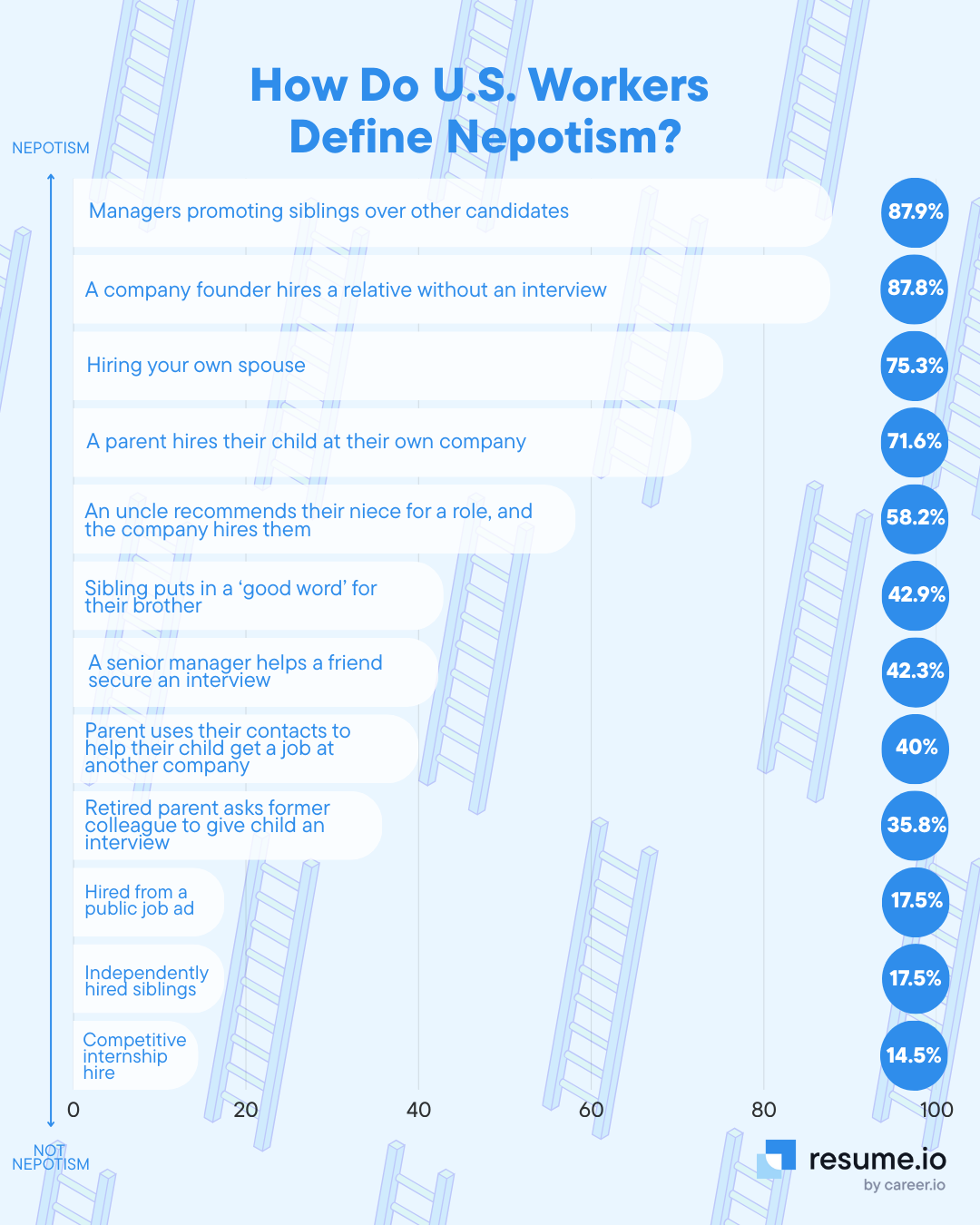
When asked whether certain scenarios counted as nepotism, respondents showed high sensitivity to family hires.
How common is nepotism inside today’s workplaces?
More than 50% of U.S. workers say they’ve got colleagues who landed jobs through family ties, and for some, it’s more than one person. Only 1 in 5 think nepotism doesn’t exist at their workplace, and 24.7% aren’t sure, showing just how quietly it operates.
Even though respondents stated that 70% of these family hires are considered a good fit for their roles, favoritism still raises concerns and affects workplace trust. However, nearly 30% say these hires wouldn’t have made it without their connections.
Where does nepotism create the biggest advantage?
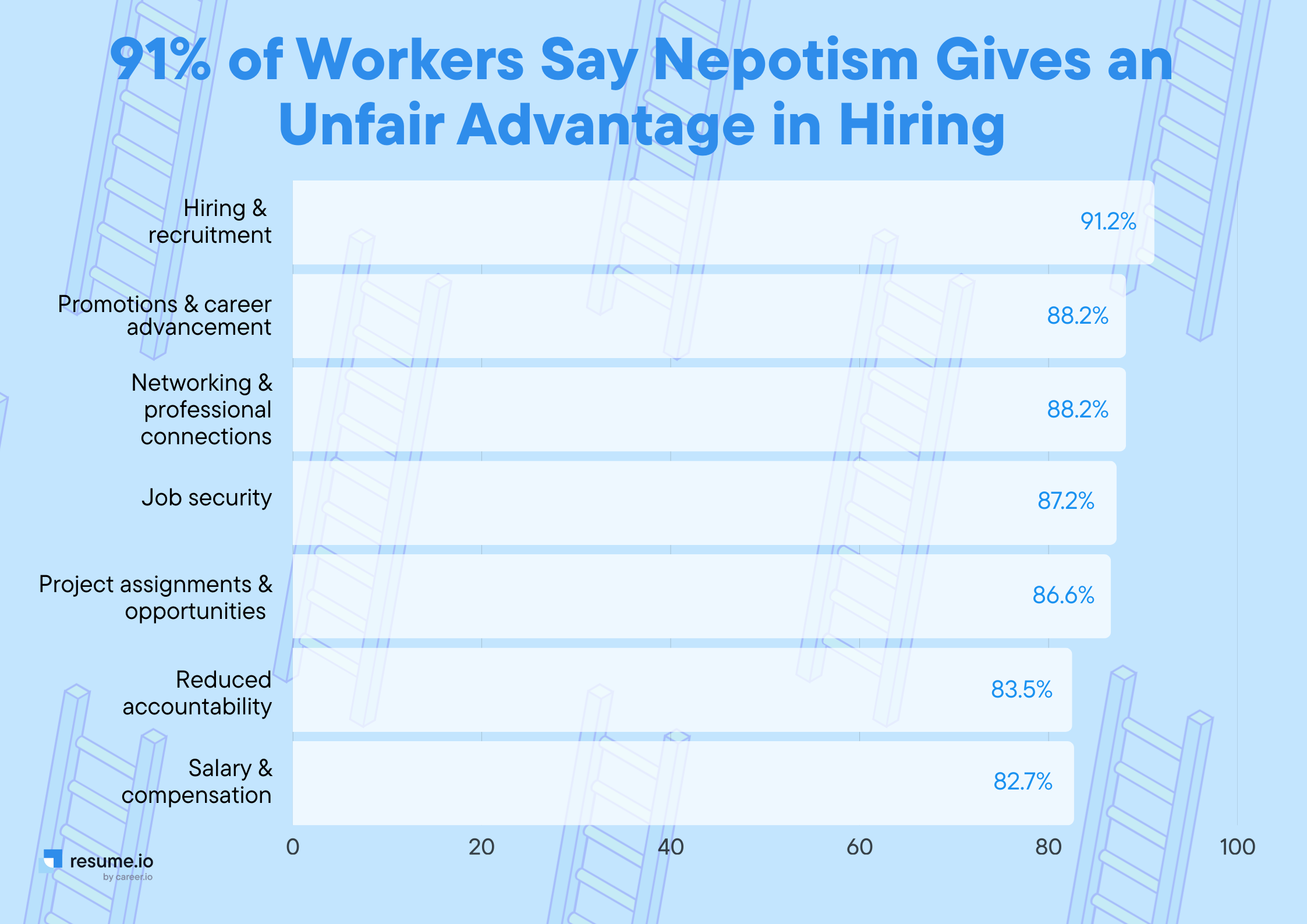
We asked workers how they see nepotism in 2025, from spotting it in the workplace to its impact on fairness, opportunities, and company culture. While responses varied in degree, nearly everyone agreed it gives an advantage.
According to our survey, employees agreed (to some level) that nepotism gives advantages in these areas:
What Nepotism does to a workplace
Employees report it drags down team morale (61%), shakes trust in leadership (62%), and damages diversity and promotion (61%). More than half of US employees said it has an impact on productivity, innovation, and succession planning, while 60.2% said it harms the company's internal and public reputation.
In short, favoritism does more than just help some people advance; it also changes how everyone experiences work, often for the worse.
Amanda Augustine, career expert at resume.io, said, “When employees believe that hiring decisions or promotions are based on family ties rather than one’s merit, it can undermine the organization. Over time, this can hurt employee engagement, team morale, and even retention. Employers need to demonstrate to their teams that opportunities are earned, not handed down, which is why most candidates benefit more from professional advocates than family members trying to open doors for them.”
Family connections help, but your resume tells the story
When asked if there’s a ‘right way’ to leverage family connections but without harming your own credibility, Amanda Augustine, career expert at resume.io, said, “It’s fine to have a relative pass your application along so it reaches the hiring manager; that’s no different than asking a friend or colleague to do the same. But from there, it’s on you to build rapport, show genuine interest, and prove your qualifications. And a key part of proving your value is presenting a well-crafted, professional resume that highlights your strengths and helps you stand out from the start."
Methodology
Online survey of 1,000 U.S. workers aged 18+, conducted by Pollfish for resume.io in November 2025. Respondents represented diverse demographics across age, gender, location, ethnicity, income, and company size and type.
Data recorded: November, 2025


