

Our nationwide survey uncovered a surprisingly sentimental streak, with most respondents choosing roles that made everyday life feel more human.
It’s a snapshot of a country quietly craving the small connections, slower pace, and analog charm that once filled a workday.
Key findings
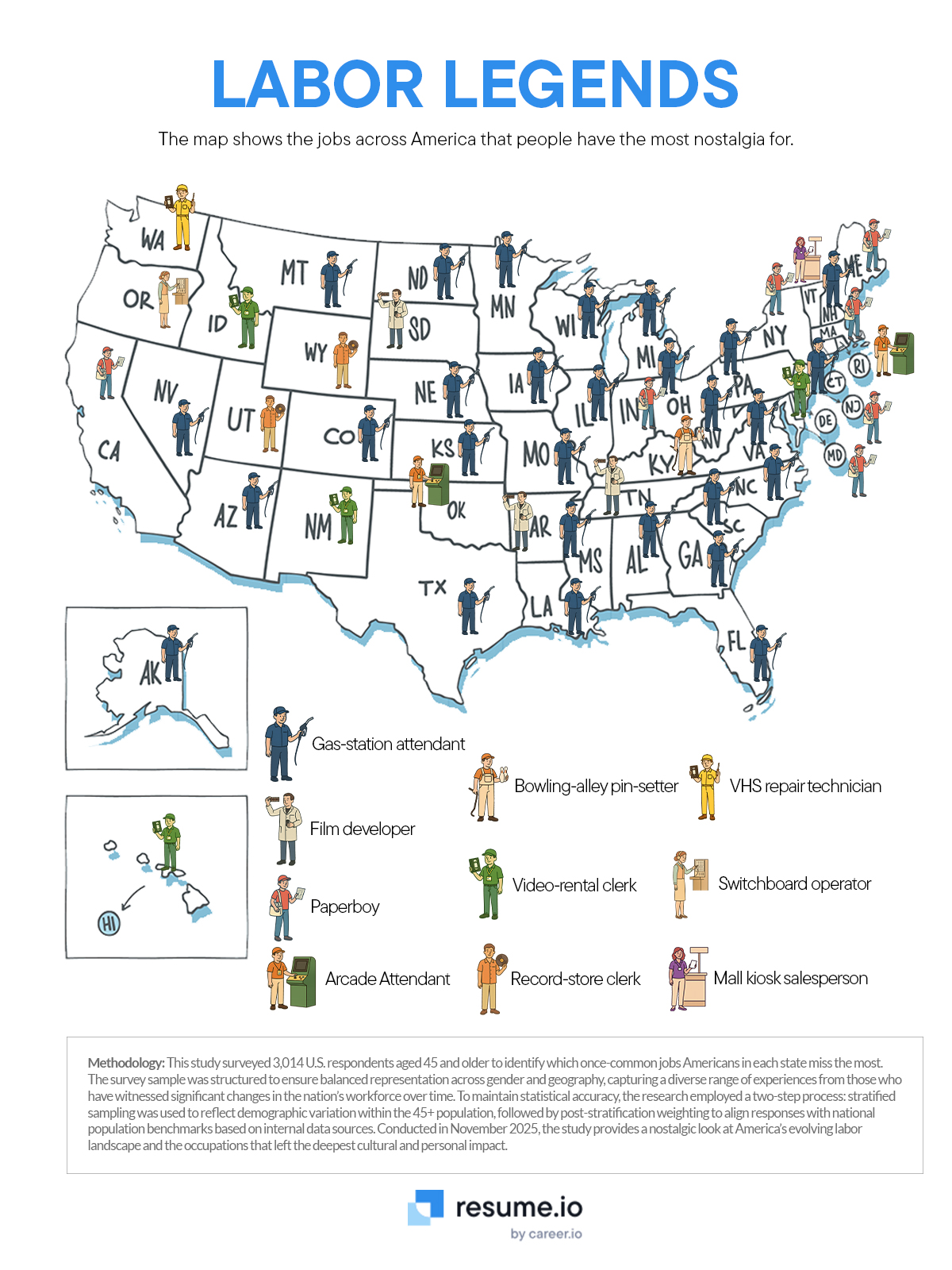
Gas-station attendants are the most missed profession
From Alabama to Alaska, the gas-station attendant is the most missed. Thirty-plus states picked it as the job they miss most — a clear sign that Americans are nostalgic for a time when customer service involved eye contact instead of a card reader.
For many, it wasn’t just about topping off the tank — it was about someone remembering your name, your car, and maybe your preferred brand of gum.
A pocket of paperboy nostalgia in the Northeast
The paperboy is the most missed in states like California, Indiana, Maryland, Massachusetts, New Jersey, and New York — all places where dense neighborhoods once relied on a daily doorstep ritual.
The paper route wasn’t just work — it was many people’s first lesson in responsibility (and entrepreneurship) before the internet replaced it with side hustles and delivery apps.
Film developers are missing in small-town America
Film developers were chosen in Arkansas, Tennessee, and South Dakota — reminders that some parts of the country still have a soft spot for tangible memories.
The slow wait for photos to develop, the smell of chemicals, the thrill of seeing what turned out — it all suggests a craving for patience in a world that now delivers everything instantly.
Nostalgia for retro entertainment
Video-rental clerks were most missed in states such as Delaware, Hawaii, Idaho, and New Mexico — a tribute to the Blockbuster era when browsing the shelves was half the fun.
Patterns of personality across regions
It’s no coincidence that service-oriented jobs dominate the South and Midwest — the very regions most associated with friendliness and conversation.
Meanwhile, creative and entertainment-driven roles cluster in the West, where culture and individuality tend to take center stage.
Meanwhile, our research also revealed nostalgia for office life before the internet:
The office relics people remember most…
When people think back to office life before everything went digital, it’s the small sensory details that come up first. The clatter of a typewriter, the warm chemical smell of fresh photocopies, even the stubborn whine of a fax machine — all of these scored far higher than you might expect. They weren’t just tools; they helped set the rhythm of a workday in a way modern apps simply don’t.
The retro office gadgets people would bring back…
Interestingly, a large share of respondents said they would happily revisit some of the old equipment for a week, just for the novelty. Typewriters and pagers were the standout favorites — partly for the nostalgia, partly for the simplicity. Others picked the overhead projector or the classic in-tray/out-tray setup, both reminders of a time when meetings and workloads were a little more tactile and a lot less cluttered.
The office eras Americans miss most…
Respondents were asked which decade of working life they would most want to return to, and the 1980s were the clear winner. Respondents spoke fondly of the energy and ambition of that era — big ideas, big hair, and even bigger briefcases. The 1950s, 70s, and 90s also had their loyalists, each remembered for its own flavour of structure, solidarity, or early tech curiosity.
Final thoughts
The disappeared jobs that Americans have most nostalgia for, from the humble gas-station attendant to the video-rental clerks, are missed for the kind of everyday human exchange that they offered customers: the quick chat, the personal touch, the sense that someone cared enough to ask how your day was.
In an economy now obsessed with AI productivity, it is clear from our research that people miss the moment of connection that came with these roles.


