

Dynamic Executive with six years of experience helping organizations reach their full potential. Adept in making key decisions and working with other professionals to achieve goals and solve problems. Experienced in managing employee and community programs, and dedicated to successfully directing business operations.
01/2013 - 09/2019, Senior Sales Executive, Pitney Bowes, Stamford
- Demonstrate proven success by achieving or exceeding 100% of the total sales quota.
- Generate new business opportunities and work to maintain excellent relationships with current customers.
- Partner with dedicated product specialist resources to ensure complete territory and account coverage.
- Engage in effective cross-selling to fully penetrate sales opportunities with both existing and prospect accounts.
- Leverage resources to assist in making new customer contacts.
- Provide accurate forecasts of sales results.
- Support clients with technical resources, continually adding to success in sales.
- Effectively negotiate and close large business transactions.
- Successfully assist with the management of a multi-million dollar franchise.
- Help to oversee software transactions and solutions.
03/2010 - 01/2013, Junior Sales Executive, Pitney Bowes, Stamford
- Managed projects which resulted in the substantial reduction of global risks and an increase in total revenue.
- Saw a 40% increase in sales during my three year position.
- Effectively coordinated a robust sales pipeline and create a strategic plan to achieve goals.
- Utilized a variety of communication tools to engage with clients, prospective clients, and with other Pitney Bowes resources.
- Successfully employed Customer Relationship Management (CRM) tools.
- Assisted with providing accurate geographic data to make smarter business decisions and lead projects to their fulfillment.
- Worked well independently, as well as with colleagues to meet goals.
09/2003 - 05/2007, Bachelor of Finance, Boston College, Boston
- German
- French
- English
- Leadership Skills
- Complex Problem Solving
- Digital Advertising
- Knowledge of CRM systems
- Interpersonal Communication Skills
Executives are the decision-making body of any company. No matter what their functional responsibility, their leadership decisions can make or break everything. They hold the fate of their people in their hands. Brilliant executives build companies up, but poor executives can destroy them. This resume guide seeks to explore how a resume of an executive might stand out from the crowd of “leaders” who assume the grandiose title just because they manage a couple of people. Whether you are a CEO, COO, CFO or CTO (amongst others), the role of an executive is pivotal in any company. True leaders let their behavior and decisions do the talking, and it is crucial to illustrate exactly this in an executive resume.
.jpg)

.jpg)
Related Resume Examples
Sales Manager resume example
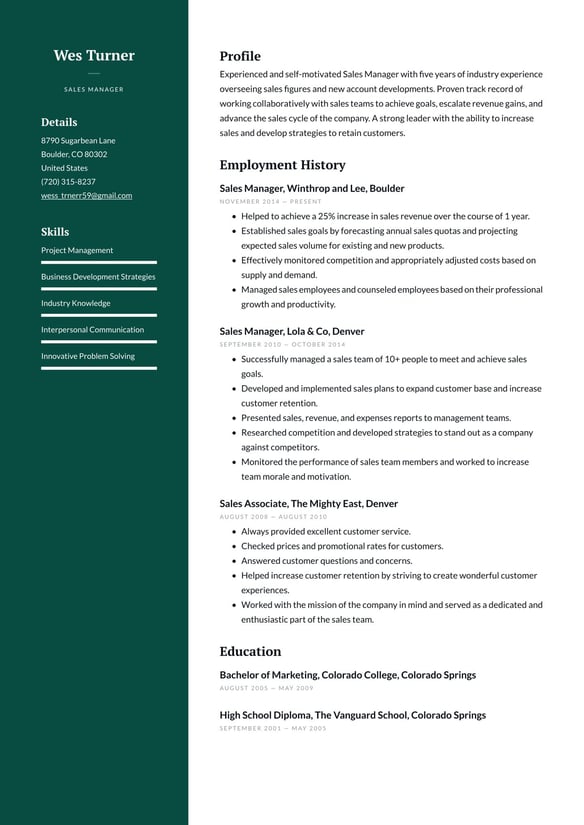
Aligned with the dynamic demands of sales leadership, this sleek, results-driven template spotlights your achievements and strategies as a Sales Manager. Its clean layout and bold headers amplify your expertise, inspiring confidence in hiring managers.
Program Manager resume example
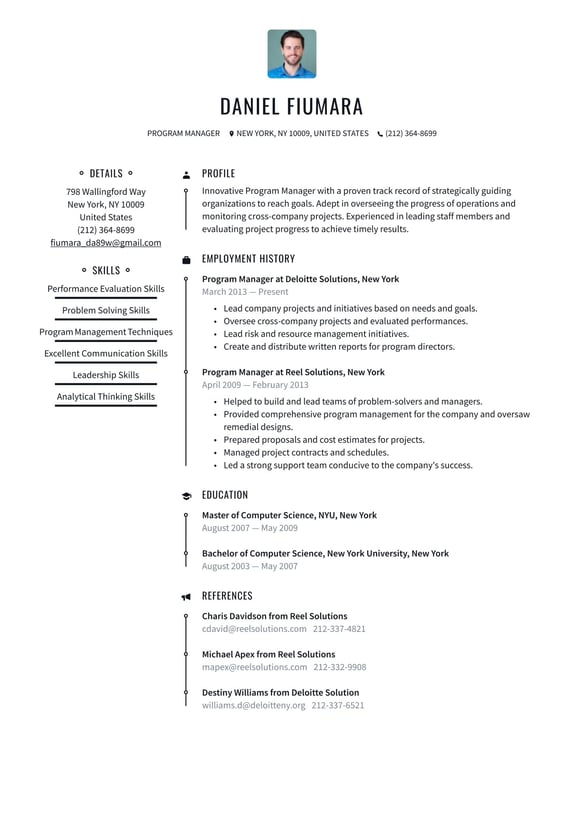
Targeted at Program Managers, this sleek, structured layout highlights leadership and strategic skills with clean sections and subtle accents. Its organized design showcases your expertise in program oversight, appealing to decision-makers and hiring teams.
Executive Assistant resume example
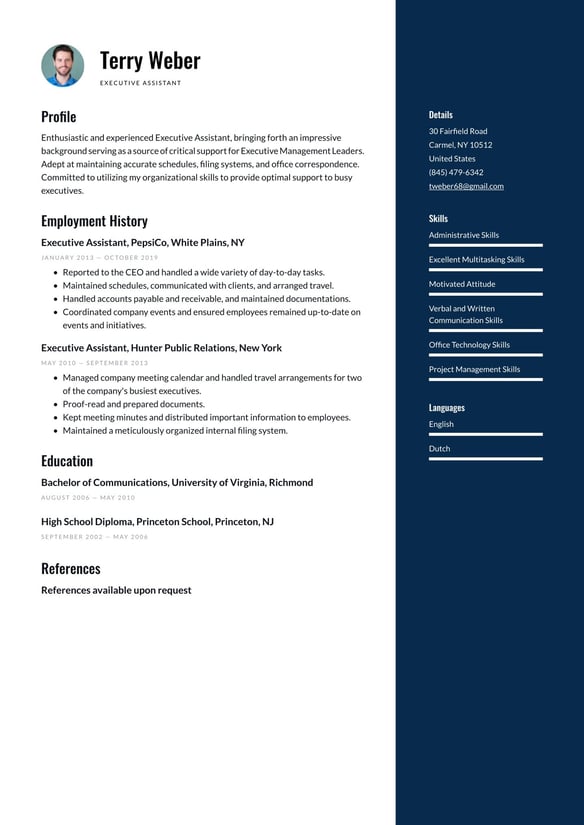
Crafted for Executive Assistants, this polished, organized layout highlights your multitasking prowess and communication skills. Its clean structure and subtle accents showcase professionalism, ensuring your expertise shines for executive-level stakeholders and decision-makers.
Operations Manager resume example
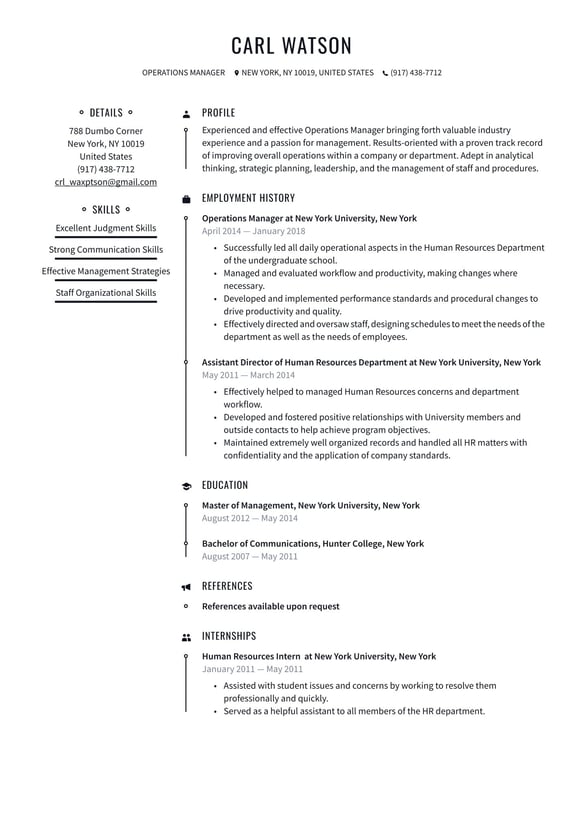
Aligned with the precision and leadership required for Operations Manager roles, this template’s clean layout and structured sections spotlight your strategic planning, analytical thinking, and leadership skills. Its professional design builds trust with decision-makers.
Business Development Manager resume example
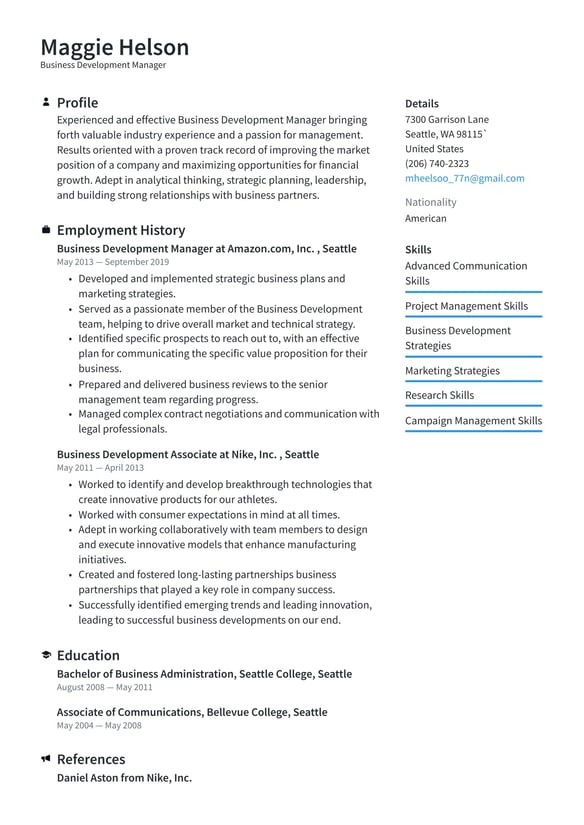
Designed for ambitious professionals, this sleek, modern layout spotlights your strategic thinking and leadership skills as a Business Development Manager. Its clean structure highlights achievements, helping you build trust with decision-makers and partners effortlessly.
IT Director resume example
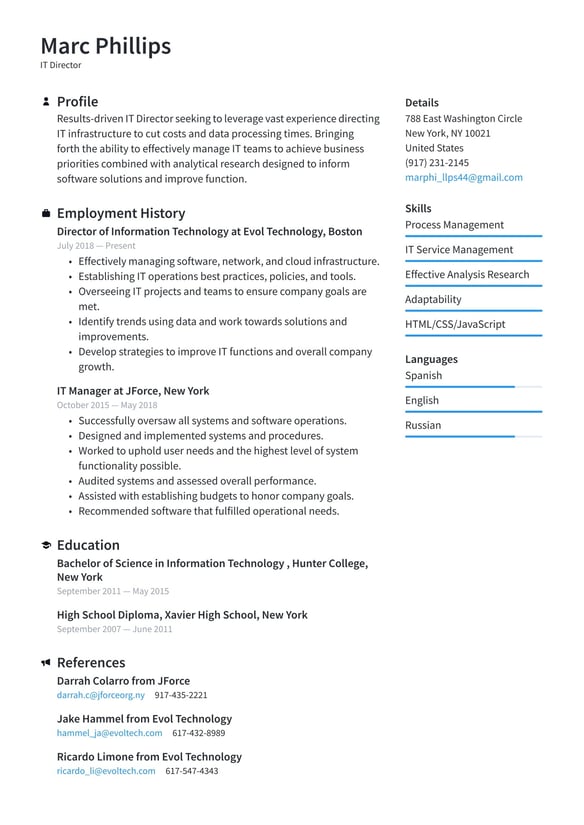
Optimized for IT Directors, this sleek, structured layout highlights leadership, technical expertise, and strategic vision. Its clean design emphasizes achievements and skills, helping you confidently showcase your ability to drive innovation and business growth.
Managing Director resume example
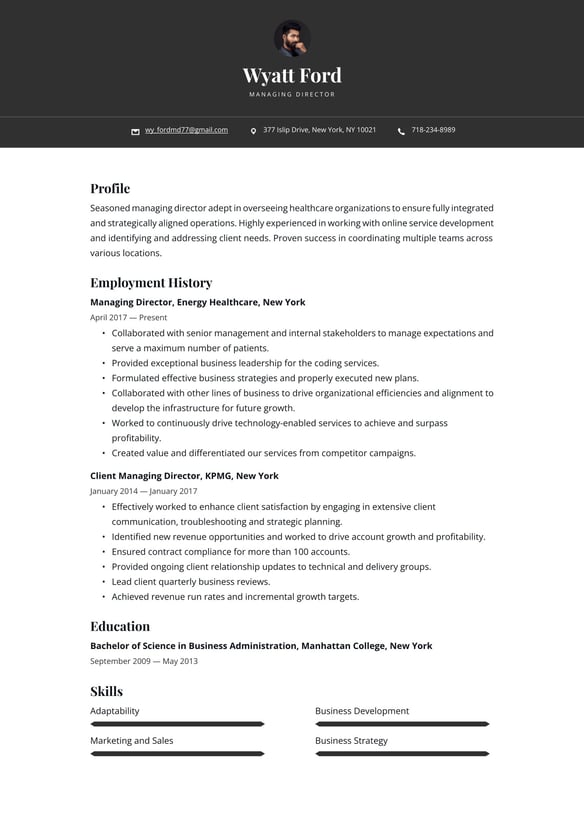
Focused on clean, professional lines and a balanced layout, this template highlights your strategic leadership and business acumen as a Managing Director. Its structured sections showcase achievements and skills, impressing senior stakeholders and decision-makers.
Chief Operating Officer resume example
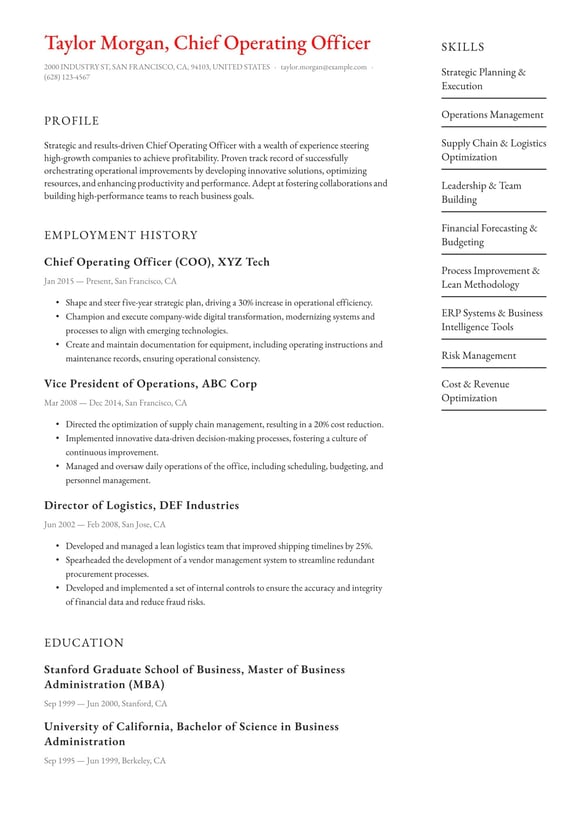
Aligned with the strategic mindset of a Chief Operating Officer, this template’s clean, executive layout highlights leadership, operational expertise, and results-driven achievements. Its structured design emphasizes your impact, inspiring confidence in stakeholders and boards alike.
Marketing Director resume example
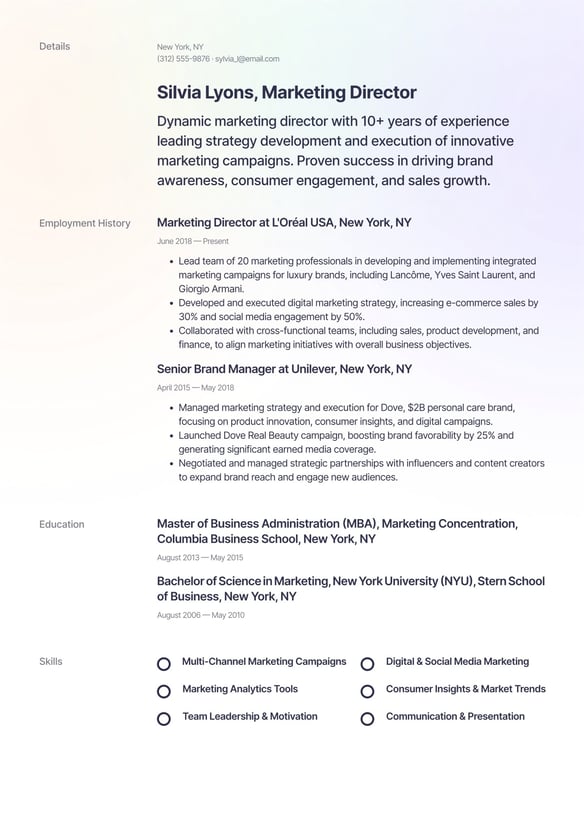
Aligned with the dynamic demands of marketing leadership, this sleek, modern template spotlights your strategic vision and creativity as a Marketing Director. Its clean layout and bold headers emphasize achievements, inspiring confidence in executive-level audiences.
When you are right at the top of any company hierarchy, it is natural to expect that you have experienced some stunning successes (and a fair few devastating failures) along the way. The secret of a great executive resume is not only to explore how you hit the highs, but also how you dealt with the lows. The person reading your resume wants to see someone who can handle all the realities of corporate life, someone who is prepared to make the tough decisions and someone who is willing to make mistakes and move on from them. An executive that does not push themselves hard enough is an executive who is always wondering what might have been. No one wants to work with (and for) a leader who doesn’t aim for the stars. Each executive role might have different functional responsibilities, but in this resume guide we want to explore what it means to be an executive in broader terms. A CFO will focus on finance and a CTO will focus on the tech, but they will share a significant number of behaviors and approaches that will make them effective. Everyone is different and there will naturally be countless versions of this ideal executive “recipe,” but the basic ingredients will all be there in differing qualities. So much is written about leadership and management in various online articles, but how can you distil the best advice to create the most compelling resume? This guide will show you how to:
- Write an executive resume that sets out the recipe for your leadership secret sauce.
- Explore your functional and industry expertise and set yourself apart from your peers.
- Ensure that the basics are ticked to get you past the ATS keyword test.
- Help you to create a curiosity in the reader and a desire to have you on their team.
Along with our sample resumes and builder tool, we will help you to show just how good you are.
The Executive job role and market

In a world of work where we are all doing ever more specialist roles, an executive might focus on a certain functional area (people or finance, for example) but they have to have a deep affinity for all sorts of more general business skills. CFOs and COOs need to be able to negotiate, present, problem solve and budget. CTOs and CHROs need to plan, communicate, develop strategy and influence others. CEOs and CPOs need to manage, deal with customers, design processes and purchase services.
In fact, they all need to be able to do all these things as part of their work. The generalist skills of an executive are wide-ranging and will to a large extent dictate their success. A CTO who is an expert in technology but who has no influencing skills will never get any projects approved. A CEO who is a great leader of people but who has no financial acumen will be easily led up the garden path by his finance team. A COO who possesses brilliant organizational skills but can’t negotiate with suppliers will find their bottom line eroded horrendously.
A great executive is a great executive for many for reasons other than their functional competencies. That is not to say that an executive’s resume should not include a great deal of their functional experience – of course, it should, but given the differing functional challenges that they will face in their new employment, the behaviours that they highlight will be equally of interest. Moreover, the behaviours of an executive do not only impact their immediate work. Their teams will take their lead from the leaders within the business – the culture is easily impacted by a new executive coming into the role, potentially either positively or negatively. Therefore, an executive hire is one of the most important strategic decisions that an employer will make. Their resume will be painstakingly analysed by a whole host of stakeholders and as many of them may only get a limited time with potential candidates (in a panel interview or a brief skype chat), the resume will remain a vital document in terms of forming a definite impression.
Looking for more tips and showcases of how similar resumes are written, see our related business & management resume examples:
- Chief officer executive resume example
- Senior business analyst resume example
- Grant writer resume example
- Program manager resume example
- Business marketing manager resume example
- Business Development Manager resume example
- Manager resume sample
- Consultant resume example
- Business Manager resume example
- Product manager resume example
- Project manager resume example
- Business analyst resume example
- Executive assistant resume example
- Procurement manager resume example
What qualities should the Executive resume demonstrate?

As discussed above, great executives have a great deal in common with each other, apart from the more obvious functional differences. Common standards of excellence in executive behaviour can be found. Differences in corporate culture will dictate that these behaviors will differ in importance to any given employer, but with a bit of research it should become clear where the emphasis should be in your resume. Executives for Tesla will behave differently to executives in General Motors, but even though these two companies seem at opposite ends of the corporate spectrum there will still be much in common.
An executive resume should include all of the behaviors that we will be exploring in this resume guide, and depending on their functional and industry emphasis, it may be that certain behaviors are highlighted more than others. This is to be expected but it should not deflect from the fact that their resume should portray them as a rounded and highly experienced business person. When you read their resume, you need to have the impression that they have “been there and done that” and can handle any challenge that comes their way.
So what sort of executive behaviors might you include in the resume? First and foremost, executives have to show extensive leadership skills. They have to take their respective teams with them on a journey of growth, find the right strategies and bring people together to make them happen. Their planning and management skills have to be top notch and they need an acute sense of how to reach their goals in the face of formidable obstacles and seemingly insurmountable doubts. Every executive needs to cultivate the right mix of people within their teams, developing a culture that is their own, recruiting the right talent and helping their people to grow.
Furthermore, no matter which department they work in, they have to have a comprehensive financial awareness and ability to positively influence the bottom line in every way that they can. Problem solving and creative thinking are at the core of many of their decisions and to get things done they need to be adept at presenting their ideas and influencing those who might not think the same way. They put their people first (often even before their customers) and they never forget that their success comes from those around them. One vital aspect to include is the fact that executives need to work together with other executives to get things done – if the COO cannot collaborate with the CTO, very few projects will get off the ground. All of these considerations should be included in an executive’s resume, but they also need to get past the more mundane test of the ATS keyword check.
How do you choose the right keywords for the ATS?
It might seem silly to suggest to a highly experienced executive that a software system might stop their resume from being viewed because it does not have the required amount of keywords, but most modern day recruitment systems work in the same way, regardless of seniority. If the ATS does not think that you are a fit, then there is still a risk that your resume might not be read by anyone at all. And given the amount of energy that you have invested in your career, that would be a tragedy.
Read the job description and imagine what the writer would be looking for in terms of key skills. The ATS will often use the job description as a template to scrape keywords from – make sure that there are enough similarities so that you do not miss out.
The most effective place to make an impact with the reader is at the start of the resume. The summary section for any executive should seek to convey authority, experience and visionary leadership skills.
Profile Summary Example: Leadership and expertise

The summary for an executive resume should focus on their impact on their people and their business function. What extra magic have they brought to their workplace? While all executives will exhibit the majority of the required behaviours (or they wouldn’t have got there in the first place), in their resume summary it is important to give a sense of the scale of their achievements. In a summary you have to lead with the standout moments in your career – great executives should have a long list of stunning successes to call upon. Amongst the thousands of CMOs out there, who has run the most popular and audacious campaigns? Which COOs have overseen change projects that have transformed the face of their businesses? How have CTOs kept their companies at the cutting edge of technological change?
Highlight your deep industry expertise
Many executives have long careers in one or two industry sectors. Your summary is the place to double down on your length of service and highlight just how many difficult situations you have overcome. If you cannot tell an employer why you consider yourself an industry leader, you need to take a long hard look at exactly why you go to work every day – this is exactly what your people and your company expect of you.
You can’t showcase every executive behaviour
The summary is a place to describe one of two massive “wins” and hint that there are many more to come throughout the resume. If you try to pack it with too much detail, you risk it becoming a boring list of responsibilities rather than an impactful one-two punch of amazingness. If you talk about a couple of genuinely impressive achievements, readers will be confident that there are more to come.
Put other people at the heart of your summary
The true power of an executive does not come from their mind; it comes from how they harness the minds and hearts of those around them. Helping to channel the talent of others will always have more of an impact than individual brilliance, so any executive summary should make mention of their work with their teams and others in their executive team. It is rare to see a group of executives pulling in exactly the same direction as sometimes plans will conflict, but if there is a willingness to work together, the end result will be optimal.
Inspirational Chief Marketing Officer in the consumer goods and cosmetics industry. Track record of running campaigns that resulted in double-digit sales uplifts, triple digit increases in social audience and $350m in tracked sales uplifts over an eight-year period. Led brands into new online selling channels and pioneered social selling at scale for an army of reps and promoters. Adept at influencing stakeholders and distilling messages from the wider business – people are motivated when they have a clear message to unite behind. Led marketing teams of 60-80 and collaborated with some of the most talented external partners in the industry.
Employment History: Best foot forward

The employment history of an executive needs to build on their summary, but here an executive has the space to share more detail about their projects. A potential employer needs to see that every conceivable business need is covered. It doesn’t really matter where in the timeline of their careers a particular project came up or a certain behaviour was required – an executive’s experience is built up over many years. The employment history should start with the most recent role (and give more information for a couple that are most recent), but there is likely to be some interesting experience from a while ago that it would be a shame not to include. Variety of experience is the key.
Some executives may have had gaps in permanent employment where they have taken on interim or consulting roles, but there is much to be learned here too, so don’t think that this will be frowned upon. When you are a senior leader, different perspectives often help when making difficult decisions. If you are doing a detailed description of a situation, you might consider using the STAR method; S - the situation that you were in; T – the task(s) you had; A the actions/strategy that you used; R- the result you achieved.
Skills Section Examples: Beyond the basics

The skills section of an executive’s resume has the potential to be very long as the demands on an executive are almost limitless. The skills that they therefore choose to highlight should be a close fit for the role in question. The longer format examples below and explanations of your skills could be integrated into your summary and employment history sections (the below are from a variety of functional areas for different executives):
- Negotiated a $90m new product deal with a 25% uplift in commercial margin.
- Recruited over 90 members of my wider team over a three-year period.
- Ran quarterly board strategy meetings and pulled together global comms.
- Made over $4m in annual cost savings from 40 external suppliers.
- Increase customer satisfaction metrics by 14% points over a six-month project.
- Presented corporate vision at over 70 conferences across 25 countries.
Leadership, Strategic Thinking, Communication, Planning, Management, Purchasing, Recruitment, Board Development, Financial Management, Negotiations, Cost Cutting, Presentations, Problem Solving, Project Management, Influencing, Customer Service, Vision, Marketing, Budgeting, Planning.
Executive Resume Format and Structure

The structure of your resume should give you enough space to do justice to your skills. Many executive resumes are three pages rather than two, so if you have things that are worth sharing, don’t be scared to add more detail. If a prospective employer is interested in hiring you, they won’t mind reading an extra page and a longer resume will give them more information upon which they can base your interview. There are no specific rules about which format to choose, but we can suggest some guiding principles:
Firstly, ensure that it is visually clean, easy to read and symmetrical. You will have a lot to say about your achievements, but the starring moments of your career will be lost if it is cluttered. Secondly, don’t make it too densely technical in any sections. A recruiter without a deep understanding might skip over to more readable parts. Including technical terms is good for the ATS, but make sure that they are integrated into the story of your career. Our professional resume template collection can be found here.
Education Section: Extra effort

Many executives have undertaken significant additional qualifications in their areas of expertise over and above a college degree. MBAs are common and general management courses are also worth including. A great executive is always learning. A bachelor’s degree in business or a functionally-related subject such as marketing, supply chain, I.T. or human resources forms the basis of the education section, but every executive should have a short list of the most impactful courses that have shaped their development. Many executive interviews will focus on how they have grown throughout their career, and without formal education to fall back on, it is not always possible to develop to the maximum possible extent.
Key takeaways
- Stand out from the crowd by highlighting how your decisions and behaviour led to glory.
- Show how and why you have made tough decisions and describe the effects.
- Don’t forget to demonstrate the breadth of your business acumen.
- Talk about how you influence others and talk about how you have been influenced.
- Highlight your impact on your company and your industry – are you really a leader?
- Share figures and growth wherever appropriate – measuring success is important.
- If you have too much to talk about, don’t be afraid to create a three-page resume.
- Make sure that you share your unique philosophy of how you lead others.