Skilled and dedicated engineer with 8+ years of experience working on major civil construction projects. Substantial knowledge and experience with environmentally sustainable construction.
02/2020 - 11/2021, Civil Engineer, MC Engineers Ltd, Manchester
- Oversee rail team and work on major projects within Manchester, including the £2.9bn Transpennine Route Upgrade (TRU) project.
- Design and plan major structures according to client specifications and legal requirements.
- Exemplary record of project completion within or under budget (87%) and on schedule or earlier (79%).
- Attend regular meetings with clients and contractors to address concerns, questions and ideas.
12/2017 - 01/2020, Assistant Civil Engineer, McWorth's Construction Co., Manchester
- Assisted civil engineers with structure design on various projects, including the Northern Hub rail project and Manchester Metrolink.
- Commended for timeliness in creating reports and for promptly answering client and contractor queries.
- Supported seven civil engineers with budgets and timescales.
- Visited sites to check on project progress and to discuss concerns with contractors.
08/2016 - 09/2020, Civil Engineering BEng (Hons), University of Manchester, Manchester
- Graduates with honours.
- Achieved Student of the Month Award on four occasions.
- Interpersonal Communication Skills
- Principles and Practices of Engineering
- Problem Solver
- Analytical Thinking Skills
There are many different types of engineering and where you end up will ultimately depend on your qualifications and interests. There are a variety of qualities that are required for engineers, including the ability to work well as part of a team, take initiative and solve problems. Engineers will usually need to be degree-qualified.
Related CV Examples
Java Developer CV example
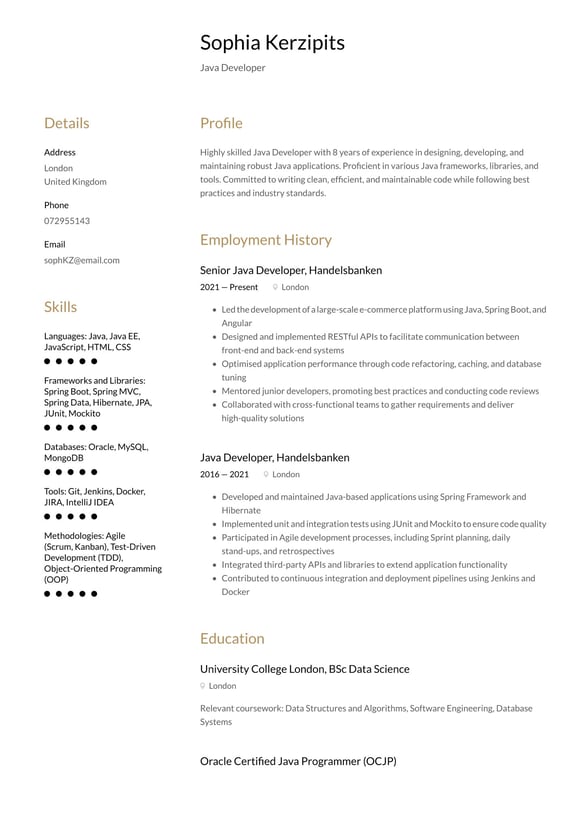
Engineered for Java developers, this sleek, modern layout spotlights technical expertise and certifications with precision. Its clean structure and strategic formatting amplify your skills and achievements, impressing hiring managers in tech-driven environments.
Full Stack Developer CV example
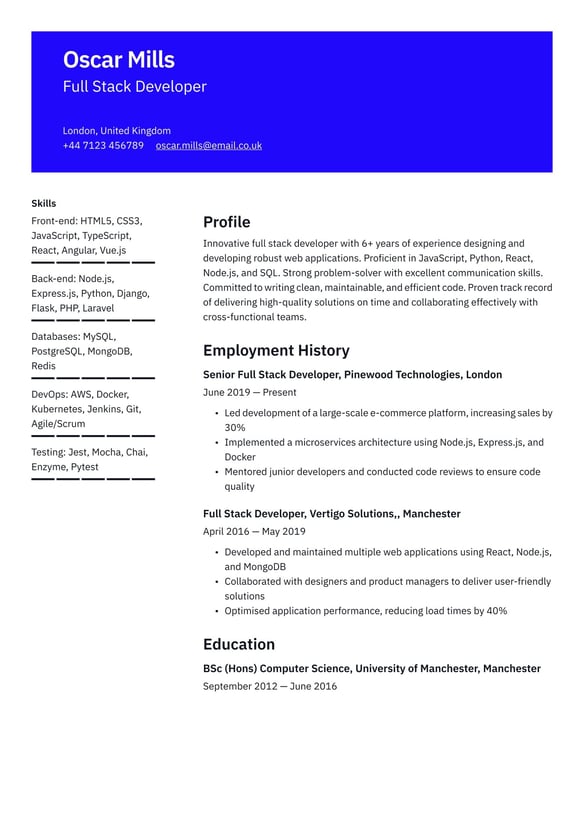
Targeted at tech-savvy Full Stack Developers, this sleek, modern layout highlights your technical expertise and problem-solving skills. Its clean structure and strategic use of whitespace showcase your achievements, making your profile irresistible to hiring managers.
Electrical Engineer CV example

Made to match the precision and innovation of electrical engineering, this template spotlights your technical expertise and leadership skills. Its clean layout and structured sections amplify your achievements, ensuring you electrify hiring managers.
Lead Engineer CV example
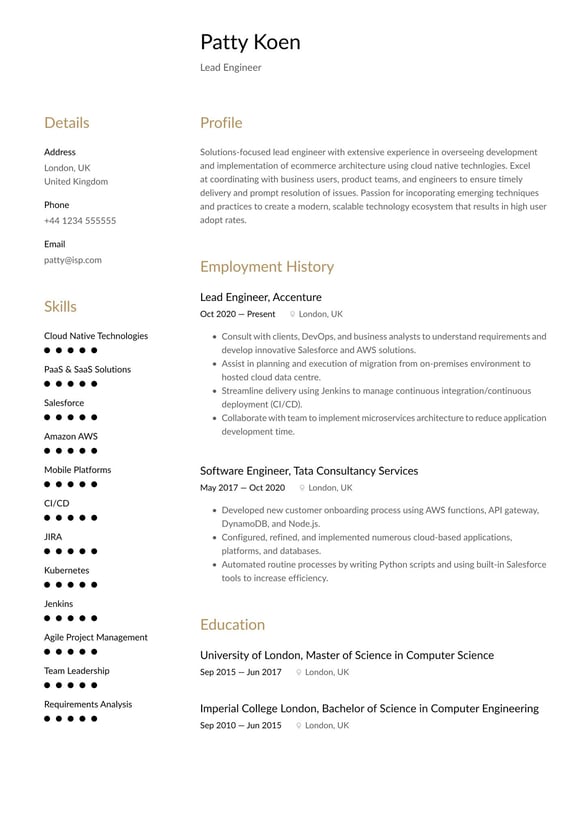
Geared toward showcasing technical expertise and leadership, this clean, modern layout highlights your engineering accomplishments with precision. Its structured sections and subtle accents emphasize cloud-native skills, making you stand out to tech-driven organizations.
Quantity Surveyor CV example
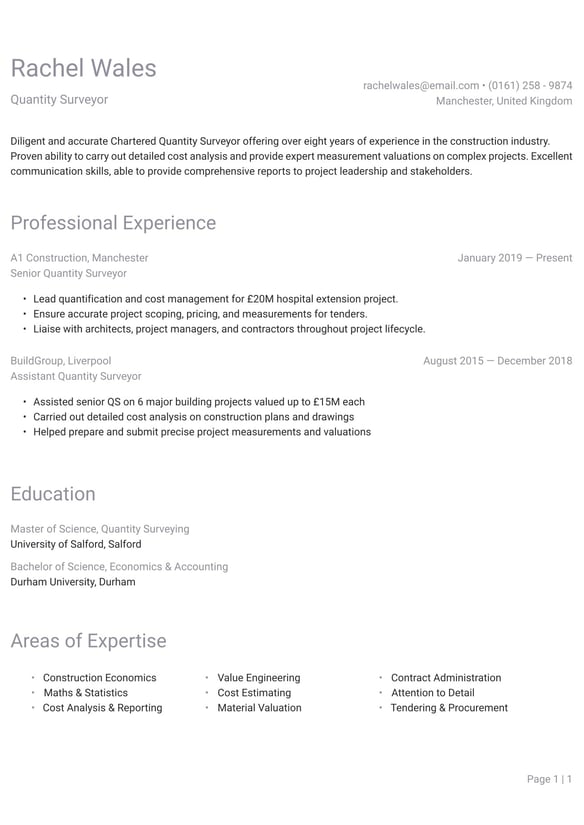
Crafted for precision-driven Quantity Surveyors, this template’s clean layout and structured sections highlight your cost analysis expertise and project leadership. Its professional formatting ensures your skills and achievements resonate with construction industry stakeholders.
Front End Developer CV example
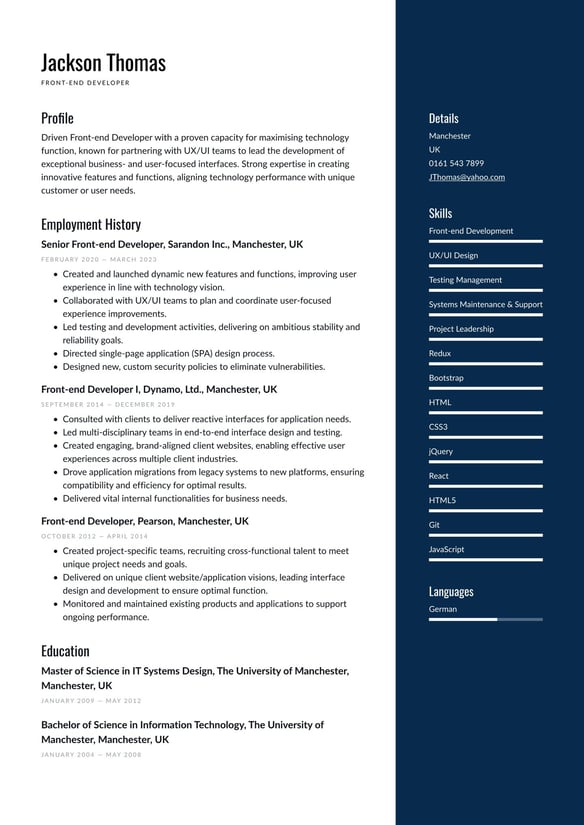
Crafted for tech-savvy Front-end Developers, this sleek, modern layout spotlights your innovation and collaboration skills. Its clean structure and subtle design accents amplify your expertise in UX/UI, ensuring you stand out to hiring managers.
Mechanical Engineer CV example
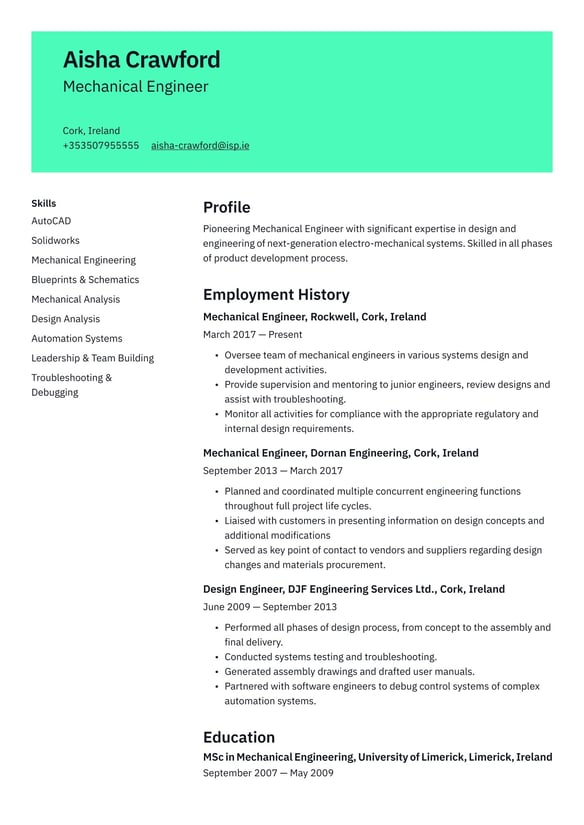
Engineered for precision and innovation, this template’s clean, technical layout highlights your expertise in design and problem-solving as a Mechanical Engineer. Its structured sections showcase your skills and achievements, impressing both recruiters and technical teams.
Programmer CV example
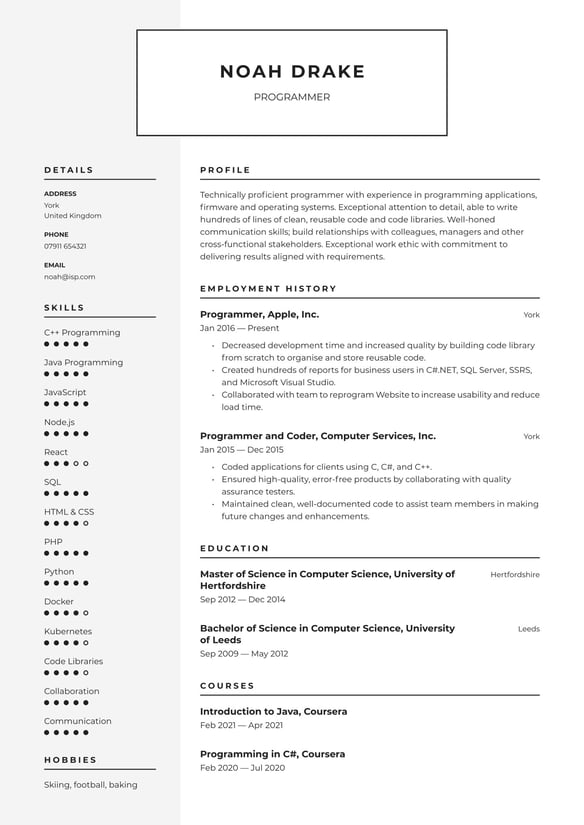
Perfectly suited to tech-savvy programmers, this clean, modern layout highlights your technical expertise and collaborative achievements. Its structured sections and subtle design elements showcase your coding skills and problem-solving abilities, impressing both hiring managers and tech teams.
Civil Engineer CV example
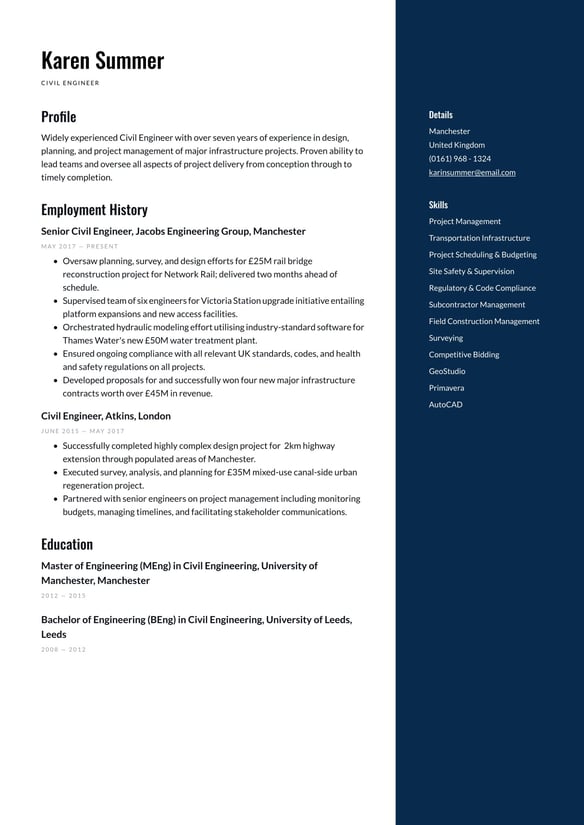
Crafted for civil engineers, this clean, structured layout highlights your technical expertise and leadership skills. Its balanced design emphasizes project achievements and certifications, helping you stand out to hiring managers in infrastructure and construction sectors.
Software Engineer CV example
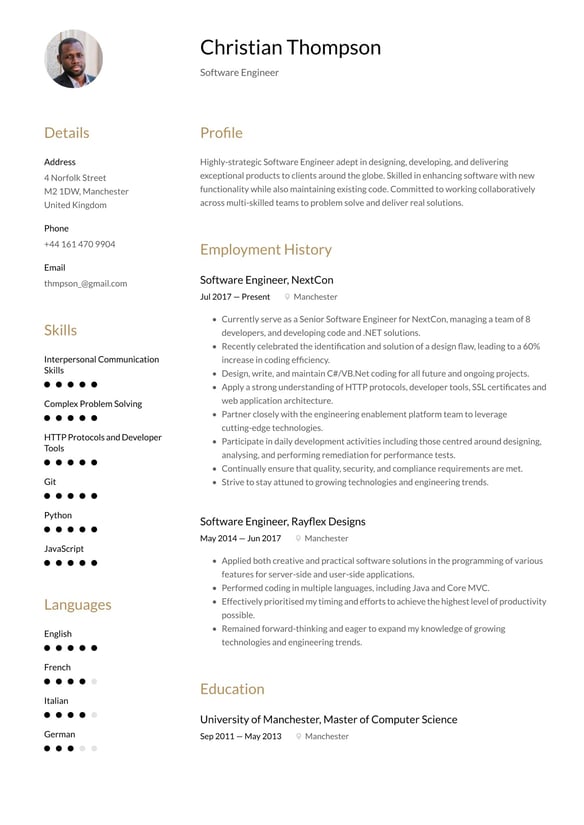
Crafted for software engineers, this sleek, tech-forward layout spotlights your technical expertise and collaborative achievements. Its clean structure highlights key skills and accomplishments, helping you impress hiring managers in fast-paced, innovation-driven industries.
When creating your engineering CV, it is vital that you get your experience and skills across to the hiring manager, as well as your desire to work in their specific area.
With occupation-specific CV examples and writing guides, Resume.io is an expert resource for job seekers in every field and at every experience level. This CV guide, along with our engineering CV example, will cover:
- What an engineer does
- How you can write your engineering CV – with some tips and tricks
- What format you should use for your engineering CV
- The main sections to include on your CV (including summary, work history, education, skills)
- The most appropriate design to use for your engineering CV
What does an engineer do?
Without engineers, we wouldn’t be able to do many of the things we take for granted. Travelling via train or plane would be impossible without engineers. Engineers are responsible for the design and build of structures and systems, such as roads and rail. There are different areas an engineer may choose to specialise in, including civil, electrical or mechanical engineering.
With 5.5 million people working in engineering in the UK, it is one of the biggest employment sectors. It accounts for 18% of total UK employment
Engineer job market and outlook
Engineers are in high demand in the UK, and it is thought that the number will double over the next year. There is also the additional pressure of the UK leaving the EU, and not being able to recruit talent from other European countries as easily as it was pre-Brexit. If the demand for engineers is filled, there could be an extra £27 billion in revenue brought into the UK economy.
If you are qualified in engineering, you can expect the outlook to be bright, as there will continue to be lots of vacancies in the sector. The demand for engineers is not confined to the UK. The job is also on the skills shortage list in many other countries, including Australia. If you want to travel, there are a wealth of opportunities for engineers.
In 2021, the average salary for a graduate engineer is £33,725 and for senior roles, it is £56,506. Directors can expect to earn an average salary of £84,901. The salary has risen by 10% in the last two years.
How to write an engineering CV
It is a good idea to plan your CV before you put pen to paper. Your CV will usually contain five main sections, although you may also want to add others, such as achievements and hobbies, if you think it is relevant to the role. These are the main sections for your engineering CV, and you will find these throughout our CV samples.
- CV header
- CV summary
- Employment
- Skills
- Education
Within engineering, there are many areas you can choose to specialise in. It is vital that you tailor your CV to suit the role you are applying for. For instance, within civil engineering, you may want to specialise in road or rail and you should always tailor your CV to suit. Hiring Managers always want to be sure you have a desire to work in that specific area. There is also the option of working within large or small organisations. Make sure you tweak the CV to suit the role and the company you are applying to. Our CV samples will help with this.
We would suggest keeping the following in mind when writing your CV:
- Understand the type of role and the company you are applying to make sure you tweak your CV for the audience.
- Your CV should be easy to read and understand. You can do this by ensuring it is carefully planned and divided into appropriate sections.
- Focus on the main elements of the role that are important and ensure these are on your CV.
Choosing the best CV format for engineers
There are three main types of CV formats: reverse chronological, functional and hybrid. Reverse chronological is the most traditional and centers on an employment history section where you can list your related role. This is the best choice for engineers since it allows you to explain what you’ve learned and accomplished in each of your previous positions.
This guide will help explain instances where alternative CV formats may be appropriate.
CV summary example: where it all began
Just as the first stage of an engineering project involves planning, the first section on your CV is a glimpse for the hiring manager into your skills and expertise. You want to give them a great initial impression, so they are keen to read more. This is where you want to focus on the significant aspects of your employment or education (depending on whether it is a graduate or experienced role.)
For example, a key sentence may be, ‘experienced engineer with 5 years of experience working within the rail sector in a multinational engineering firm.’
Below you’ll find the summary from our CV example.
Skilled and driven engineer with 5+ years of experience working on civil construction projects, including highways, rails and roads. Passionate about the creation of environmentally sustainable structures and focused on delivering the highest quality of work.
Employment history sample: telling your story
The employment history section is where you show the hiring manager all your relevant experience, which has led you to this point in your career. You should start with your most recent employment, or it may be your current employment, and then work back. It is best to use bullet points, and only focus on the key aspects of the role, rather than listing every single part of the job. It is also a good idea to quantify your experience. Here you will find an engineering employment history CV sample which you can adapt for your own experience.
Civil Engineer, MC Engineers Ltd, Manchester
Jan 2017 - Present
- Oversee rail team and work on major projects within Manchester including the £2.9bn Transpennine Route Upgrade (TRU) project.
- Design and plan major structures according to client specifications and legal requirements.
- Ensure that ongoing projects are kept within budget and schedule.
- Attend regular meetings with clients and contractors to address concerns, questions and ideas.
Assistant Civil Engineer, McWorth's Construction Co., Manchester
Dec 2014 - Jan 2017
- Assisted civil engineers with structure design on various projects including the Northern Hub rail project and Manchester Metrolink.
- Created reports and answered queries from clients and contractors.
- Supported civil engineers with budgets and timescales.
- Visited sites to check on the progress of projects and to discuss concerns with contractors.
CV skills example: what you can bring to the role
It is a good idea to think of the skills section of your CV as what you can bring to the role. Engineers are expected to have great technical abilities, they are problem solvers, with strong critical thinking skills. Use the job spec as your base for creating the skills section of your engineering CV and tailor it to suit. If you are a graduate applying for an engineering role, you can use transferable skills for other roles, if you’ve never worked in engineering before, or skills you have obtained from university. For example, you may have had to use problem solving skills during an engineering project or been required to show strong communication skills when working as part of a team. Check out the engineering skills CV sample below.
- Interpersonal Communication Skills
- Principles and Practices of Engineering
- Problem Solver
- Analytical Thinking Skills
Engineering CV education example: your achievements
It is very unlikely that you will be offered a role within engineering, without relevant qualifications – whether it be through college or university. Engineers are professionals and usually need a good standard of degree, especially to work within a reputable organisation.
Your education should start with the most recent, just as you would with your employment, and work back. You should include any qualifications, even those you might not feel are directly relevant to the role. Hiring managers are always impressed by candidates that are focused on professional career development. If you did some online courses during lockdown, don’t forget to mention them, they are all relevant and important for your future career prospects.
Here is the education section from our engineering CV example.
Civil Engineering BEng (Hons), University of Manchester, Manchester
Aug 2010 - Sep 2014
- Graduates with honours.
- Achieved Student of the Month Award on four occasions.
CV layout and design: no need for gimmicks
The design of your CV is almost as important as the wording itself. While you shouldn’t go over the top with color or imagery, a clean and professional layout shows the hiring manager you are serious about the position. Make sure to balance the amount of white space to text and create an attractive header to catch the reader’s attention. If you want to be sure your layout is done correctly, you may consider using a professionally-designed CV template.
Key takeaways for an engineering CV
- Understand the structure you want to follow, before you get started, and think about the area you want to specialise in and why.
- Use the most important elements of your skills and experience on your CV. Keep to the point and quantify these where possible.
- Tailor your CV to suit the role and make sure the hiring manager is left in no doubt that this is the area you want to specialise in (for instance, aviation/defence)
- Check out our engineering CV sample for more ideas on creating an eye-catching page layout.