

04/2013 - 08/2019, Data Scientist, Open System Technologies, New York
- Analyzed data sets and helped companies make decisions based on findings.
- Served as a thoughtful advisor, working with Sales and Marketing professionals.
- Utilized algorithmic and programming tools to build helpful predictive models.
- Performed exploratory data analysis and discovered notable relationships.
- Tracked performance and identified business improvement trends.
11/2008 - 03/2013, Data Scientist, Maxwell Research Group, New York
- Worked to assess the company's needs and resolve issues with the use of data.
- Effectively mined unstructured data.
- Created and presented portfolios of growth, pointing out key trends.
- Identified new external data sources.
- Explained complex modeling in an understandable and relatable way.
- Worked to improve analytical tools and achieve greater results and awareness.
08/2003 - 05/2007, Bachelor of Communications, Manhattan College, Bronx
09/1999 - 05/2003, High School Diploma, Maria Regina High School, Hartsdale
- Data Verification and Maintenance
- Predictive Modeling
- Database Development
- Excellent Communication Skills
- Data Munging
- Strong Analytical Skills
- Leadership Skills
This is the era of the geek, so let your flag fly! If you love crunching numbers, count yourself lucky: The Harvard Business Review named data scientist as the sexiest job of the 21st Century. Businesses are snapping up people with your skills in record numbers. That means you have your choice of positions, so dream big! You can increase your odds or even get multiple job offers if you take a deliberate, analytical approach to develop your resume. With an investment of about 20 minutes, this guide will take you step-by-step through the process of:
.jpg)

.jpg)
Related Resume Examples
Business Analyst resume example
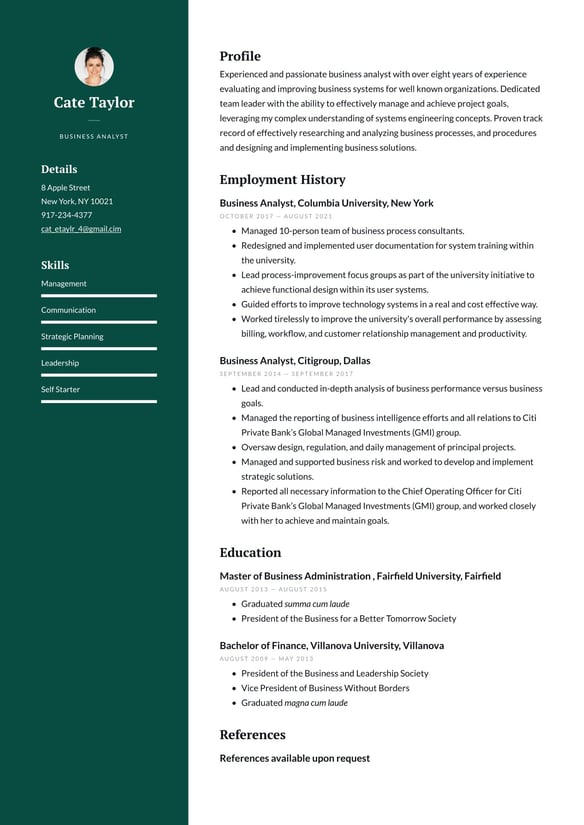
Created for business analysts, this clean, data-driven layout highlights your analytical expertise and leadership skills. Its structured sections and subtle design elements showcase your achievements, helping you connect with decision-makers in dynamic, results-focused environments.
Data Analyst resume example
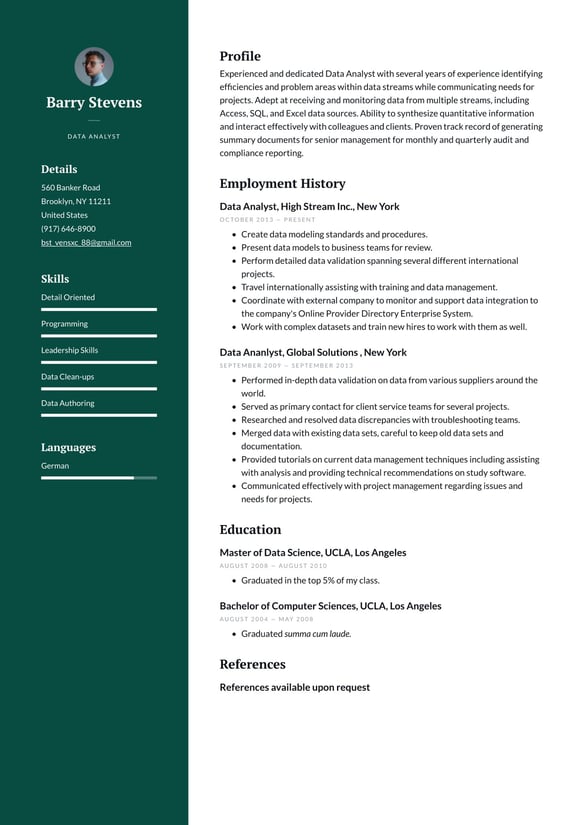
Optimized for precision and clarity, this clean, grid-based layout highlights your analytical mindset as a Data Analyst. Its structured sections showcase technical skills and achievements, helping you communicate expertise to data-driven employers with ease.
Web Analyst resume example
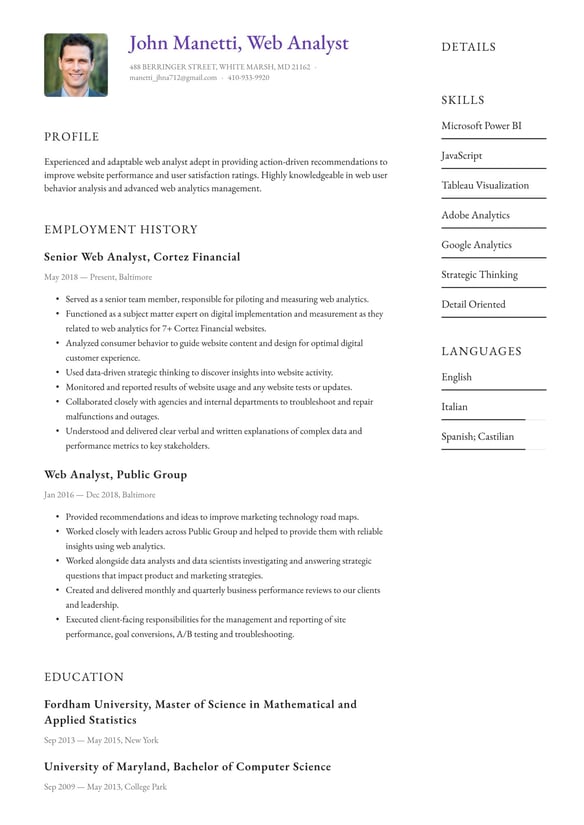
Aligned with the analytical precision of web analysts, this template’s clean layout and structured sections highlight data-driven achievements and technical expertise. Its modern design emphasizes clarity, helping you connect with decision-makers in digital analytics roles.
Data Engineer resume example
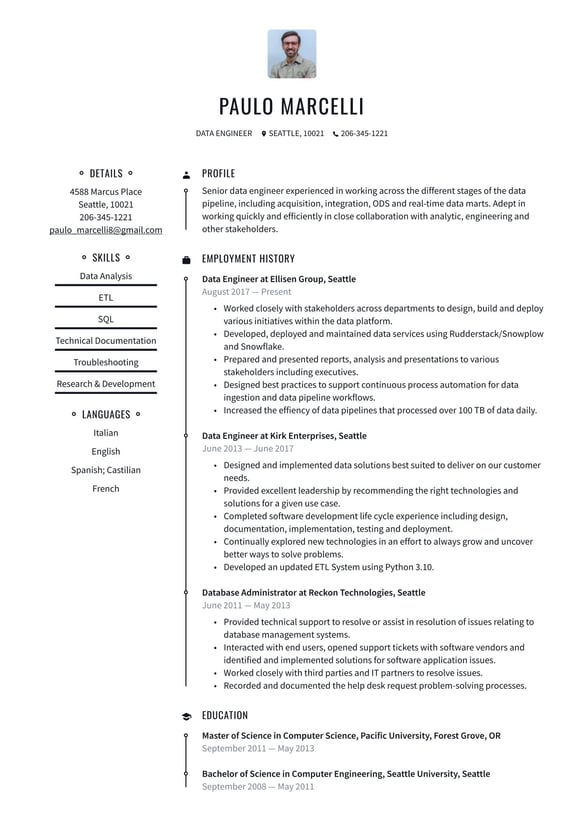
Aligned with the technical precision and analytical mindset of a Data Engineer, this template’s clean layout and structured sections highlight your expertise in data pipelines, ETL, and collaboration. Its modern design ensures your skills resonate with tech-driven employers.
Machine Learning Engineer resume example
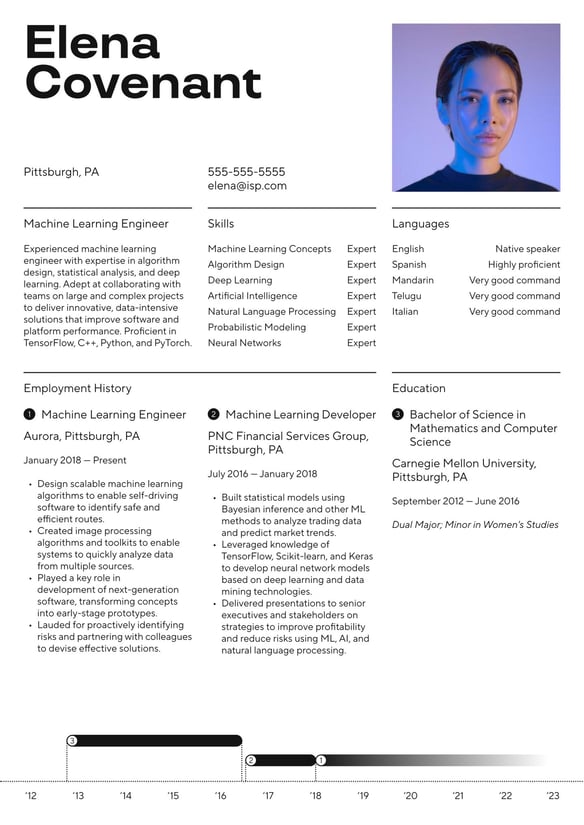
Aligned with the innovative and analytical demands of a Machine Learning Engineer, this template’s clean, structured layout highlights technical expertise and project achievements. Its modern design emphasizes your skills, making a strong impression on tech-focused employers.
SQL Developer resume example
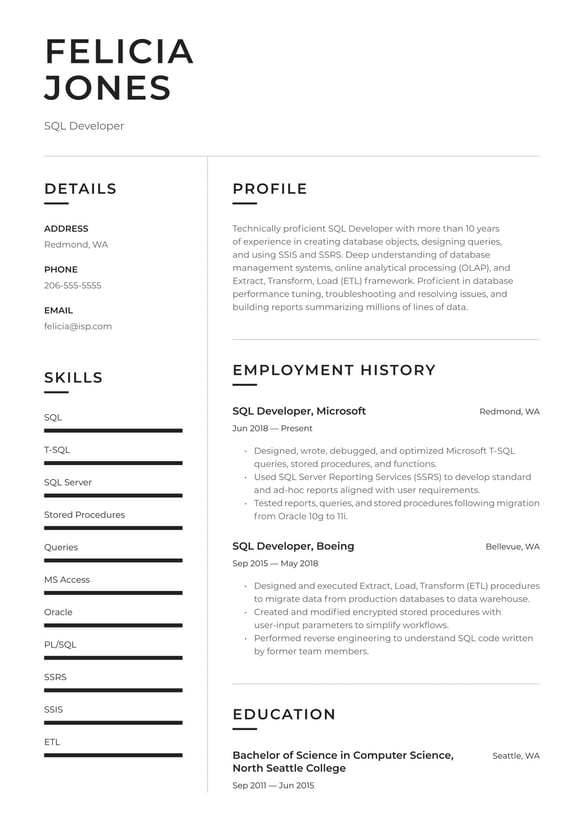
Tuned for SQL Developers, this clean, grid-based layout highlights technical expertise and project achievements with precision. Its structured sections and subtle design elements showcase your database skills, making a strong impression on data-driven teams.
AI Engineer resume example
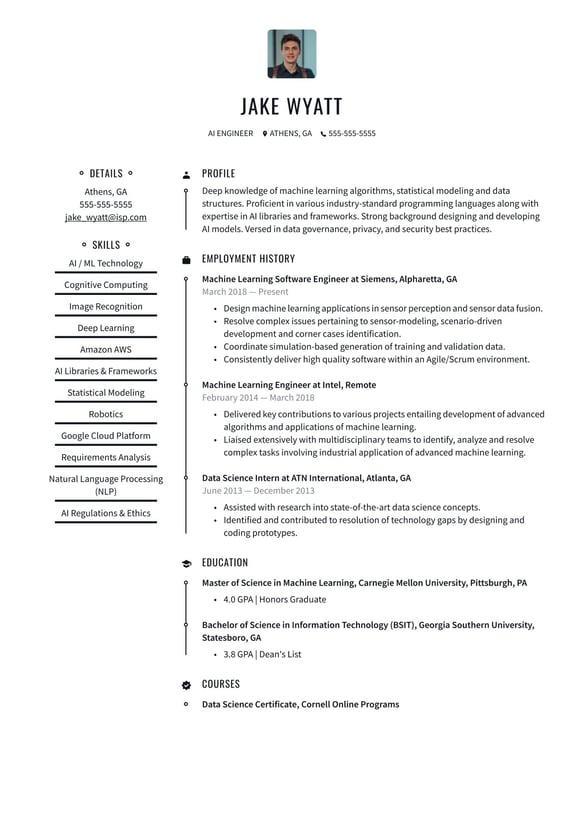
Formatted for tech-savvy innovators, this sleek, modern layout highlights your AI expertise with precision. Its clean structure and subtle accents showcase advanced skills and achievements, helping you stand out in competitive AI Engineer roles.
Business Intelligence resume example
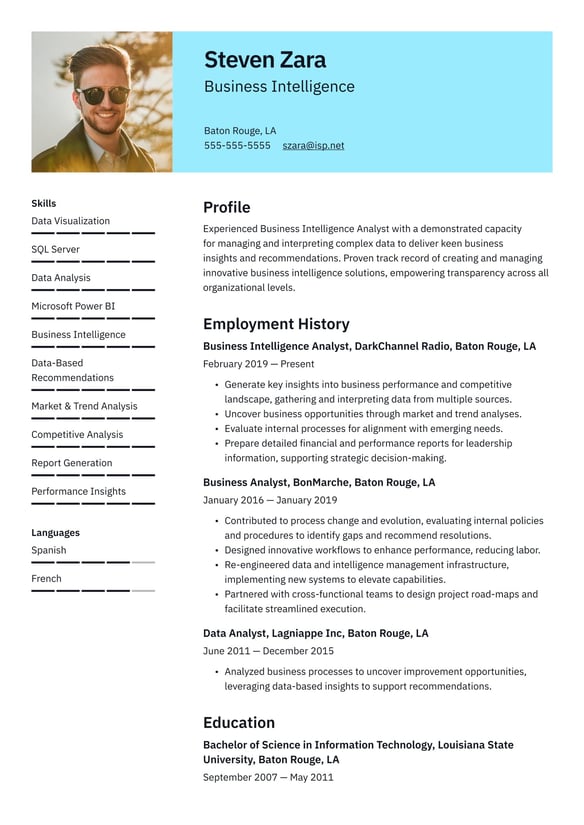
Created for Business Intelligence professionals, this sleek, data-driven layout highlights your analytical expertise with clean sections and structured formatting. Its modern design emphasizes key insights and achievements, ensuring your skills resonate with decision-makers.
Python Developer resume example

Optimized for showcasing technical expertise, this clean, modern layout highlights your Python proficiency and problem-solving skills for Python Developer roles. Its structured sections emphasize achievements, helping you connect with tech-focused recruiters effortlessly.
UX Researcher resume example
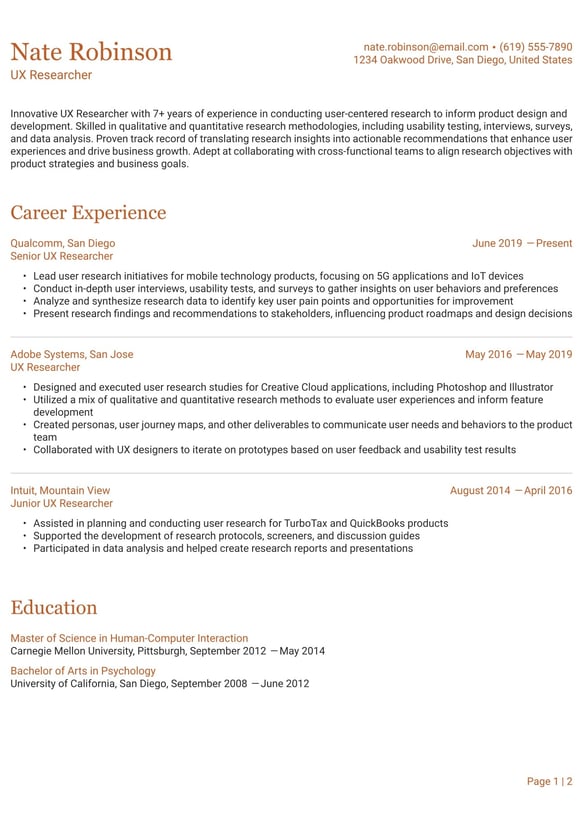
A smart fit for UX Researchers, this sleek, modern layout emphasizes clarity and structure, showcasing your research expertise with precision. Its clean design highlights your skills and achievements, helping you connect with user-focused teams and stakeholders.
- Uncovering all your skills and accomplishments
- Using hacks and tips to overcome Applicant Tracking Systems
- Showing off your professional personality
- Presenting your experience in the best light
- Keeping your resume’s layout and formatting recruiter-friendly with Resume.io’s expertly-designed resume templates.
First, let’s investigate the data science industry.
The market for data science: harnessing the power of analytics

Why would Harvard call data science sexy? The field reaches into all our lives, almost every day and you are on the forefront of making that data meaningful.
Big data and data analysis spending is forecast to have a compound annual growth rate of 13.2 percent from 2018-2022. That means that by 2022, revenue would reach $274.3 billion, IDC believes.
In our technology-driven world, companies are gathering large caches of information about human behavior, demographics, and any other category that can be quantified. That information is useless on its own. That’s where you come in. As a data scientist, you take that data, analyze and interpret it, so that it can be used to make decisions about everything from which color to make a product to where the biggest need for a government program lies. Data scientists work with unstructured data and their modeling techniques may include machine learning and deep learning protocols. Many industries capitalize on big data. Which ones are making the most of it right now? Here are the top verticals where Data Science Central believes data scientists can use their skills best and earn the highest salaries:
- Finance
- Healthcare
- Travel
- Energy
- Manufacturing
- Gaming
- Pharmaceuticals.
The GeeksforGeeks list adds even more potential employer sectors:
- Retail
- Construction
- Transportation
- Communications, media, and entertainment
- Education
- Government
- Energy and utilities
- Outsourcing.
Each of these industries uses big data to inform decision-making and solve problems, but each has different needs and goals. With that variety, it will be in your best interest to focus your resume as specifically as you can to each of your areas of interest. You need to be able to explain in your resume what value you will bring to a business with your analyses. Businesses are looking for ways to streamline processes, save money, sell more, improve efficiency, get ahead of trends, identify and refine their target audience, recruit appropriate talent, and use quantifiable evidence to make and test decisions. You can do that, but first you have to sell yourself.
As a data scientist, you should have little trouble passing through the first challenge: Applicant Tracking Systems. These systems use algorithms to rank your resume based on employers’ requirements. Resumes that don’t rank high enough end up on the slush pile. There are hundreds of ATS programs on the market, so there is no single way to ensure you will beat one, but as a data scientist, you may have an advantage because you know how to analyze information. Your first step is to do just that. Look at each job description (researching the employer also helps a ton) and decide which listed skills and attributes are most important to that employer. Then, make sure you use those skills and attributes in your resume. Here are some facts to help you:
- ATS software searches for exact keywords and phrases from job descriptions
- Some weight rare keywords more highly—for instance, unique skills are more sought after
- Not all ATS can read data in tables or headers and footers
- Use acronyms and spell out entire titles just in case the ATS is programmed for only one.
Now that you have an overview, let’s jump into crafting your resume.
Having trouble with putting your Data Scientist cv together? Get inspired by these IT resume samples below:
- Systems Analyst resume sample
- Technical Project Manager resume sample
- Computer Science resume sample
- Network Engineer resume sample
- IT Director resume sample
- Software Engineer resume sample
- Film and Video Editor resume sample
- Motion Graphics Artists resume sample
- Network Systems Analyst resume sample
- 3D Animator resume sample
- Software Developer resume sample
- Web Developer resume sample
- Programmer resume sample
- IT manager resume sample
- IT Project manager resume sample
The Summary: These sentences add up to more than an introduction

Your summary, or, if you prefer, your profile, briefly tells recruiters who you are and what you find most important about your career thus far. In this short narrative—no more than three to five sentences—you have the opportunity to showcase your professional personality and attributes while highlighting one or two of your biggest successes. This is the place to put in adjectives that describe your workplace demeanor and explain why you are the best candidate for the job. If you are tempted to be modest, resist! You should be proud of your accomplishments, but steer clear of overstating. If you are looking for your first full-time job, use any projects you have completed either at university or because as a data geek you do this stuff for fun.
Each summary should reflect the job for which you are applying. You don’t have to rewrite for every position but integrate the keywords your analysis has found are most important to give your ATS ranking a boost.
Although this section appears at the top of your resume, you may want to write it last (depends on whether laconic creative writing is among your strengths) —after all, it is called a summary so it may help to have all the data in front of you first.
Experienced and dedicated Data Scientist with several years of experience identifying efficiencies and problem areas within data streams, while communicating needs for projects. Adept at receiving and monitoring data from multiple data streams, including Access, SQL, and Excel data sources. Bringing forth the ability to synthesize quantitative information and interact effectively with colleagues and clients. Proven track record of generating summary documents for senior management for monthly and quarterly audit and compliance reporting.
Employment History: mine your own data

Your Employment history is the meat of your resume: It gives recruiters the roadmap of your career progress. Think of this section in the same way you think of putting together chunks of data to form a big picture. Each job or data science project is a stepping stone to the next. The key idea here is to show recruiters what you have brought to each job, how you have grown, and what steps you are ready to take next. Many data scientists begin their careers as software developers, data engineers, business analyst or data analysts, so if you’re trying to make the leap to data scientist, be sure to show a clear pattern of growth in responsibility and knowledge. Begin by thinking about all the skills you need to be a successful data scientist. You can think of what Innoarchitech calls the four pillars of data science:
- Business: General knowledge of how businesses operate or distinct information about one or more industries
- Mathematics: Statistics and probability are important to data analysis
- Computer science: Software engineering and data architecture
- Communication: Ability to explain your methods, findings, and conclusions both orally and in writing.
The Harvard Business Review describes a data scientist as a combination of data hacker, analyst, communicator, and trusted advisor. Being expert in all these areas makes you a true unicorn.
Remember to name the “Three Vs:” volume, velocity, and variety, you dealt with when describing your data projects.
Go heavy on the details in this section (but avoid unnecessarily wordy sentences and cut down on “auxiliary grammar” that can be shortened), as this is one way to demonstrate that you track your own achievements and growth. Use strong action verbs as you write. Here are some example phrases to get you started:
- Devise and apply models
- Analyze and interpret data
- Determine optimal data sets and variables
- Gather large structured and unstructured data sets
- Create visualizations to communicate findings
- Discover solutions and opportunities
The median salary for data scientists is $96,032. The top 10 percent of earners make $134,000 and the bottom 10 percent earn $66,000, according to Payscale.
When you write your descriptions, try to anticipate questions recruiters may ask you and include some answers. Potential questions may include those from the following categories:
- Basic: What is the difference between data analysis and data science?
- Statistics: What are correlation and covariance?
- Data analysis: Explain different types of sampling.
- Machine Learning: Explain decision tree algorithms.
- Deep Learning: What is reinforcement learning?
If you can organically incorporate answers to these or examples of how you have used these ideas in your descriptions, recruiters are more likely to grant you an interview.
Projects section
You may have completed many projects that were not related to your employment or you may have been working as an independent contractor. If either of those is the case for you, consider organizing your experience by project. That way, you can offer recruiters more details about your biggest achievements. You should still follow the guidelines in the employment history section:
- Organize in reverse chronological order
- Show a pattern of growth
- Use details and data
- Describe with strong action verbs
This organization can also help if you have any gaps in employment. These gaps are less obvious, and more explainable, if you have been working as a contractor or on a single-project basis. If you only have a few projects and were mostly an in-house employee
This section is also a great way to include open-source contributions and blogs or social media content that relates to your career.
- Performed in-depth data validation on data from various suppliers across the world.
- Served as the primary contact for client service teams for several different projects.
- Researched and resolved data discrepancies with troubleshooting teams.
- Merged data with existing data sets, careful to keep old data sets and documentation.
- Provided tutorials on current data management techniques including assisting with analysis and providing technical recommendations on study software.
- Communicated effectively with project management regarding issues and needs for projects.
Education section: let your STEM background work for you

Data science is a fairly new area, so you probably don’t have a degree in it, although certification programs and “bootcamps” are popping up to fill the void. If you have completed one, that’s great, but you can get a job as a data scientist without one. The most sort-after degrees for recruiters seeking data scientists are:
- Mathematics
- Computer science
- Information technology
- Physics
- Statistics and, of course,
- Data science
If you have a minor in any of these subjects, you should also include that when you list your education. Many data scientists have master’s degrees, which focus their field of expertise, but a master’s degree is not a requirement to get hired as a data scientist, especially if you have a background in the subjects above. If you want to strengthen your resume or fill in skill gaps, consider a certification program or further studies. Other STEM degrees, such as biotechnology or engineering, may also lead to a career as a data scientist.
2004-2008 UCLA, Bachelor of Computer Sciences LA, CA 2008-2009 UCLA, Master of Data Science LA, CA
Skills Section: aim for distinguishing abilities

Your skills section is an at-a-glance list of the talents you have that match the job for which you are applying. Now’s the time to brainstorm a list of every program, statistical model, branch of math, etc. that you know. These are the hard skills you need to do your job. Next, think about your people skills and other soft skills such as communication, organization, and time management required to be a productive worker. Turn this into a Master List that you can add to as you grow as a data scientist and search for new challenges.
This is the easiest section to individualize for each job, but it shouldn’t be the only one you alter. Make sure you consider each job description and target those specific requirements when you customize your resume.
This section of five to ten top skills is a great place to add those rare keywords that will distinguish your resume and help you beat the ATS. Skills can be thought of in these three categories:
- Necessary skills: These are the abilities you need at the very least to do the job. You may have used these skills in a lower-level position such as data analyst. They are general skills such as economics, statistics, and software development.
- Defining skills: These are the skills you will need to perform your job on a daily basis. Examples include data mining and analysis, machine learning, and predictive modeling.
- Distinguishing skills: These are advanced skills that elevate your resume in ATS rankings and impress recruiters. If you know classification algorithms, econometrics, or model building, great!
As you build your skills section, choose higher level skills over lower level skills. You don’t need to list any necessary skills if you have defining and distinguishing technical skills. Don’t neglect soft skills, however, because as a data scientist you are also responsible for analytical ability and communicating your findings and making the case for your solutions.
- Analytical Skills
- Numerical Skills
- Data Protection Knowledge
- Programming
- Data Authoring
Formatting and Layout: clarity over creativity

As a data scientist, you know that the message is more important than an ornate design. Use this philosophy to develop the look of your resume. This is a visual representation of your professional personality, so be sure to reflect that.
Check for typos, save your resume as a PDF file, and scan for formatting errors. Even tech-savvy professionals make those mistakes. Don’t be one of them!
The main idea is to keep it legible. Recruiters will spend only seconds scanning for information and getting an impression of who you are. If your resume features big blocks of type or a confusing layout, it is likely to end up in the garbage. Here are a few rules of thumb:
- Vary your line lengths
- Use bulleted lists instead of paragraphs
- Limit the amount and brightness of color
- Make sure your contact information, skills, and job titles are easy to find
- Avoid using tables or placing important information in headers and footers the ATS can’t read.
Start with one of the four categories of layout templates from Resume.io: Simple, Creative, Modern, or Professional. If you choose to modify them, make sure you don’t overdo the color or change the font to one that is harder to read.
Key takeaways
- Data science is a recent addition to the range of technology careers and skilled data scientists are highly sought-after
- You should have plenty of data to show the problems you have faced, the actions you took, and the solutions you derived
- Consider using a Project section instead of Employment History; it may be a better way to showcase your abilities
- Focus your Skills section on the rare abilities that will boost your ranking in the ATS and impress recruiters
- Clarity and legibility are more important that creativity when it comes to your resume’s design
Use resume.io, the resume builder-tool, and its expertly designed templates to elevate your resume. Get started today!