

Experienced and passionate chef with experience in various restaurant and company settings, striving to serve the best food possible. Recognized as a visionary chef with knowledge of food trends and the ability to think outside the box when it comes to the creation of a menu. Bringing forth an in-depth knowledge of flavors and food relationships, resulting in mouth-watering dishes and attractive menus.
08/2016 - 09/2019, Executive Head Chef, Corros NYC, New York
- Manage a kitchen staff of 40+ people.
- Oversee all kitchen and food operations.
- Develope attractive and popular wine lists and menus.
- Remaine up to date on food trends and the best seasonal fare.
- Earned Best Fine Dining in New York Award, 2017.
07/2014 - 08/2016, Head Chef, Peter Parla's, New York
- Hired, trained, and managed kitchen personnel.
- Sourced elite food products, creating a better dining experience.
- Worked effectively with all workers, to promote a happy working environment.
- Worked with regard for food safety regulations.
09/2010 - 06/2014, Sous Chef, Peter Parla's, New York
- Effectively managed 30+ kitchen employees.
- Updated staff on menu changes and items.
- Prepared impressive dishes, resulting in return customers.
- Managed allergies with care and professionalism for customer safety and satisfaction.
- Designed unique menus using seasonal products.
07/2005 - 05/2009, Bachelor of Culinary Arts Management, Culinary Institute of America, Hyde Park
09/2001 - 05/2005, High School Diploma, Warwick High School, Warwick
- Knowledge of Food Chemistry
- Culinary Techniques
- Excellent Customer Service Skills
- Food Safety and Sanitation Practices
- Quality Assurance
Does your chef resume have the right ingredients to take your career to the next level?
.jpg)

.jpg)
Related Resume Examples
Caterer resume example
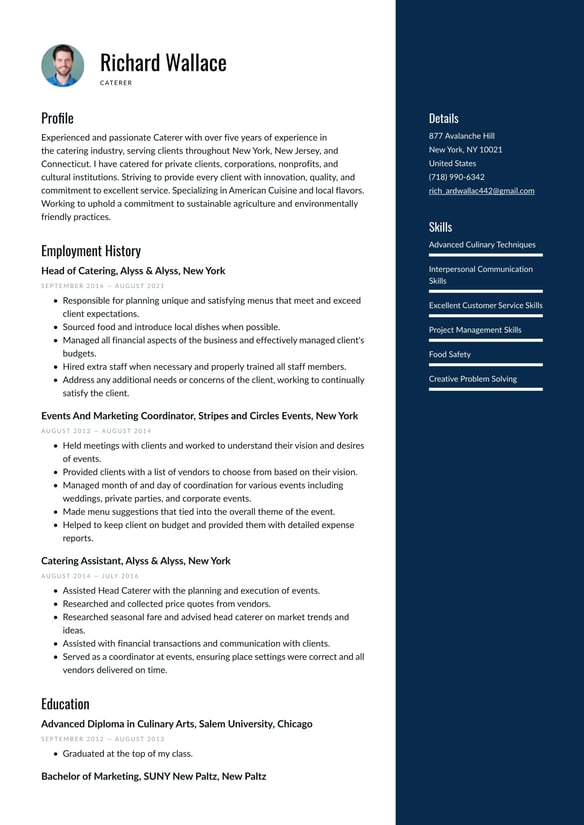
Customized for caterers, this sleek, menu-inspired layout spotlights your culinary expertise and event management skills. Its clean structure and tasteful accents serve up your creativity and professionalism, leaving a lasting impression on clients and employers.
Server resume example
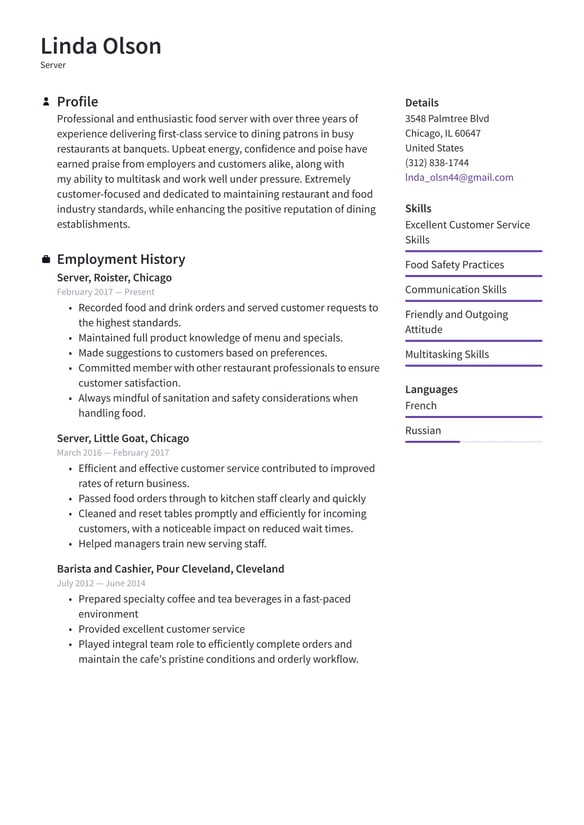
Perfectly suited to showcasing your customer-focused energy, this clean and approachable layout highlights your service expertise as a Server. Its balanced structure emphasizes key skills like multitasking and communication, ensuring a lasting impression on hiring managers.
Cook resume example
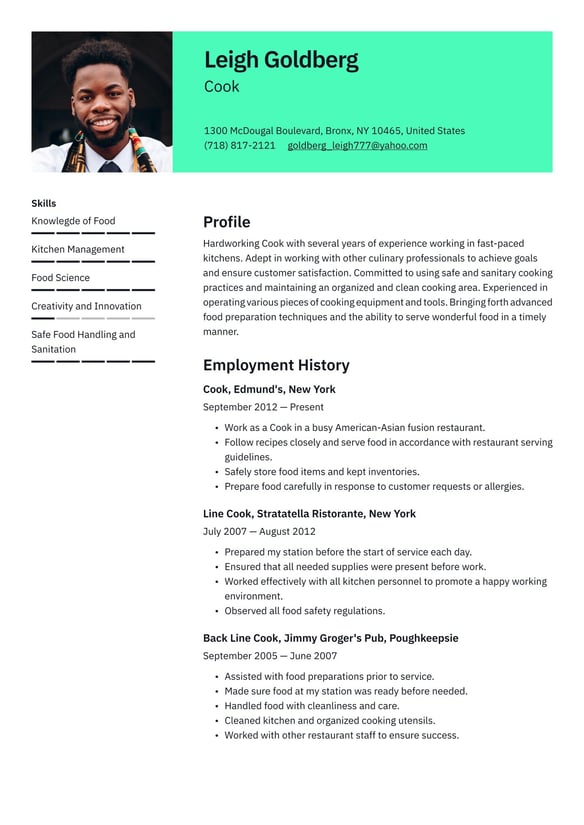
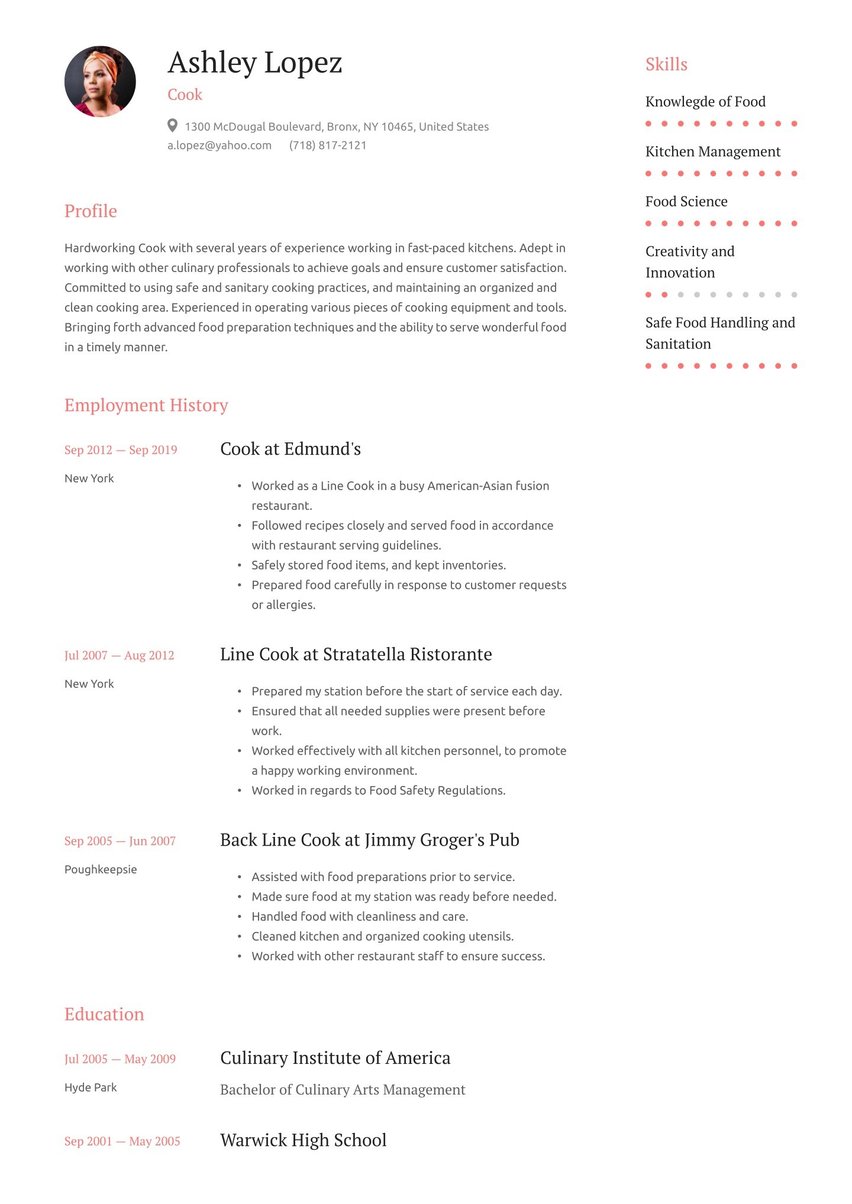
Primed for culinary professionals, this clean, structured layout highlights your kitchen expertise and teamwork skills with precision. Its organized sections showcase your experience and certifications, helping you impress restaurant managers and hiring chefs.
Bartender resume example
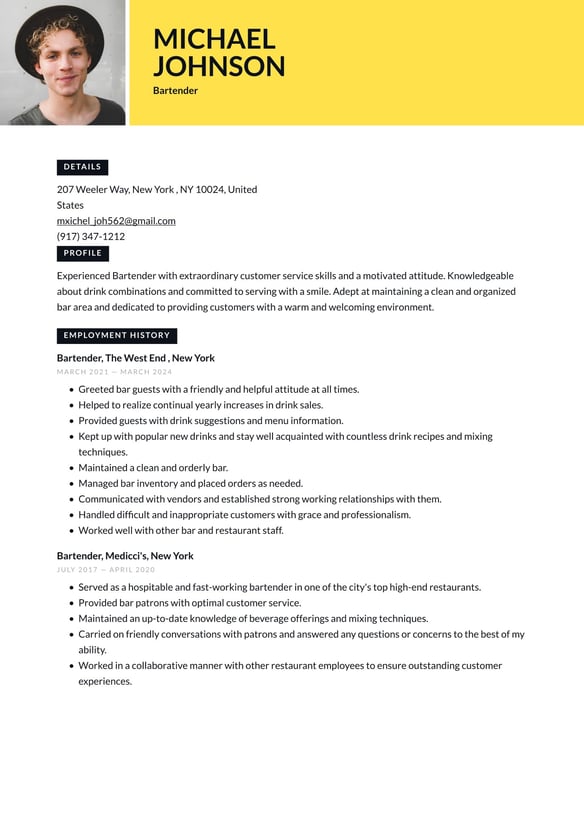
Ideal for bartenders, this sleek, modern template spotlights your customer service expertise and drink mastery with a clean layout and bold headers. Its organized structure highlights your skills and experience, impressing managers in fast-paced hospitality settings.
Food Services Manager resume example
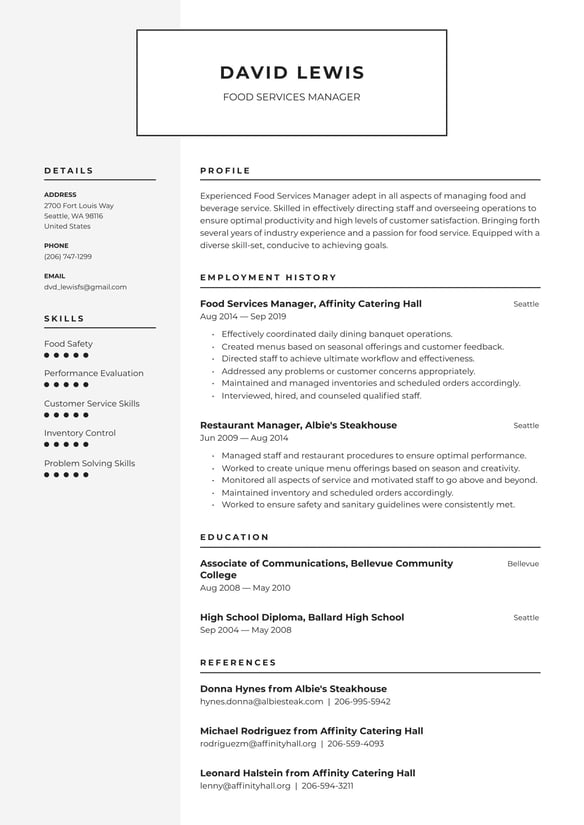
Crafted for food service leaders, this clean, structured layout highlights your management expertise and customer-focused achievements. Its balanced design showcases your skills and experience, helping you connect with employers in hospitality-driven roles.
Restaurant Manager resume example
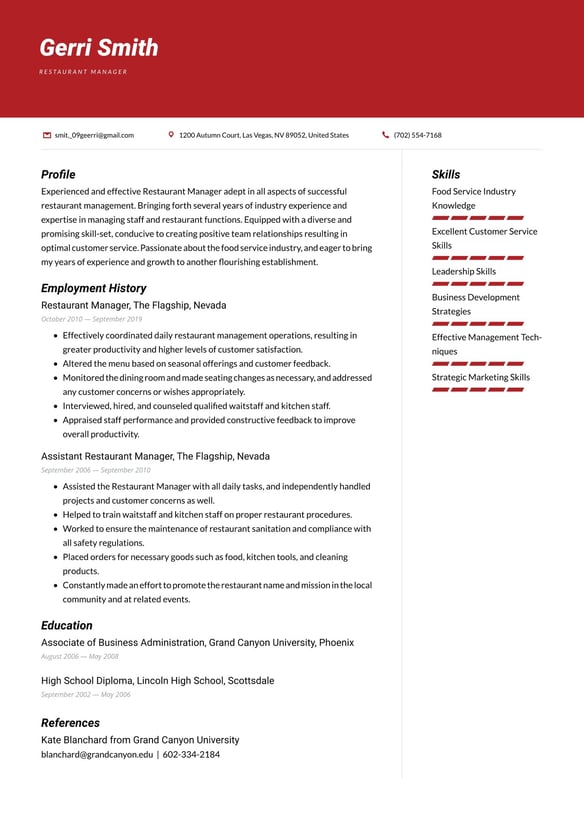
Ideal for showcasing leadership in fast-paced hospitality roles, this sleek, organized layout highlights your management expertise and customer service skills. Its clean structure emphasizes achievements, helping you connect with employers seeking confident, results-driven Restaurant Managers.
Food and Beverage Director resume example
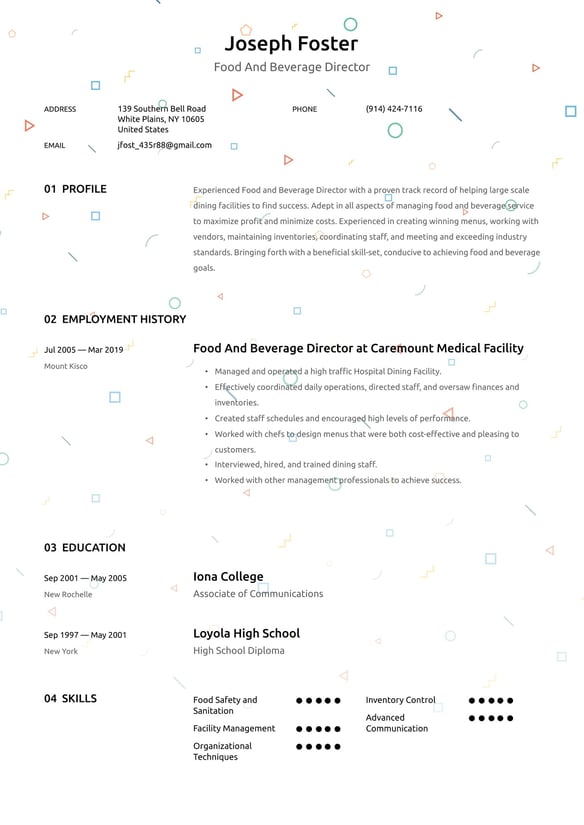
Made to match the polished professionalism and leadership of a Food and Beverage Director, this template blends clean layouts with structured sections to spotlight your expertise. Its elegant formatting highlights your skills, leaving a lasting impression on decision-makers.
Pastry Chef resume example
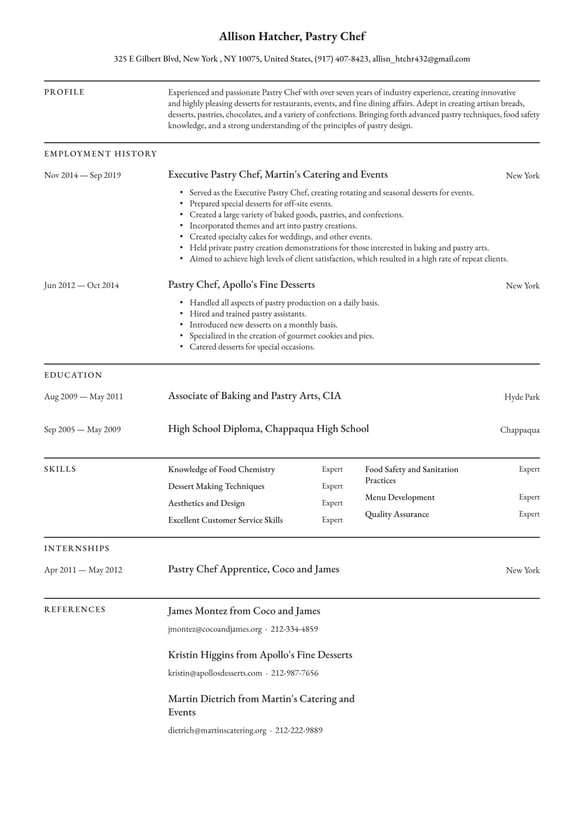
Formatted for culinary creatives, this elegant template highlights your artistry and precision as a Pastry Chef. Its clean layout and tasteful accents showcase your dessert-making expertise, leaving a lasting impression on upscale dining establishments and event planners.
Line Cook resume example
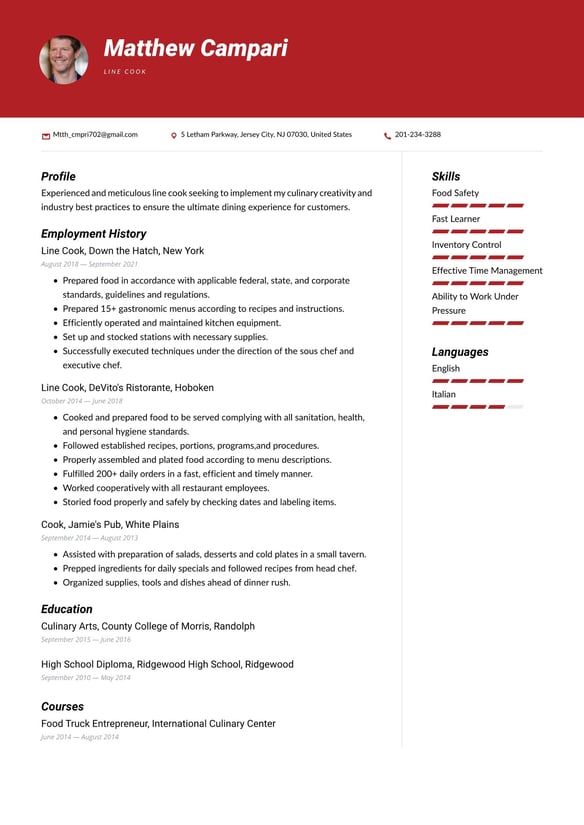
Made to match the fast-paced energy of culinary professionals, this sleek, organized layout highlights your efficiency and creativity as a line cook. Its clean structure spotlights your skills and experience to impress restaurant managers.
Sous Chef resume example
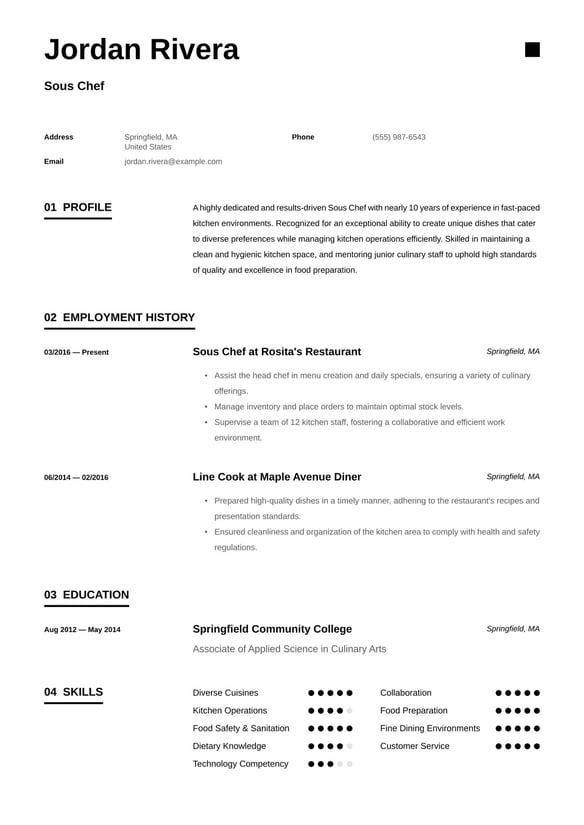
Structured for culinary excellence, this sleek, organized template highlights your leadership, creativity, and operational expertise as a Sous Chef. Its clean layout and bold headings showcase your skills and achievements, impressing restaurant managers and hiring teams.
There’s an infamous test in the cooking world: the omelette. It might seem like a humble breakfast food, but it requires proper timing, temperature and skill to get it just right. That’s why it’s a favorite of head chefs when they want to find out if a new cook has the chops.
Your resume is quite like the omelette test. Before a restaurant owner is going to let you touch his most expensive tools and ingredients, he wants to see that you’ve mastered the basics.
Your resume doesn’t have to be fancy, it just needs to show the proper amount of attention to detail in a clean and attractive format. For others, that might be daunting. But we’ve got your back. This guide, along with our templates and resume builder tool, will cover these topics:
- What does a chef do and what does the job market look like?
- How to craft a chef resume that highlights your most impressive skills and knowledge
- The best format for a chef resume
- Craft a resume that highlights your most impressive skills and knowledge
- Advice on each section of your resume: summary, work history, education and skills
- Professional resume layout and design hints
More than half of Americans have worked in a restaurant at some point in their lifetime. This sector makes up 4 percent of the U.S. GDP, according to the National Restaurant Association.
What does a chef do? Inside the world of cooking
Chefs are head cooks who manage everything from staff training and menu creation to ingredient sourcing and the dinnertime service. They often oversee sous chefs, line cooks, dishwashers and other kitchen help. In fact, they probably have first-hand experience with those jobs themselves before they rose through the ranks into leadership positions.
Almost half of chefs work in restaurants, cafes and other dining places, according to the U.S. Bureau of Labor Statistics. But there are also chefs in resorts, hotels, casinos, amusement parks and cafeterias. A smaller percentage of cooks work directly in clients’ homes as personal chefs.
Want to look at another Chef's kitchen? For more material to inspire and advise you, take a peek at these related cv examples below:
- Pastry Chef resume sample
- Food Service Worker resume sample
- Barista resume sample
- Hotel Management resume sample
- McDonald's resume sample
- Doorman resume sample
- Cook resume sample
- Restaurant manager resume sample
- Hostess resume sample
- Caterer resume sample
- Waitress resume sample
- Recreational Facility Attendant resume sample
- Food and Beverage Director resume sample
- Food service manager resume sample
- Concierge resume sample
- Bartender resume sample
- Hotel Front Desk Employee resume sample
- Server resume sample
- Sommelier resume sample
The hiring process
While other industries use fancy algorithms and online job listings to recruit and filter candidates, the restaurant business is a bit more colloquial. There’s a good chance you heard about your current position from someone you know. Maybe you even walked in the door of your favorite restaurant and asked if they were hiring. Whichever way you found your position, your resume, presentation and professionalism is what landed you the job. Restaurant owners don’t need a computer program to tell them what they can see with their own eyes: after a day’s trial run it will quickly become apparent if you’re a good fit for their kitchen.
Because the restaurant industry still hires based on acquaintances and contacts, it’s important that your resume adequately captures all your skills and experiences so you can put your best foot forward, even if you don’t have a connection to the restaurant. When a restaurant owner hires you, they’re hoping you won’t become a part of their most-dreaded statistic: the high-turnover rate. Up to 70 percent of kitchen employees leave within a short time of landing the job. This is a real headache for a restaurant’s bottom line. When kitchen staff hits the road, they take with them all the invested time, training and money while the owner is left scrambling to fill the gaps. But for you, the job seeker, this high turnover rate means two things:
- There are a lot of openings available to you, and
- Your resume needs to convey reliability and stamina during long hours in the kitchen.
Industry Growth
The U.S. Bureau of Labor Statistics projects that the job market for chefs and cooks will grow by 6% from 2019 to 2029. That’s faster than the average and means that almost 9,500 new jobs will become available during that time. More and more restaurants are opening to meet customer demand for dine-in and take-out meals. Cafes and other non-traditional establishments will also begin to offer larger menus and will require competent cooks.
The industry is also shifting to meet diners’ demands for global flavors, locally-sourced ingredients and healthful dishes that are both flavorful and creative. While restaurants will always be seeking qualified cooks, competition will be fiercer in the highest-paying jobs at fine dining restaurants, casinos and hotels. Chefs that can not only produce a meal but do it with flair and creativity will be best-suited for these positions.
According to the National Restaurant Association, two thirds of diners say the flavors of their favorite restaurant are tastes they cannot recreate at home.
How to write a chef resume
The very first step in writing your car sales resume is understanding what sections to include. Your CV should contain the following elements:
- The resume summary (also known as profile or personal statement)
- The employment history section
- The education section
- The resume skills section
A successful chef resume requires special preparation to ensure that the style, tone and message are geared to the person you are communicating with — possibly the restaurant owner or someone else in the hiring manager‘s role. Investigate everything you can about the job you are applying for: the place and the people. Especially try to put a name and a face to the hiring manager, and whoever will be your boss if it’s not the same person. Write your resume as if you are answering interview questions that haven’t been asked yet.
Choosing the best resume format for a chef
The most commonly used chronological resume format would work well for chefs whose work history has followed a linear path in a series of employee positions. In that resume section, progressive job experience and accomplishments are organized by employer / workplace in reverse order from most recent to earliest dates.
Alternative resume formats are sometimes appropriate for those new to the workforce or changing careers, or those with a more varied occupational background. That includes some self-employed professionals with a project-based background well suited to a “functional” resume format. Chefs who have run their own catering business might want to consider this resume format, or perhaps a functional resume that emphasizes specialized skills or niche markets and clientele, rather than work history. In some instances, a hybrid (combination) work history makes sense in adapting chronological and functional elements.
The profile summary: the introductory course
To give yourself the best chance of a six-figure upper-level job, it’s important your resume is polished and includes only your top-tier skills and accomplishments. That all starts with your profile summary.
Personality, skills and experience: your profile summary is just a taste of what you can do. There’s a reason why the appetizer comes out before the main meal. It whets your appetite and gives an impression of what you can expect in the courses to follow. This is exactly what your profile summary does for a restaurant owner. It should highlight your most appealing characteristics, any specialties you have and give a global sense of your experience. If you’re looking for a leadership position, it’s also important to mention why you feel qualified to handle this additional responsibility.
If you’ve had a wide variety of experiences, there's no need to include them all in the profile summary. Choose the skills and styles that best match the restaurant you’re applying to and create a profile of yourself that shows the restaurant owner why you fit the bill.
One or two numbers can’t hurt in quantifying just how skilled you are. Some possible sources include the number of years of experience you have, the reputation of your latest restaurant, the size of the staff you managed or the number of dishes you created.
- Fine dining chef with 6 years of experience in Japanese and Thai cuisine. Skilled in the development and preparation of Asian soups and salads. Directed a 4-person team in a restaurant voted San Francisco’s No. 1 casual date spot.
- Creative and organized head cook with 3 years experience in Mexican and vegan cooking. Developed a 14-item menu and led training of 6 new hires in a recently-opened plant-based restaurant. Also has experience in catering and hotel restaurants.
Employment history sample: A piece of cake
Don’t skimp on this section — it’s how a hiring manager knows you’ve got what it takes. When you hand your resume to a restaurant owner, their eyes will probably jump to the experience section. That’s because it’s the easiest way for them to assess if you have what it takes to work in their restaurant. In this industry, there’s no doubt that each previous position has taught you something new and sharpened your skills. List your experiences in reverse chronological order with the latest position at the top. If you’ve had a long and storied career, you may only choose to include the last few years of relevant employment. If you’re just starting out, you’ll need at least two work history examples showing time spent in a kitchen. Describe your duties in a concrete way, giving facts and figures wherever possible. Some possible sources of numbers:
- Staff size
- Menu size
- Food cost percentage
- Labor cost percentage
- Health and safety rating
- Restaurant review stars
Don’t forget about the achievements of your restaurant as a whole. Details like positive reviews, Michelin stars, awards or various press coverage help to give credibility to your experience there.
Extra Roles
Don’t forget about all the responsibilities you've had other than cooking. Were you in charge of hiring and training staff? Did you create menus? Did you help develop the dining room and ambiance of a new restaurant? You might have been responsible for shipments and inventory. If you ran your own restaurant or catering business, you were probably responsible for promotion and office work. It’s not necessary to harp too hard on entrepreneurial skills if you're looking for a job as a line cook, but these details, in moderation, can help you present yourself as a well-rounded candidate.
- Managed staff of 6 cooks and 8 servers in a busy 4-star hotel restaurant
- Developed 12 new menu items plus daily specials in a recently-opened French bistro
- Kept food cost below 30 percent in all three restaurant locations
- Received a 4-star rating from city paper, highest in restaurant history
- Managed inventory and ordered from 3 different distributors
- Oversaw health and safety, created HAACP plans and regularly checked stock freshnes
Chef resume education example: The cherry on top
Even though many of a chef’s skills can be learned on the job, a strong education section will make you a standout candidate. Many a head chef started as a dishwasher, or at least a line cook following the orders of someone more experienced. In this hierarchical industry, everyone must rise through the ranks and prove their abilities at the small tasks before attempting bigger ones. But that doesn’t make your education section any less important. Formal training will help boost you into the sphere of higher-paying positions and show that you're not just interested in a job, but a career.
Culinary education
Not all cooking schools are created equal. Some are culinary institutes – think of Paris’ Le Cordon Bleu – while others are state programs designed to get you from classroom to working kitchen in the shortest amount of time possible. Culinary institutes will offer accredited education and degree programs lasting a number of years. These types of schools are universities for cooking at the highest level. If your dream is to work in one of the world’s top Michelin star restaurants, this type of education will greatly improve your chances. Culinary schools are more like trade programs. You can complete a certification in a matter of months and get real-world experience through opportunities offered by the school. If your goal is to skip the dishwashing phase of a cooking career, a culinary school might give you the advantage you’re looking for.
If you’re already employed as a cook but want to take your skills to the next level or switch to a different type of cuisine, a short-term class or culinary program might be the best fit. These courses can last a day or a number of weeks. You may travel to the home country of the cuisine you want to learn about, or you may complete these courses on the weekend. While this program may not give you an accredited certificate, it’s the easiest way to show your commitment to expanding your skillset and continuing your education.
2013 – 2016: New England Culinary Institute, B.A. Culinary Arts, Montpellier, VT
2019: Tokyo Ramen Academy, Tokyo, Japan
Completed a weeklong certification course in traditional Ramen-making methods including preparation of soup, noodles, meat and toppings
In the United States, there are more than 200 culinary programs accredited by the American Culinary Federation, according to the U.S. Bureau of Labor Statistics.
Skills example section: The sharpest knife in the drawer
Pay attention to this section to become the top candidate on paper and in the kitchen. Did you forget about that high turnover rate we talked about in the profile summary? The restaurant owner certainly didn’t. This is one of his or her biggest concerns when taking on a new hire and the reason your skills section needs to convey dependability and professionalism. These types of soft skills also include your personality traits, communication and people skills, none of which should be underestimated when it comes to working in a kitchen.
Your hard skills are the ones you’ll be using when it comes to preparing and plating dishes. You don’t want to weigh your resume down with each nitty-gritty step so breaking your hard skills up into categories or types of cuisines will give the owner a good idea of what you know how to do.
Here’s a chef resume sample for the skills section:
- Pastries and bread baking
- Japanese, Mexican and French cuisine
- Grilling and marinating
- Italian and Asian noodles
- Menu development and plating
- Inventory ordering and management
- Creativity
- Communication
- Leadership
- Efficiency
- Time management
- Organization
- Attention to health and safety standards
- Physical stamina
When looking for a higher-paying job, it’s a smart idea to update your skills section for each restaurant you apply to. If it’s French food, dive further into the dishes and processes you’re comfortable with. You don’t need to completely remove the experience you have with Vienamese noodles, just make sure the most relevant skills are at the forefront.
Languages
Depending on where you work, your kitchen staff or customers may have a different native language than you do. You can give yourself an advantage by showing you are competent in the primary and secondary language of the restaurant. This is only necessary in areas where there’s a good potential for a mix of languages. If, for example, you speak English as a native language, and so does the staff and majority of the clientele, this section is probably not necessary.
French: Bilingual
German: Conversational
Resume layout and formatting: The visual story
Keep your resume like you keep your kitchen: clean and organized. No matter how polished your cooking skills are, you won’t make it to that infamous omelette test if your resume has already sent the message that you’re messy and unprofessional. Your resume’s layout is essential to the image you’re trying to convey. In this industry, it’s best to forgo colors, fancy font or pictures. Keep your resume attractive and straightforward so that an owner can digest the information in the shortest amount of time possible.
So how do you convey your artistry through your layout? Resume.io’s field-tested resume templates give you options when it comes to creating a professional chef’s resume that doesn’t sacrifice style. For this job, a template from the Professional or Simple categories will offer you the balance you’re looking for and will make adding your own details a piece of cake. Since you’re most likely going to be printing your resume and hand-delivering it, you need a format that looks great on paper. A PDF is the way to go, since it doesn’t change no matter how you deliver it (even if you need to email it to the restaurant owner ahead of time). Our resume builder makes it easy to download your masterpiece as a PDF in just a few clicks.
Key takeaways for a chef resume
- The demand for chefs is expected to grow substantially in the coming decade, meaning this is the perfect time to get your resume in front of restaurant owners.
- A high turnover rate continues to be an industry issue, but you can use it to your advantage if your resume conveys reliability and professionalism.
- Your strongest cooking skills can be grouped into categories, and don’t forget the soft skills that make you someone others want to work with.
- Education can help you advance more quickly in your career and land a higher-paying more competitive job at a casino, resort or hotel.
And if you need the perfect tool to craft the right resume, try our customizable templates and easy-to-use builder tool to get yourself into your dream kitchen — pronto!